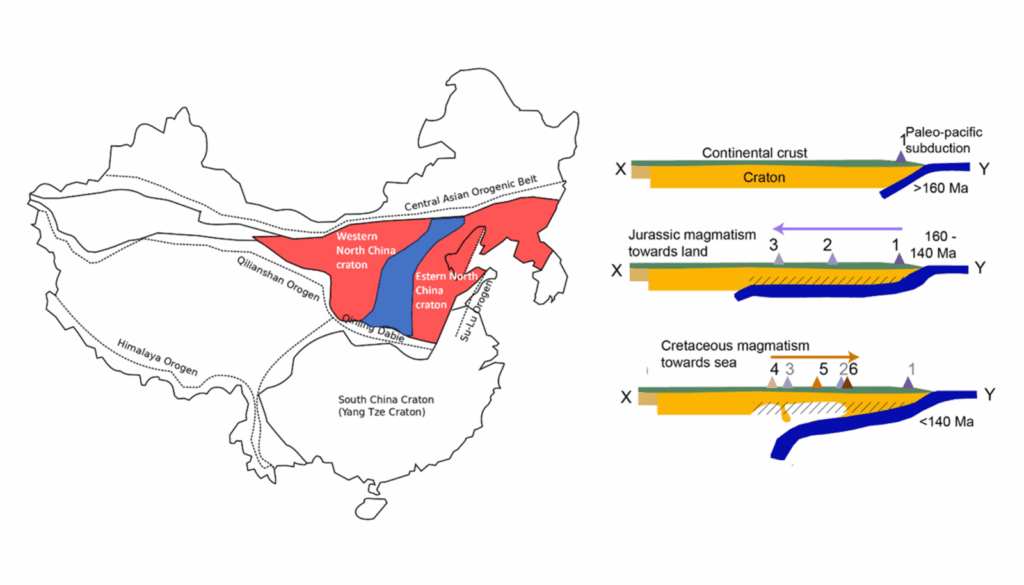

Cratons are forever, until they are not. These long-lived portions of lithosphere are known for being remarkably stable. However, if the conditions are right, even cratons can be ripped apart by geological forces, with far-reaching impacts on Earth’s systems. This week, Jyotirmoy Paul from the University of Oslo, Norway will tell us the downfall of the North China Craton, using numerical sim ...[Read More]
Journey of the Indian plate
Plume craton interaction is a fascinating geological phenomenon. The Indian plate, which has experienced several plume eruptions underneath it, is one of the best locations to study the effect of plume craton interaction. In this week’s news and view, I will provide an overview of the controversy and hypotheses related to the plume craton interaction within the Indian plate since the mid-Cre ...[Read More]
Continental drift in academia
After spending about three decades in the hustle-bustle of Asian megacities, I landed up in a quiet European town to continue my research work as a postdoc. When you know you will not meet your family soon in person, you know that you will not get the food you love and, the climate that has guided you in the sun and shadow will be very different; you may expect a life struggle. Yet, people have di ...[Read More]
2021: 100th year of the craton concept and beyond
One hundred years back, Leopold Kober first introduced the term “Kratogen”. With time, the concept of kratogen has evolved, and they are now known as cratons. In this week’s news and views, Jyotirmoy (@GeophyJo), a PhD student from the Indian Institute of Science revisits the history of craton science: how the craton concept has evolved and what are the modern problems related to them. &nbs ...[Read More]
Geoscience in the third world
In this week’s wit and wisdom, Jyotirmoy Paul, a PhD student at the Indian Institute of Science, analyses the outlook of geoscience from the third world’s perspective. Academia has been shaped and influenced by the course of world history. The third world concept was seeded in Brussels, 1927, in a gathering of the League Against Imperialism1 and became popular in the mid-1950s through variou ...[Read More]
EGU 2018: Experience of a first time attendee
Your first time at the General Assembly can be a daunting experience. It’s not easy to navigate the scientific programme and let’s not even mention navigating the building! It becomes even more difficult if you do not know many people in your scientific community yet. Luckily, one of the easiest things to do at EGU is meeting new people. Jyotirmoy Paul, PhD student at the Indian Instit ...[Read More]