
When Homer wrote The Odyssey nearly three thousand years ago, he described a journey filled with storms, uncertainty, unexpected detours, and the relentless hope of eventually reaching Ithaca. Today’s journeys may no longer cross the Mediterranean, but they continue to test researchers’ resilience in unexpected ways. Not because researchers sail across unknown seas, but because the pursuit of science often extends far beyond laboratories, conferences, and publications. Behind every manuscript lies a parallel journey: crossing borders, adapting to new cultures, navigating unfamiliar languages, administrative systems, and building a life while striving to remain productive as researchers. In this week’s blog post, Katherine Villavicencio from the University of Pisa, draws inspiration from Homer’s Odyssey to reflect on the invisible journey behind an academic career, where scientific discovery often unfolds alongside migration, adaptation, and resilience.
Unlike Odysseus, however, the obstacles faced by international researchers rarely come in the form of mythical creatures or raging seas. Instead, they often appear as visa applications, residence permit renewals, unfamiliar healthcare systems, administrative paperwork, language barriers, and the uncertainty that comes with building a career far from home. These challenges often remain invisible within academia, yet they shape the daily lives of thousands of researchers around the world (Fazel et al., 2025). Research has consistently shown that moving abroad for study or work involves much more than geographic relocation. International researchers frequently navigate cultural adaptation, language barriers, changing social networks, and the psychological demands of building a new life while maintaining academic productivity. Rather than isolated experiences, these challenges are part of a broader process of adaptation that has been widely described in studies on international mobility and researcher well-being (Thomas, H.N. et al. 2026).
The call to leave Ithaca.
Every scientific journey begins with curiosity. For many researchers, that curiosity eventually extends beyond laboratories and classrooms, encouraging researchers to cross borders in search of new ideas, collaborations, and opportunities for growth. The decision to leave home is rarely driven by the desire to migrate itself, but rather by the pursuit of knowledge and the belief that science flourishes through the exchange of people, perspectives, and cultures.
Like Odysseus setting sail from Ithaca, we often embark on this journey with a destination clearly in mind: a PhD, a postdoctoral position, a research collaboration, or the opportunity to work alongside scientists whose work we admire. Yet, studies on international academic mobility suggest that crossing borders is never simply a geographical transition (Fazel et al., 2025). It also marks the beginning of a process of cultural adaptation, personal growth, and unexpected challenges that extend far beyond research itself.
Sailing into unknown waters.

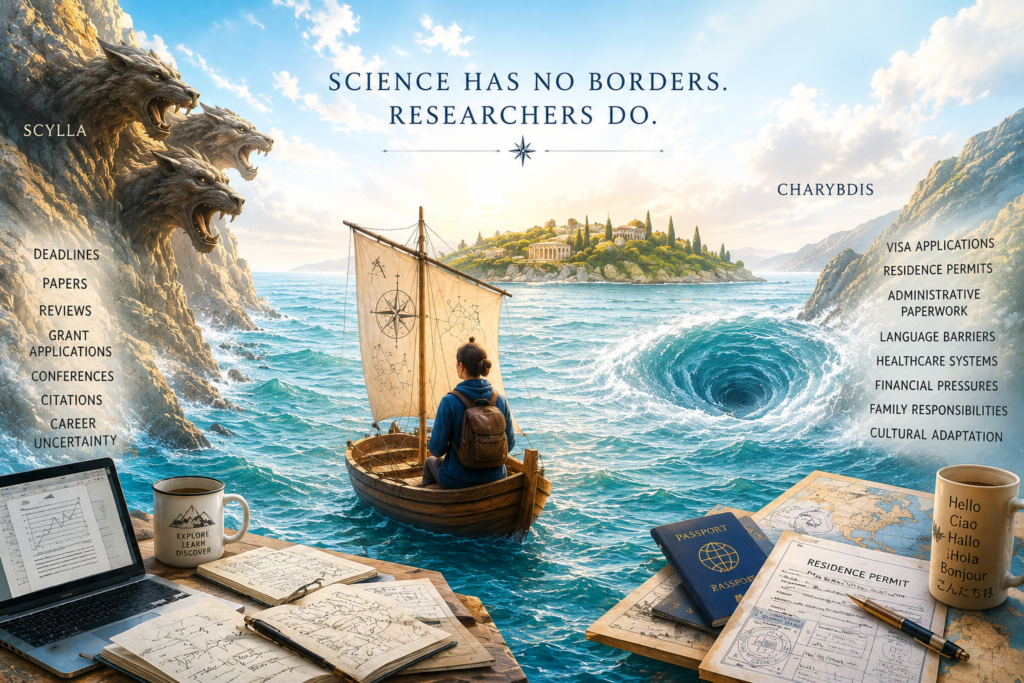
Figure 2. Behind every manuscript lies a parallel journey. This conceptual illustration portrays the often unseen balance between scientific ambition and the bureaucratic and personal realities of international academic mobility. Image generated using IA.
Scientific careers are often planned around grant deadlines, conferences, field campaigns, and publication schedules. Administrative processes, however, rarely follow the same timeline. For many international researchers, periods of uncertainty become an unavoidable part of academic life while waiting for visas, residence permits, work authorizations, or other documents required to continue moving across borders.
Unlike scientific projects, these processes are largely beyond a researcher’s control. A delayed residence permit may postpone conference travel, limit international mobility, complicate fieldwork, or simply make everyday decisions unexpectedly uncertain. While experiments and manuscripts continue to move forward, administrative processes often do not.
Between Scylla and Charybdis.
In The Odyssey, one of Odysseus’ greatest challenges was navigating the narrow strait between Scylla and Charybdis, where avoiding one danger meant moving closer to another. For many international researchers, academic life often feels remarkably similar. The pursuit of scientific excellence unfolds alongside a second, less visible journey: adapting to a new country while trying to meet the expectations of an increasingly demanding academic environment.
Recent studies have highlighted that many of the pressures experienced by researchers arise from the interaction between internal academic demands, such as publishing, securing funding, career uncertainty, and external challenges, including migration, financial constraints, family responsibilities, and the process of adapting to a new society (Thomas, H.N. et al. 2026, Nicholls et al. 2022). Rather than existing separately, these pressures often reinforce one another, making the scientific journey considerably more complex than the publication record alone might suggest.
Like navigating between Scylla and Charybdis, international researchers are often required to balance competing priorities for which there is no perfect solution. Time devoted to administrative responsibilities, relocation, or personal adaptation is time that cannot be devoted to writing, publishing, or preparing grant proposals. In contrast, focusing exclusively on scientific productivity may leave little opportunity to address the practical demands of building a life in a new country.
Finding Ithaca.
Perhaps the greatest lesson of The Odyssey is that the journey changes the traveller as much as the destination. For international researchers, the same may be true. Along the way, we learn far more than new scientific techniques or analytical methods. We learn resilience, adaptability, patience, and the ability to find opportunities in unfamiliar places. Every border crossed, every collaboration formed, and every challenge overcome quietly shapes not only the scientist, but also the person we become.
Ithaca may not be a permanent position, a particular country, or even the laboratory we once dreamed of joining. Instead, it may be the moment when we realize that home is no longer defined by geography alone, but by the communities we build, the knowledge we share, and the people we meet along the way. Science may have no borders, but researchers do, and perhaps crossing those borders is what ultimately allows us to grow beyond them.

FIgure 3. Finding Ithaca. The destination is not defined by a place, but by the resilience, knowledge, and sense of belonging gained throughout the journey. Image generated using IA.
References

Fazel, P., Kovacs, K. E., Jourian, N., & Kovács, J. Overcoming borders: A systematic review of mental health issues and challenges faced by international students. Social Sciences & Humanities Open, 2025. https://doi.org/10.1016/j.ssaho.2025.102263

Nicholls, H., Nicholls, M., Tekin, S., Lamb, D., & Billings, J. The impact of working in academia on researchers’ mental health and well-being: A systematic review and qualitative meta-synthesis. PLOS ONE, 2022. https://doi.org/10.1371/journal.pone.0268890

Thomas, H. N., Norman, M. K., Vempalli, H., Hamm, M., White, G. E., Morone, N. E., Murrell, A. J., Rubio, D. M., & Gauvin, N. "Academia Is a Very Unforgiving Space": A Qualitative Study of Challenges Faced by Under-represented Scholars in Biomedical Research. Journal of General Internal Medicine, 2026. https://doi.org/10.1007/s11606-026-10366-x