
Travel across the globe and you will see landscapes change along the way. But what if the same were true inside Earth? What if the landscapes we see on the surface also exist deep within?

Ankit Barik from Johns Hopkins University
In this week’s Geodynamics 101 post, Ankit Barik, Assistant Research Scientist at Johns Hopkins University, explores the hidden topography deep inside our planet and why do they matter.
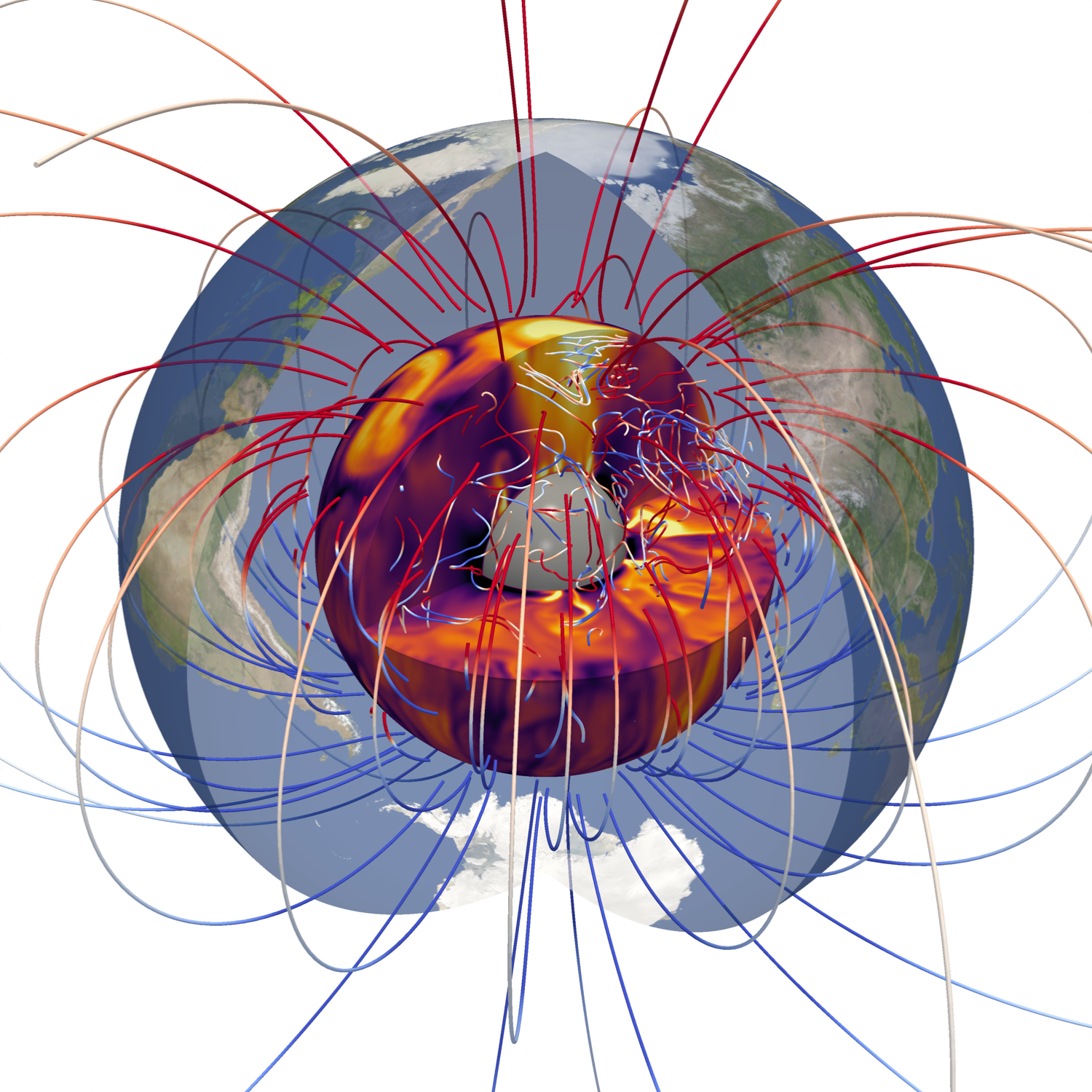
Figure 2: A dynamo simulation showing a convecting core inside. The colors inside show temperature and magnetic field lines are colored by the radial magnetic field.
The only fluid part of the Earth’s interior is the outer core, which undergoes vigorous turbulent convection and maintains our planet’s magnetic field through a process called the dynamo. Geodynamo theorists and planetary scientists have been trying to recreate this process on computer since the 90s (Glatzmaier & Roberts, 1997). Since then, the models have grown remarkably good enough to reproduce the Earth’s magnetic field not just what looks like today, but how it likely behaved millions of years in the past. However, most of these models till date were built considering the core-mantle boundary (CMB) to be a perfectly smooth surface (as shown in an example simulation in Figure 2). But…
Is the CMB really smooth?
Let’s start with what we already know for certain. Earth is not a perfect sphere; geometrically speaking the shape is an oblate-spheroid, which means it bulges slightly at the equator and flattens at the poles, a signature of its own spin. Strikingly, it is not restricted to the surface only. The same rotational flattening extends all the way down to the core-mantle boundary. Geodetic studies tell us that the CMB is about 9 km flatter at the poles compared to the equator. So even 2,900 km beneath our feet, Earth’s rotation leaves its mark!
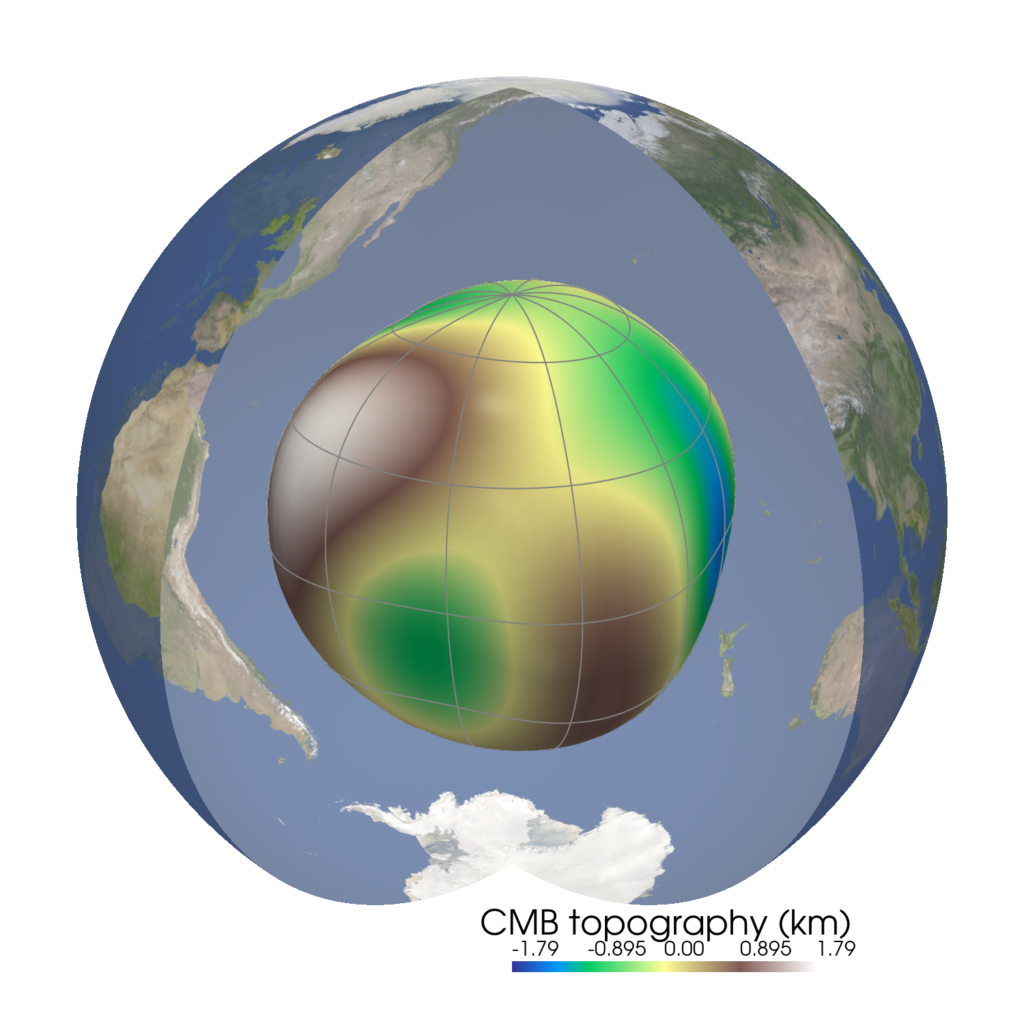
But that’s just the broad brushstroke. The real question is whether there’s finer details hiding underneath it. The first hints came in the late 80s when scientists first pulled signs of smaller-scale topography from Earth’s gravity data (Bowin, 1986). Since then, seismological investigations have played a key role in deciphering the shape of this hidden boundary, using the rumble of earthquakes (normal modes, P-waves, S-waves). Different seismic models still disagree with each other in the details (Koelemeijer, 2021). But when you average across them, a picture starts to emerge — a weighted map of ridges and valleys 2,900 km down (Figure 1).
So it turns out that the CMB is not smooth!
Which leaves us with the obvious next question: what could possibly carve mountains and valleys into a boundary buried at the bottom of the mantle?
Well, the view depends on where you stand!
We’re used to thinking of Earth’s surface being shaped by water, wind, ice and rock chemistry (the exogenic processes). But mantle dynamics, volcanism and tectonics (the endogenic processes) matter just as much. And of these, the mantle takes the lead. (If you want to explore more on this, Rafael Monteiro da Silva’s blog is a great place to start.) As it convects slowly over millions of years (drifting at tens of centimeters per year), the mantle pushes the lithosphere up in some places and lets it sink in others, sculpting what’s called dynamic topography (a story explained beautifully in Fred Richard’s blog).
But now delve deeper into the Earth’s interior, down to the core-mantle boundary. Here, the perspective flips entirely. The core fluid is racing along at about 0.5 mm per second, a hundred thousand times faster than the mantle above it. From the core’s point of view, it’s the mantle that now seems frozen in place. Like water sculpting ripples into a stone riverbed, the fast-moving core presses against this “stationary” mantle, carving topography into the CMB that persists for long stretches of geological time. And etched into this boundary are its most striking features: the large low-shear-velocity provinces (LLSVPs) and the ultra-low velocity zones (ULVZs). Both are made of material that’s heavier than the mantle around it. Because it’s so dense, this material sinks and settles at the bottom instead of being swept along by mantle flow, piling up over hundreds of millions of years and pushing the CMB downward wherever it sits. The smaller, even denser ULVZs collect right at the edges of these piles, adding extra bumps of their own. So LLSVPs and ULVZs don’t just sit on CMB topography, they help create it.
Once you know the reason behind CMB topography, the next question is whether it matters. Think of the Himalayas: they wring the monsoon clouds dry on their southern flank, keeping Nepal and northern India lush and green, while leaving the Tibetan plateau on the other side parched. A single ridge of topography reshapes an entire climate system. If mountains can do that at the surface, it shouldn’t be surprising that topography deep down does something just as consequential to the flow above it. So,
what does this rough boundary actually do?
Length-of-Day (LOD) Variation
We tend to treat 24 hours as fixed, but Earth’s day actually stretches and shrinks by milliseconds over time, on cycles ranging from years to decades (Figure 3, left). Scientists have long suspected the culprit lies at the core-mantle boundary itself, where the twisting force (torque), driven by topography, gravitational and electromagnetic, drives this variation (Gross, 2015). As molten iron flows past the carved topography, it builds up uneven pressure across these bumps, generating a fluid pressure torque, which makes the core and mantle exchange spin, i.e. if the outer core speeds up, the mantle and crust must slow down to compensate. Since we can only measure the spin of the solid Earth (not the hidden core), this slowdown or speedup of the mantle is exactly what shows up as decadal fluctuations in Figure 3 (left, marked b) — tiny changes in LOD that recur over roughly 20–30 year cycles.
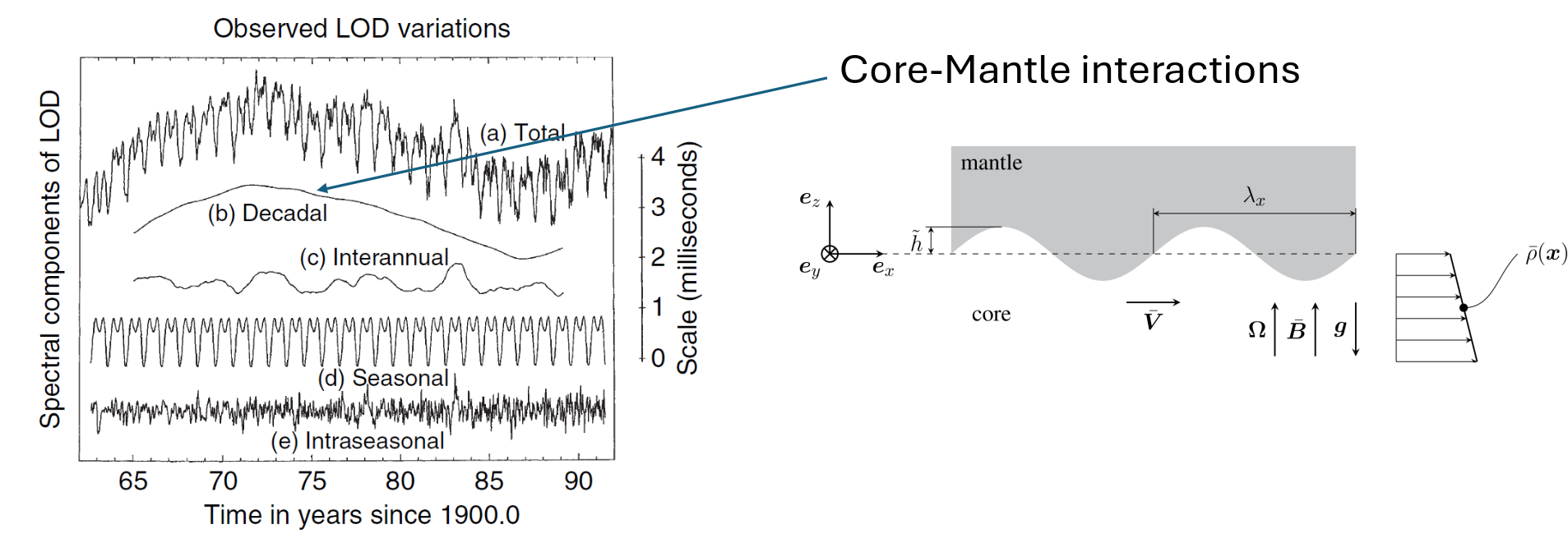
Figure 3: Left: Length-of-Day (LOD) variations on different periodicities (from Gross, 2015). Right: A simple model of torque exerted on topography (Glane & Buffett, 2018).
There’s another interesting aspect. When we talk about “core convection”, it’s easy to picture the entire outer core churning as one turbulent mass. But, that’s not the scenario. Just beneath the CMB, there is a layer where fluid arranges itself into distinct density bands rather than being mixed fully. You can think of it like oil sitting on top of water. Growing evidence (Braginsky, 1999, Buffett, 2014) suggests that this stably stratified layer resists the vertical mixing seen elsewhere in the core, with lighter fluid stably layered above denser fluid below. As a result, the core flow cannot easily glide over the mantle’s “inverted mountains” and it gets blocked against these bumps, amplifying the upstream pressure buildup. Recent studies (Glane & Buffett, 2018, Monville et al., 2025) show when a steady current of liquid iron moves through this layer in a magnetic field, it generates slow, decadal waves (Figure 3, right), which combined with the blockage effect, enhance dissipation and produce the net torque responsible for the multi-millisecond LOD variations.
Perhaps this shouldn’t come as a surprise. These deep waves behave much like Lee waves in the ocean, generated when currents flow over underwater ridges (Bell Jr., 1975). The same physics that ripples through our oceans, it turns out, is also quietly nudging the clock at the center of the Earth.
Increase in heat flux
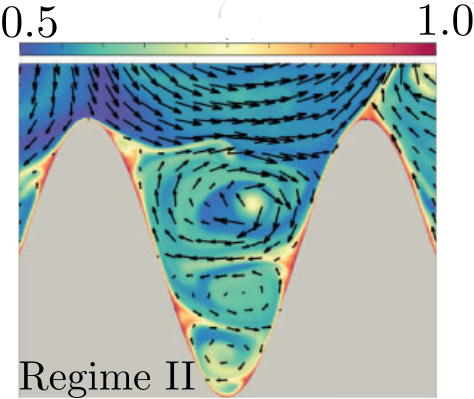
Figure 4: Convection with rough boundaries in a non-rotating regime showing increasing in temperature (red marked) near boundary. (Zhu et al., 2017)
Imagine a pot of boiling water with a lid on top. The water churns wildly but at the lid, the fluid calms; a thin, quiet film clings there. Heat can’t ride the fast currents through this stillness; instead, it has to creep across like a bottleneck. This is the viscous boundary layer that acts like an invisible blanket. Now, scar that lid with ridges and bumps. As the calm film tears apart, it lets the chaos reach to the boundary. With the blanket gone, heat rushes through instead of creeping.
This is exactly what happens at CMB (shown in Figure 4). So a rough CMB opens a wider door for heat to escape. And since that heat powers the dynamo generating the magnetic field, even a boundary’s texture shapes the planet’s deepest engine.
Conclusion
Topography, it turns out, is everywhere — not just on the surfaces we walk on, but on boundaries buried deep within our planet. Where fluid meets a rough boundary, that roughness does real work: it generates torque, enhances heat flux, and at large scales can even trigger three-dimensional turbulence. Interestingly, this isn’t just an Earth story either. The same reasoning extends to the interior of Icy moons (e.g. Titan), where ice-ocean topography may play a similar role (Kvorka et al., 2018).
This is a departure from the smooth-boundary picture that has long shaped our understanding of convection and magnetic field generation and it marks
a new frontier for fluid dynamics in planetary interiors!
The field is catching up: topography experiments (such as the Coraboloid at UCLA, the Topographic Rotating Convection (ToRoCo) at the University of Rochester and the ERC project THEIA) paired with novel numerical studies are beginning to light the path towards study of fluid flow interactions with topography in planetary interiors.
References

Bowin, C. (1986). Topography at the core‐mantle boundary. Geophysical Research Letters, 13(13), 1513–1516. https://doi.org/10.1029/GL013i013p01513

Braginsky, S. I. (1999). Dynamics of the stably stratified ocean at the top of the core. Physics of the Earth and Planetary Interiors, 111(1), 21–34. https://doi.org/10.1016/S0031-9201(98)00143-5

Buffett, B. (2014). Geomagnetic fluctuations reveal stable stratification at the top of Earth's core. Nature, 507(7493), 484–487. https://doi.org/10.1038/nature13122

Glane, S., & Buffett, B. (2018). Enhanced Core-Mantle Coupling Due to Stratification at the Top of the Core. Frontiers in Earth Science, 6. https://doi.org/10.3389/feart.2018.00171

Glatzmaier, G. A., & Roberts, P. H. (1997). Simulating the geodynamo. Contemporary Physics, 38, 269–288. https://doi.org/10.1080/001075197182351

Gross, R. S. (2015). 3.09—Earth rotation variations – long period. In G. Schubert (Ed.), Treatise on geophysics (second edition) (pp. 215–261). Elsevier. https://doi.org/10.1016/B978-0-444-53802-4.00059-2

Koelemeijer, P. (2021). Toward Consistent Seismological Models of the Core–Mantle Boundary Landscape. In H. Marquardt, M. Ballmer, S. Cottaar, & J. Konter (Eds.), Geophysical Monograph Series (1st ed., pp. 229–255). Wiley. https://doi.org/10.1002/9781119528609.ch9

Kvorka, J., Čadek, O., Tobie, G., & Choblet, G. (2018). Does titan’s long-wavelength topography contain information about subsurface ocean dynamics? Icarus, 310, 149–164. https://doi.org/10.1016/j.icarus.2017.12.010

Zhu, X., Stevens, R. J. A. M., Verzicco, R., & Lohse, D. (2017). Roughness-Facilitated Local $1/2$ Scaling Does Not Imply the Onset of the Ultimate Regime of Thermal Convection. Physical Review Letters, 119(15), 154501. https://doi.org/10.1103/PhysRevLett.119.154501