
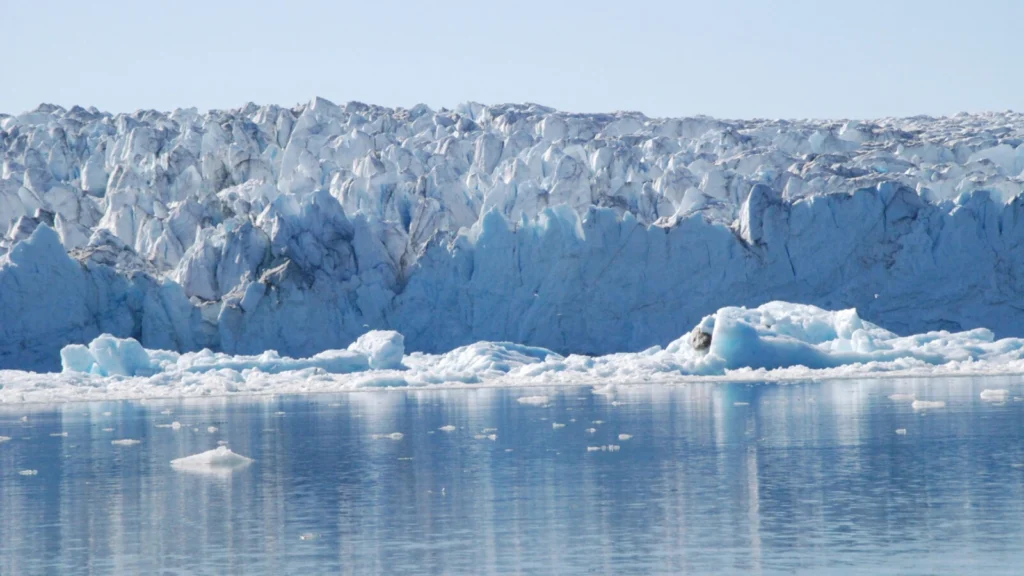
The rise and fall of massive ice sheets have shaped Earth’s surface for millions of years, but their influence may extend far deeper than previously recognized. This week in News & Views, Tao Yuan, a PhD student at the University of Colorado Boulder, explores how glacial cycles can alter lithospheric plate motions and even modulate the spreading of mid-ocean ridges.

Tao Yuan, from the Department of Physics, CU Boulder
The ongoing melting of glaciers, including the Greenland and Antarctic ice sheets, is expected to raise global sea levels by meters over the next century, posing a critical threat to humanity. Although the current rapid melting of glaciers is largely a result of human activities, Earth has experienced fiercer advances and retreats of glaciers and ice sheets during glacial cycles over the last few million years. The waxing and waning of large ice sheets have a wide influence on Earth’s surface processes, perhaps more than we thought. For example, have you ever thought that melting glaciers can affect lithospheric plate motions and the spreading of mid-ocean ridges?
How do ice sheets deform Earth during glacial cycles?
Before getting to the effects of melting glaciers on plate motion and mid-ocean ridge spreading, let’s first understand how Earth is deformed by glacial loadings during glacial cycles. Quaternary glacial cycles are the repeated advances and retreats of ice sheets primarily driven by cyclic variations in Earth’s orbit and tilt (Milankovitch cycles). The last glacial cycle, starting from ~120 thousand years ago, reached its maximum at about 26 thousand years ago (the last glacial maximum), when much of North America and Fennoscandia was covered by ice sheets of over 3 km thick ice (Fig. 1). Since those continental ice sheets stayed for tens of thousands of years and the mantle deforms like a viscous fluid over long-term timescales, the surface of Earth was depressed by hundreds of meters under the weight of those ice sheets. When ice sheets melt away, Earth’s surface rebounds (Fig. 2). This process is called Glacial Isostatic Adjustment (GIA).
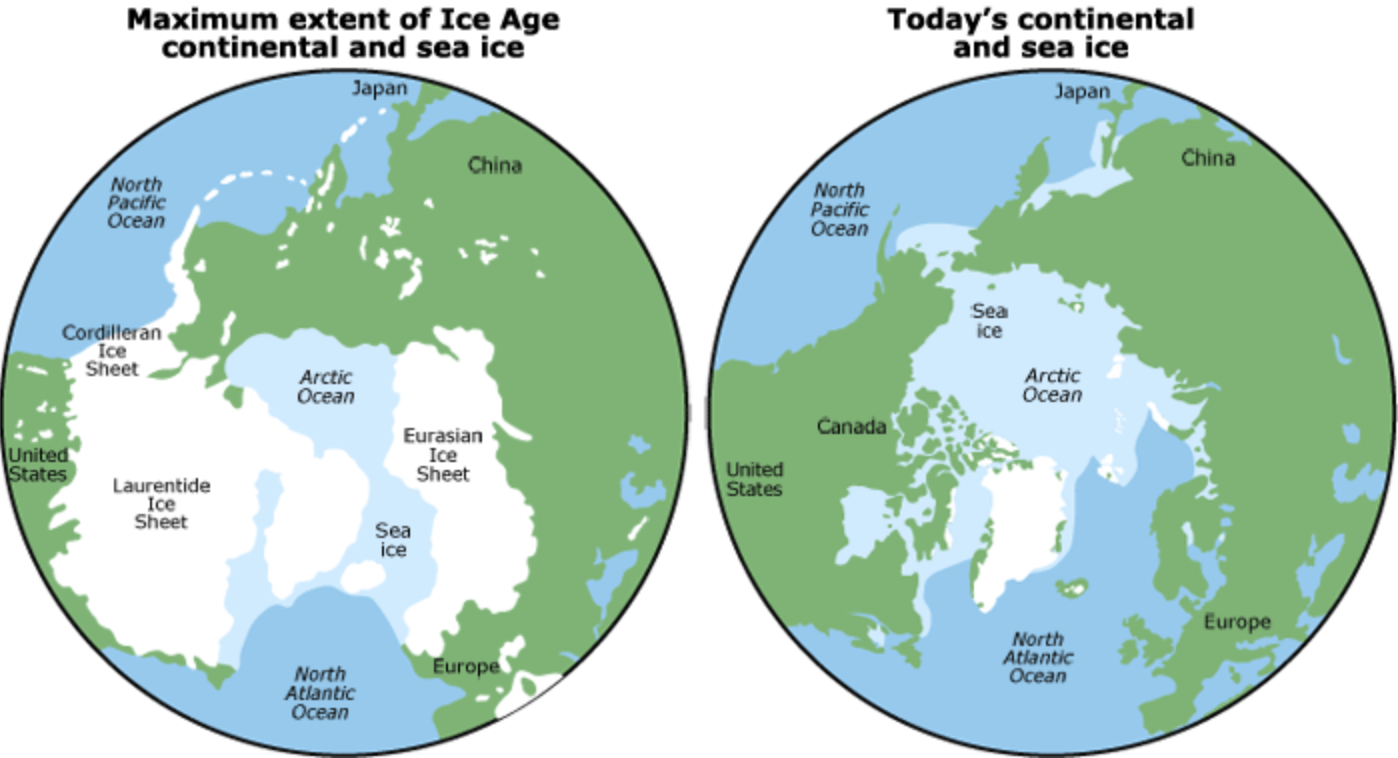
Fig 1. Extent of continental ice sheets at the last glacial maximum (left) and at the present day (right). White represents ice sheets. From When Were the Ices Ages and Why Are They Called That? – Mammoth Discovery.
Understanding the GIA process is important for various reasons. First, GIA, driven by the last deglaciation, is still deforming the Earth (Fig. 2). The land is rebounding in the former deglaciation center and subsiding in the peripheral regions, causing sea level changes. It also drives gravity changes as seen by GRACE satellites and needs to be removed from observed gravity signals in order to estimate surface mass changes. Currently, GIA is a big source of uncertainty in estimating the recent ice loss in Antarctica (Willen et al., 2025). Secondly, GIA can be used to infer both the history of ice sheets (i.e., how ice sheets evolved in glacial cycles) and mantle rheology (i.e., viscosity), thus having implications on both long-term climatic and mantle dynamic processes. In fact, GIA provides the first robust inference of mantle viscosity (Haskell, 1935), providing important support for the idea of mantle convection during the establishment of plate tectonics theory.
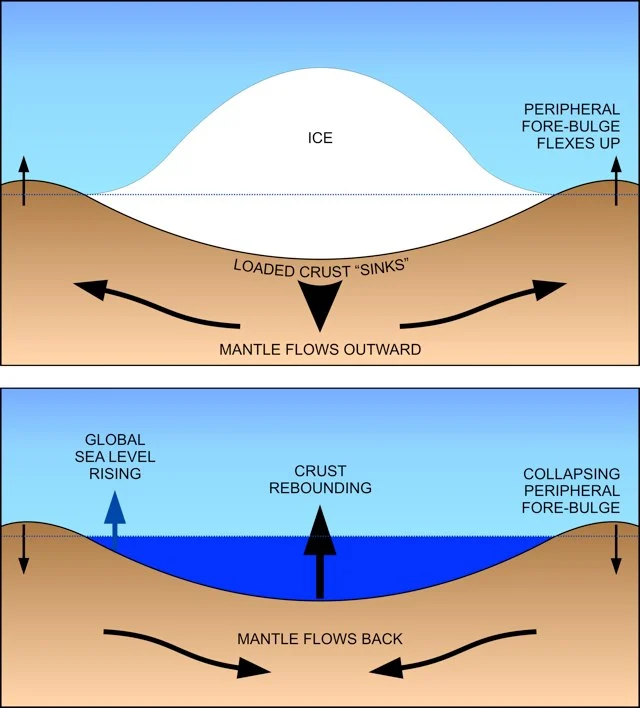
Fig 2. Illustration of glacial isostatic adjustment. The top panel depicts the glaciation stage in which ice loads cause depression. The lower panel shows the glaciation stage when the crust rebounds after ice melts (Source: UNAVCO 2026).
So, how do we study GIA? The GIA process is recorded in various kinds of observations, including paleo-sea-level changes, current land rebound (Fig. 2), and time-varying gravity, etc. Those observations can be used to constrain GIA models, including both ice-sheet history and mantle rheology. There have been widely used GIA models, although most of them are based on simplified models, including an Earth rheology structure with only radial variations (Peltier et al., 2015). We are continuing to improve GIA models by using stronger data constraints and more realistic model parameterizations, and by exploring model uncertainty (Yuan et al. 2026).
GIA on lithospheric plate motions and mid-ocean ridge spreading:
The aforementioned GIA studies are primarily based on GIA-induced vertical motions (sea level, gravity, etc.). How about horizontal motion? GIA’s effects on horizontal motion are not negligible. When ice sheets grow, the surface bends to subside, the mantle moves away from the ice sheet centers – both processes cause horizontal motions on the surface (Fig. 2). GIA is still causing crustal horizontal motions in both Canada and Northern Europe as observed by GPS (Milne et al., 2001).
So, how significant is the GIA-induced horizontal motion during glacial cycles? Could it be strong enough to compete with the long-term plate motion driven by mantle convection? If you compare the GIA-induced crustal horizontal motion recorded by GPS in Canada (Kreemer et al., 2018) to the current plate motion rate, you might say no – the latter is at least one order larger than the former. However, this comparison is only for the present day, and it is almost certain that the GIA-induced horizontal motion during the last glacial cycle was much more significant than it is now, given periods with much more rapid ice growth and melt. Could the glaciation/deglaciation affect the long-term tectonic plate motion? If so, plate motions in glacial cycles (tens of thousands of years timescale) would not be as stable as many thought. This question has not been explored previously and could have broad implications on tectonic processes during glacial cycles, including plate motion, mid-ocean ridge spreading, and mantle degassing rate.
Unlike vertical motions recorded by paleo-sea level indicators, it is difficult to find direct observational evidence of GIA-induced horizontal motion throughout glacial cycles. So, to answer that question, we rely on numerical modeling. GIA modeling depends on input models of ice history and Earth’s rheology. Luckily, we have a basic understanding of ice history from sea-level and geomorphological records (Peltier et al., 2015) and some understanding of Earth’s rheology. Lithospheric plates have strong (i.e., less deformable) plate interiors and weak (i.e., less viscous, more deformable) plate boundaries, and mantle viscosity is on the order of 1021 Pa s (with a possibly less viscous asthenosphere beneath the lithosphere). By choosing model inputs as realistic as possible, we perform numerical calculations to simulate GIA-induced horizontal motion during the last glacial cycle.
Our GIA models show strong influences of glacial forcing (loading and unloading) on lithospheric motion (i.e., motion on Earth’s surface). GIA causes plate-scale rotations in the North American plate, with a counterclockwise pattern during glaciation (Fig. 3a) and a clockwise pattern during deglaciation. The magnitude of the plate-scale rotation induced by GIA could reach ~25% of the current geologic plate motion rate for the North American plate. Note that the North American plate is where GIA has the greatest impact, since it hosted the largest ice sheet during the last glacial cycle.
With the existence of weak plate margins (e.g., at mid-ocean ridges) that decouple strong lithospheric plates, GIA causes differential horizontal motion across mid-ocean ridges (Fig 3), affecting the spreading rate of mid-ocean ridges, especially for the North Atlantic mid-ocean ridge near the former Laurentide ice sheet. Similar effects of GIA on mid-ocean ridge spreading are also observed in our models around Antarctica (Fig. 3b). One particularly interesting area is the Iceland mid-ocean ridge, which is so close to the Greenland ice sheet. Models show that deglaciation in Greenland caused up to 40% fluctuations in the spreading rate of the Iceland Ridge between 12,000 and 6,000 years ago, which may explain Holocene volcanism in Iceland (Yuan and Zhong, 2025). The Greenland ice sheet is currently experiencing rapid melting. Could it soon affect Iceland Ridge’s spreading rate and magma production rate? It is an important question to investigate.
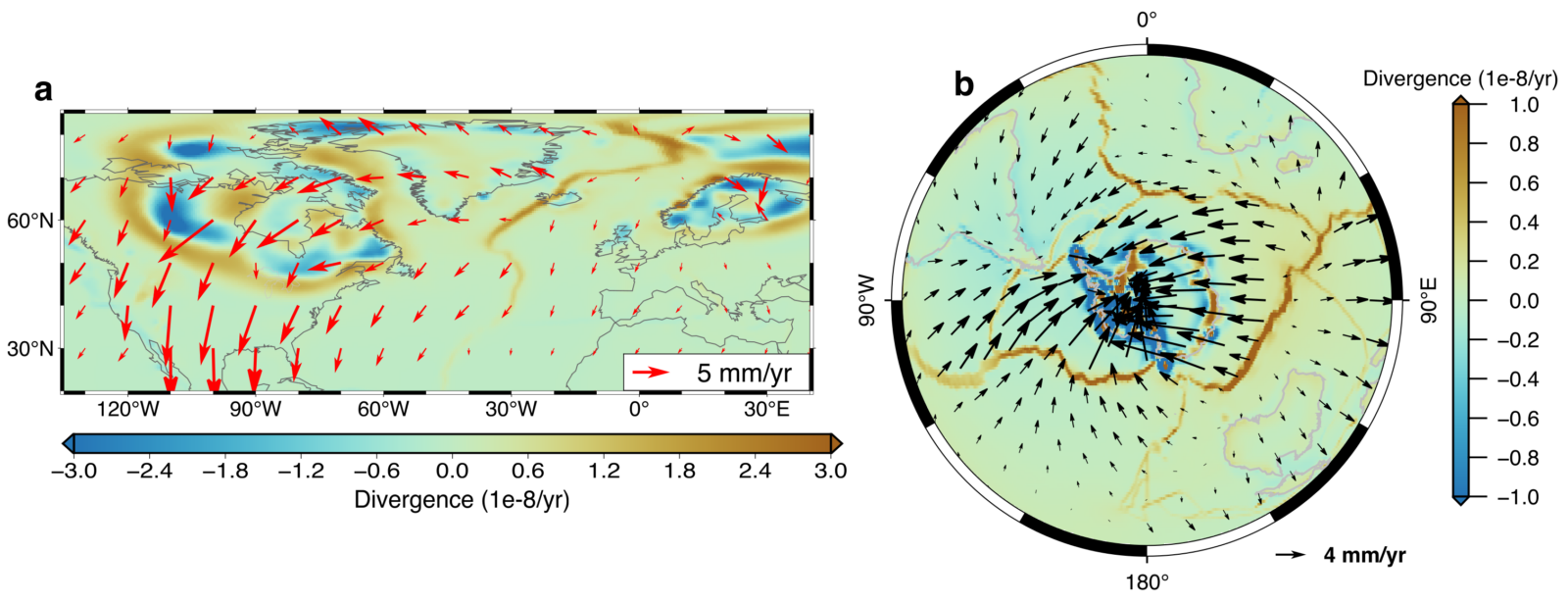
Fig 3. GIA-induced surface horizontal motions in North America (a) and Antarctica (b). Color represents horizontal divergence, and vectors represent horizontal velocity. a) is during the glaciation stage at 110 thousand years ago, and b) is at the deglaciation stage at eight thousand years ago. The brown-colored linear features represent the enhanced horizontal divergence rate at mid-ocean ridges. Modified from Yuan and Zhong (2025).
These results, shown in Fig. 3 and in our paper (Yuan and Zhong, 2025), reveal an interesting dynamic interplay between glacial cycles, lithospheric motion, ridge spreading, and climate during ice ages. It is well known that tectonic processes strongly affect climate; for example, they may be responsible for the global cooling in the Cenozoic (Raymo and Ruddiman, 1992). However, it is less well known that climatic forcing can also leave a fingerprint on tectonic processes, including large-scale plate tectonics. In addition to what we showed in Fig. 3, it has also been discussed whether global sea-level fluctuations during glacial cycles could trigger observable crustal topography and/or thickness variations in the seafloor (Crowley et al., 2015; Olive et al., 2015). We hope our findings from numerical modeling can inspire greater interest in this topic and more efforts to detect subtle signals in observations to better quantify the impacts of climatic forcing on tectonics.
References:

Yuan, Tao, and Shijie Zhong. 2025. “Effects of Glacial Forcing on Lithospheric Motion and Ridge Spreading.” Nature, April 23, 1–7. https://doi.org/10.1038/s41586-025-08846-x.

Yuan, Tao, Shijie Zhong, Glenn Milne, and Donna dePolo. 2026. “Reconciling Inferences of Mantle Viscosity and Late Quaternary Ice - the Importance of an Asthenosphere and 3-D Viscosity.” ESS Open Archive 2026 (0417). https://doi.org/10.22541/essoar.15001943/v2.

Crowley, John W., Richard F. Katz, Peter Huybers, Charles H. Langmuir, and Sung-Hyun Park. 2015. “Glacial Cycles Drive Variations in the Production of Oceanic Crust.” Science 347 (6227): 1237–40. https://doi.org/10.1126/science.1261508.

Haskell, N. A. 1935. “The Motion of a Viscous Fluid Under a Surface Load.” Physics 6 (8): 265–69. https://doi.org/10.1063/1.1745329.

Kreemer, Corné, William C. Hammond, and Geoffrey Blewitt. 2018. “A Robust Estimation of the 3‐D Intraplate Deformation of the North American Plate From GPS.” Journal of Geophysical Research: Solid Earth 123 (5): 4388–412. https://doi.org/10.1029/2017JB015257.

Milne, G. A., J. L. Davis, Jerry X. Mitrovica, et al. 2001. “Space-Geodetic Constraints on Glacial Isostatic Adjustment in Fennoscandia.” Science 291 (5512): 2381–85. https://doi.org/10.1126/science.1057022.

Olive, J. A., M. D. Behn, G. Ito, W. R. Buck, J. Escartín, and S. Howell. 2015. “Sensitivity of Seafloor Bathymetry to Climate-Driven Fluctuations in Mid-Ocean Ridge Magma Supply.” Science 350 (6258): 310–13. https://doi.org/10.1126/science.aad0715.

Peltier, W. R., D. F. Argus, and R. Drummond. 2015. “Space Geodesy Constrains Ice Age Terminal Deglaciation: The Global ICE-6G_C (VM5a) Model: Global Glacial Isostatic Adjustment.” Journal of Geophysical Research: Solid Earth 120 (1): 450–87. https://doi.org/10.1002/2014JB011176.

Raymo, M. E., and W. F. Ruddiman. 1992. “Tectonic Forcing of Late Cenozoic Climate.” Nature 359 (6391): 117–22. https://doi.org/10.1038/359117a0.

Willen, Matthias O., Bert Wouters, Taco Broerse, Eric Buchta, and Veit Helm. 2025. “Satellite Data Reveal Details of Glacial Isostatic Adjustment in the Amundsen Sea Embayment, West Antarctica.” The Cryosphere 19 (6): 2213–27. https://doi.org/10.5194/tc-19-2213-2025.

UNAVCO, 2026, GPS Spotlight: Station CHUR: https://spotlight.unavco.org/station-pages/chur/chur.html (accessed May 2026).