
Why do coral reefs flourish along some continental margins, while elsewhere they form scattered platforms and isolated atolls? In this new blog post, Dr. Zhibin Lei explores this question through the lens of biogeodynamics, showing how tectonics can shape the physical foundations of coral reef habitability. From continental rifting to passive-margin subsidence and surface processes, geodynamic evolution helps create the shallow marine environments where coral reefs can establish, grow, and persist over geological timescales.

Dr. Zhibin Lei is an assistant research fellow at the South China Sea Institute of Oceanology, Chinese Academy of Sciences. His research connects geodynamics, tectonic geomorphology, and marine ecology.
Coral reefs are among the most biodiverse ecosystems on Earth, supporting roughly a quarter of all marine species despite covering less than 1% of the ocean floor. Yet the geological conditions that allow these ecosystems to exist in the first place — a firm, shallow seafloor bathed in warm, clear water — are far from random. Walk the coastlines of the central and northern Red Sea, and you will find reefs packed into a narrow fringe clinging to the shore. Venture into the South China Sea and the picture is entirely different: hundreds of isolated atolls and submarine banks scattered across a vast oceanic plateau. Why does the same geological setting — a rifted passive continental margin — produce such radically different reef landscapes?
This is the question at the heart of our recently published study in Earth and Planetary Science Letters, which argues that the answer lies deep in Earth’s geological past, in the style and pace of continental rifting itself.
More than 75% of the world’s coral reefs sit on rifted passive margins
Passive continental margins, the drowned edges of continents formed when plates rift apart, host the vast majority of the world’s shallow coral reefs (Fig. 1). This is not a coincidence. The subsidence and morphological legacy of continental break-up creates exactly the kind of shallow, laterally extensive, hard-substrate terrain that corals need to settle and grow. But the specific geometry of that terrain, its extent, connectivity, and topographic relief, depends critically on how the rift evolved over geological time.
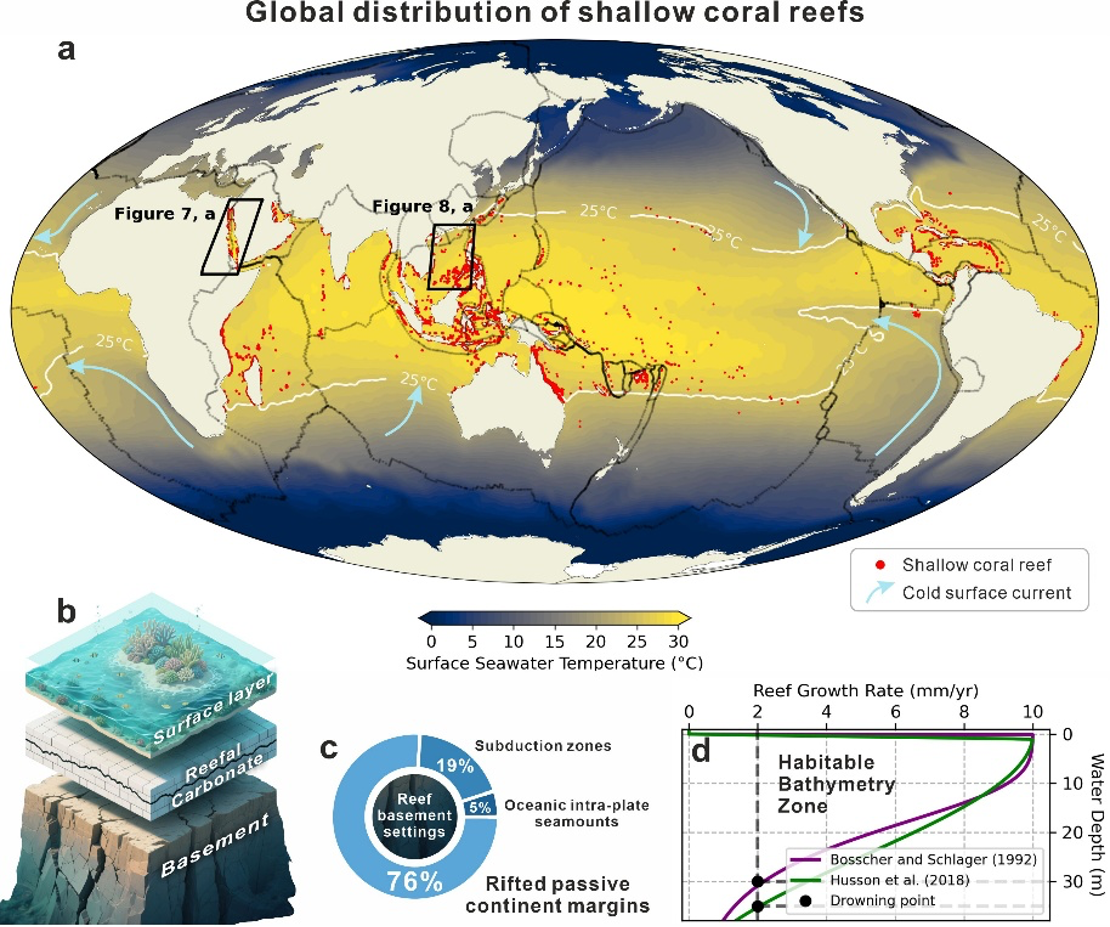
Figure 1. Global distribution of shallow coral reefs (Figure from Lei et al., 2026, EPSL, CC BY 4.0). More than 75% occur on passive continental margins formed by continental rifting. The South China Sea, a wide-rift setting, hosts dispersed archipelagos; the northern Red Sea, a narrow-rift setting, hosts a narrow coastal fringe.
Coupling geodynamics with surface processes
We modelled the full rift-to-drift cycle, from initial continental extension through to seafloor spreading, using a coupled framework that links the ASPECT geodynamic code, which simulates lithospheric deformation and thermal evolution, with the FastScape surface process model, which tracks erosion, sediment transport, and deposition. The models run forward in time across tens of millions of years and track the area of seafloor that falls within the 0-30 m water depth window: the Habitable Basement Zone (HBZ) for shallow coral reefs.
We then benchmarked the model output mainly against two natural case studies spanning the range of global passive margins: the Red Sea and the South China Sea, while also briefly extending our findings to the Great Barrier Reef and mature passive margins on both sides of the Atlantic Ocean.
A four-quadrant framework for reef basement classification
Our results show that two factors, acting largely independently, control the geometry and area of the HBZ throughout the rift lifecycle (Fig. 2).
Rift type (wide vs. narrow) determines the structural template. Wide rifts, like those that formed the South China Sea, involve distributed faulting across a broad zone of extended crust. This produces numerous isolated fault blocks, rotated horsts, and submarine highs spread across a wide area, generating an archipelago-style reef landscape with HBZ areas more than twice as large as those produced by narrow-rift systems. Narrow rifts, like the Red Sea, concentrate deformation along a single narrow axial zone, yielding a linear margin with limited lateral variability.
Surface process intensity, meaning the efficiency of erosion and sediment redistribution, acts as a powerful amplifier. Among all the variables we tested, sediment transport is by far the most sensitive control on HBZ area. Efficient sediment delivery fills and smooths the rough rift topography, dramatically expanding shallow-platform area, in some cases increasing HBZ size by an order of magnitude relative to a tectonically equivalent margin with minimal sediment input. This finding helps explain why the southern Red Sea coast, which receives more fluvial sediment, hosts wider fringing reefs than its northern counterpart, and why the northern margin of the South China Sea, proximal to the South China mainland and its rivers, is morphologically distinct from the carbonate-dominated Nansha Islands to the south.
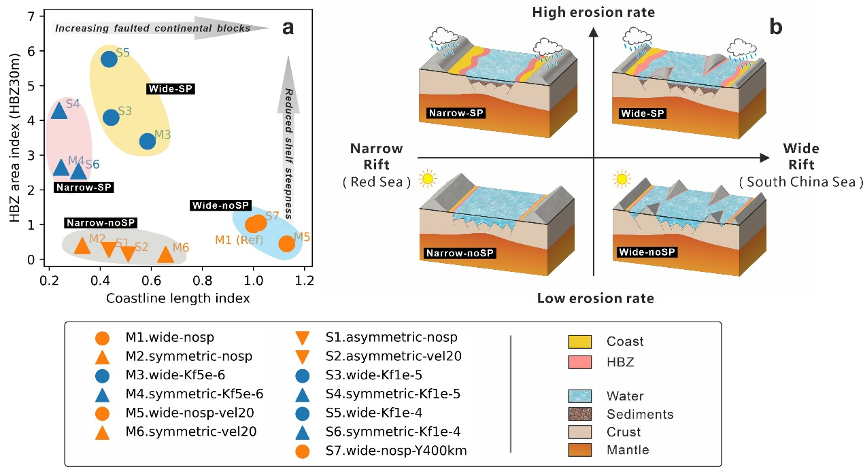
Figure 2. The four-quadrant classification framework (Figure from Lei et al., 2026, EPSL, CC BY 4.0). Rift type (wide/narrow) and surface process intensity (high/low) combine to produce four distinct passive-margin reef basement styles.
Geology lays the table; biology comes to dinner
One of the implications of our framework that we find most striking is that the gross architecture of today’s coral reef biogeography, the difference between compact coastal reefs and dispersed oceanic archipelagos, was essentially written into Earth’s geology tens of millions of years ago, long before any coral polyp ever settled on these substrates.
This does not mean biology and oceanography are irrelevant; of course they are critical for understanding which reefs grow, survive, and bleach under modern conditions. But the physical stage on which all of that plays out, the distribution, extent, and connectivity of shallow seafloor habitat, reflects a tectonic inheritance that operates on timescales of 10-100 million years.
A comparison of modern reef morphology against our numerical rift stratigraphy (Fig. 3) shows that the present-day Red Sea and South China Sea reef geometries are broadly consistent with the topographic predictions of narrow- and wide-rift evolution, respectively.
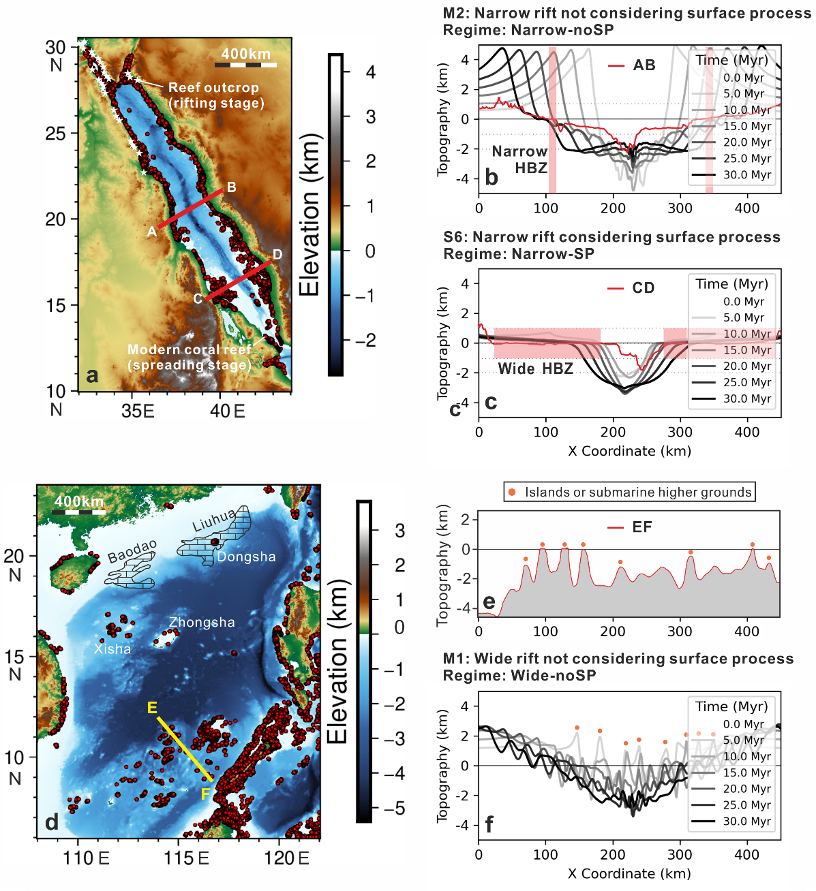
Figure 3. Cross-margin bathymetric profiles of modern reef systems in the Red Sea (narrow rift) and South China Sea (wide rift), compared with numerically modelled topographic evolution at equivalent rift stages (Figure modified from Lei et al., 2026, EPSL, CC BY 4.0).
Towards a quantitative biogeodynamics
We think of this as a small contribution to an emerging way of working, call it biogeodynamics, that asks how deep-Earth processes shape the physical conditions for life over geological time. The four-quadrant framework is intentionally general: it applies not just to coral reefs but to any shallow marine ecosystem whose habitat depends on the geometry of tectonically sculpted seafloor.
Looking forward, the natural next steps are to couple this framework with dynamic coral growth and carbonate accumulation models, and to extend the analysis to other global margins, particularly those now experiencing rapid ecological change under climate warming. Understanding the geological baseline of reef habitat is a prerequisite for predicting how much room there is for reef ecosystems to migrate or persist as sea levels and temperatures continue to change.
We also hope this work demonstrates the value of cross-disciplinary approaches that connect mantle dynamics, crustal deformation, and surface processes to ecological outcomes, bridges that are still relatively rare in the geodynamics community but that we believe hold significant scientific promise.
Full reference
Lei, Z., Xia, S., Brune, S., Pons, M., Zhang, C., Gou, T., Zhang, C., and Fan, C. (2026). Geodynamic controls on the habitable basement of shallow coral reefs at rifted continental margins. Earth and Planetary Science Letters, 687, 120073.
NB: Do not hesitate to comment and let us know if you like this type of article.