

The surviving house in Pacific Palisades became one of the most discussed images from the 2025 California wildfires (Fig. 1). What makes it scientifically interesting, though, is not that it survived. It is that many of the features associated with the house’s survival – a more fire-resistant exterior, stronger windows, and details that reduce ember entry – are already well known. This case points to a broader problem explored in our paper: disaster losses remain high, not simply because knowledge is missing, but because existing knowledge is still not consistently implemented in planning, building practice, and policy.
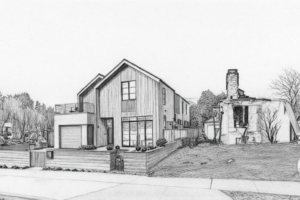
Figure 1. A house in Pacific Palisades that survived the 2025 wildfire events. Its design included a fire-resistant exterior, heat-resistant windows, sealed openings, and details intended to reduce ember entry and debris build-up. The point is not that the house was “miraculous”, but that many of the protective principles were already known. Image credit the authors based on a Google Street View scene (02/2025)
This issue sits at the heart of our recent Invited Perspective in Natural Hazards and Earth System Sciences. Using the 2025 California wildfires as a starting point, we argue that the problem is often not a lack of scientific or technical knowledge. In many cases, the necessary knowledge and solutions already exist. What fails, however, is the translation of that knowledge into land-use planning, building practice, public communication, and policy. Disaster risk reduction is not only a technical challenge but also a social, institutional, and political one. In the paper, we identify four key failures that undermine the effectiveness of disaster risk reduction: limited awareness, limited capacities, weak incentives, and governance barriers. These failures are interconnected. They interact and reinforce one another (Fig. 2), making it harder to reduce future losses before the next event.
Key failure 1: limited awareness
Living with risk does not automatically mean high risk awareness. Hazard information may well exist, but it is not always easy to understand, reliable, or straightforward to act upon. During the 2025 California wildfires, limits in risk communication, evacuation guidance, and access to hazard information constrained people’s ability to interpret what was happening and respond in time. More broadly, awareness is shaped by familiar human tendencies: underestimating future danger, focusing on immediate costs, or assuming that someone else will take responsibility.
Key failure 2: capacity deficits
Even when risk awareness in society is high, a lack of money, time, technical knowledge, or institutional support can undermine preparedness. This is evident at different scales: from single households to local authorities and organisations. Rules and standards may exist on paper, but they still require staff, expertise, coordination, and funding to be sufficiently implemented. In wildfire-prone areas, this challenge is especially clear: responsibility often falls to local governments and residents, even though their capacity to act is uneven. Voluntary programmes can help, but they also implicitly shift responsibility for risk reduction onto individuals by often assuming that households already have the resources needed to respond.
Key failure 3: lack of incentives
Knowledge of appropriate preparedness, response and recovery actions does not necessarily translate into action. In California, rebuilding after wildfire often takes place in the same risky places instead of encouraging settlement and development away from hazardous areas. Recovery systems frequently support rapid reconstruction more than long-term risk reduction. That means the easiest path is often to rebuild exposure rather than reduce it. The paper points to evidence showing that rebuilding in place remains common after destructive fires, with little shift toward lower-risk locations.
Key failure 4: inadequate governance
Responsibilities are often fragmented across several actors such as agencies, levels of government, and sectors. As a result, coordination becomes difficult and accountability unclear. In the case of California, wildfire suppression and emergency response operate within a complex multi-level system, while land-use planning and building practice depend heavily on state and local authorities. The result is a fragmented landscape in which prevention can easily fall between institutions. The paper also points out that some proposed wildfire safety regulations in California had stalled in bureaucratic processes, even after years of discussion.
Crucially, these four failures are not isolated from one another – they interact in ways that reinforce and intensify each other, creating a cycle that perpetuates disaster losses. Limited awareness weakens public demand for change. Limited capacity means even good intentions may not be translated into action. Weak incentives can encourage rebuilding in risky places. Governance barriers can delay or dilute action. Together, they constrain the ability of institutions and communities to reduce risk in a sustainable way. In our paper, we show these challenges as a connected system: these linked barriers contribute to continued exposure, poor adaptation choices, and socially unequal outcomes.
Therefore, our perspective goes beyond wildfire. Although the California fires provide the entry point, the same pattern appears across many hazards and contexts. The 2023 Turkey–Syria earthquakes, the 2024 Valencia flood, and the 2025 Texas floods all show versions of the same broader problem: existing risk knowledge not translated effectively into action. Across these cases, failures in communication, weak enforcement, fragmented responsibilities, and limited institutional capacity shaped the severity of impacts.
This broader perspective is crucial because it reshapes how we think about solutions.If disasters were mainly a problem of weak scientific capacities, lack of technology and missing knowledge, the answer would simply be more research. Research remains essential, of course, but it is not enough. The greater challenge is making risk reduction work in the real world, under real political pressures, unequal resources, and competing priorities. That means improving not only scientific understanding, but also the ways that knowledge is communicated, funded, regulated, and embedded into everyday decisions.
Moreover, we have to acknowledge that disaster losses are deeply shaped by inequality. Risk is not shared evenly, and neither is the ability to prepare, recover, or relocate. When adaptation depends heavily on private resources, some people can protect themselves more easily than others. When rebuilding is encouraged without changing the underlying conditions of exposure, future losses remain locked in. Disaster risk reduction is therefore not only about safety. It is also about equity.
So what lesson should we draw from the surviving house in Pacific Palisades?
Surely not that solely risk-aware building design can solve the problem. Nor is that people simply need better technical advice. The real lesson is broader and demands immediate action. Knowledge to reduce hazard impacts is available. However, unless societies address awareness, capacity, incentives, and governance together, that knowledge will continue to be applied unevenly and ineffectively. When that happens, disaster losses remain high not because risk cannot be reduced, but because risk reduction breaks down between science and action.
In that sense, the challenge is not only to know better but to act better, together.
Reference (s)
[1] Fuchs, S., Karagiorgos, K., Keiler, M., Nyberg, L., Papathoma-Köhle, M., and Polderman, A.: Four reasons DRR does not work as intended – lessons from the 2025 California wildfires and beyond, Natural Hazards and Earth System Sciences, 26, 1785-1794, https://doi.org/10.5194/nhess-26-1785-2026, 2026.
Post edited by: Hedieh Soltanpour and Navakanesh M Batmanathan








Sven Fuchs
Thank you very much for this very important and nuanced comment. We agree with you: in many cases, it is not a question of a lack of knowledge, but of setting priorities amidst financial, political and institutional constraints. It is precisely when disaster risk reduction, under budgetary pressure, shifts from being a long-term investment to a short-term, negotiable expenditure that the problems we have described become particularly evident.
The point that responsibility is often shifted downwards — to local authorities, households or individuals — without the necessary resources being provided, is also central. It is precisely here that limited capacities and governance problems reinforce one another.
On the question of the EU Cohesion Fund: In our view, fiscal leeway should be given greater consideration, but not as a criterion that further disadvantages already burdened states or regions. Rather, limited fiscal capacity could be an argument for more targeted and long-term support. The key, therefore, would not be to restrict resilience-building measures where there is little fiscal leeway, but to design funding instruments in such a way that they realistically reflect different options for action.
This may perhaps sound a little like a wish to Father Christmas. But we see similar contradictions in other areas too: when, for example, cuts are made to research and education in order to reduce government spending in the short term, it is often overlooked that it is precisely these investments that generate social and economic benefits in the long term. The situation is similar in disaster risk reduction: prevention initially appears as a cost factor in the budget, but its true value often only becomes apparent when damage, losses and follow-up costs are prevented from arising in the first place.
hediehsoltanpour
Thank you very much for your feedback.