
Reflections from a workshop on multi-risk impact-based forecasting and warning systems for weather-related hazards.
With mounting evidence that hazards rarely occur in isolation, the question is no longer whether multi-risk impact-based forecasting and warning systems are needed, but how to build them [1]. Yet, moving beyond single-hazard thinking towards genuinely multi-hazard and then multi-risk perspectives is far from straightforward. It brings with it a range of challenges – from how we define and model interacting hazards and risks, to how institutions coordinate, communicate, and ultimately act on this information. Making sense of these challenges is a necessary first step, not only to clarify what multi-risk forecasting and warning systems should look like in practice, but also to reflect more critically on whether this transition is operationally achievable or still, to some extent, a scientific ambition.
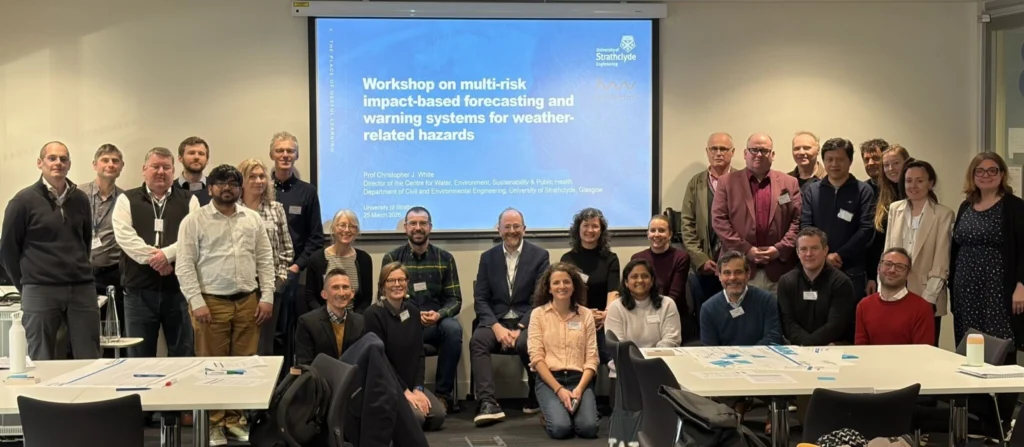
It is precisely these challenges that framed a recent workshop convened by Professor Chris White from the University of Strathclyde, in collaboration with Emma Brown, Darren Lumbroso and Mario Bianco from HR Wallingford, in Glasgow. Part of the Multi-risk Impact baseD forecasting (MIDAS) project, funded through the UK Met Office’s Weather and Climate Science for Service Partnership (WCSSP) India programme, the workshop brought together researchers and operational practitioners in a hybrid format. It created a space to move beyond conceptual ambition and engage with the practical realities of multi-risk impact-based forecasting and warning systems for weather-related hazards. Discussions were structured around three central questions: do truly multi-risk systems exist in practice, are they achievable, and what concrete steps are needed to move from concept to operation?
This blog offers a brief reflection on these discussions, focusing on some of the key challenges, insights, and open questions that continue to shape this evolving field. Drawing on the keynote presentations, interactive forum discussions and breakout groups, it reflects on how current forecasting approaches are being extended beyond single-hazard frameworks – and sometimes challenged – by the growing need to account for interconnected and cascading risks.
Framing the discussion: insights from the keynotes
The keynote session brought together perspectives from international and operational contexts, with contributions from the World Meteorological Organization, the India Meteorological Department, and the UK Met Office.
One of the most striking points emerging from the keynote presentations was the absence of a clear, shared understanding of what constitutes an operational multi-risk impact-based forecasting system. Recent work from the MIDAS project highlights that even among researchers and practitioners, interpretations vary widely. While warnings for different hazards are often issued in parallel or sequence, this does not necessarily amount to a genuinely integrated multi-risk approach. This lack of clarity makes it difficult not only to assess progress, but also to define what success should look like.
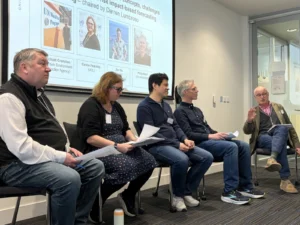
Panel discussion on the concepts, challenges and progress of multi-risk impact-based forecasting and warning. Image credit (Chris White)
A second key theme, illustrated through operational examples of heavy rainfall forecasting from the India Meteorological Department, was the persistent gap between forecasting multi-hazards and anticipating their real-world impacts. This was particularly evident when looking at the so-called “value chain” of warnings – from observations and forecasts through to decision-making and response – where information, and ultimately value, can be lost at each stage. Even where forecasts capture the hazard reasonably well, the resulting impacts are not always anticipated with the same accuracy, highlighting a disconnect between scientific capability and real-world outcomes.
Underlying many of these challenges is a more fundamental issue: the lack of accurate, robust and consistent impact data. Across the keynote presentations, it became clear that while hazard data are increasingly available, information on indirect, cascading, and compound impacts remains sparse and fragmented. This limits not only the development of multi-risk approaches, but also their validation in real-world contexts. It also constrains the potential of emerging tools such as artificial intelligence, which depends heavily on large, accurate and reliable datasets. In this sense, the difficulty of modelling multi-risk systems is not purely technical – it reflects the fact that many of the processes we aim to represent are still only partially observed.
A further point, highlighted particularly from operational perspectives, is that risk itself is inherently dynamic. Exposure and vulnerability are not fixed conditions, but shift over time and across space – influenced by seasonality, socio-economic factors, and the functioning of infrastructure systems. Multi‑risk forecasting goes beyond combining hazards to understanding how risks change over time, but this remains difficult to implement in operational settings where information must be communicated clearly and simply.
A one‑hour panel discussion with experts from the Scottish Environment Protection Agency, the Danish Meteorological Institute, University College London, and Vrije Universiteit Amsterdam highlighted that weather‑related forecast and warning systems still largely rely on hazard‑based thresholds. The discussion stressed that moving towards multi‑risk approaches is crucial for improving decision‑making and will depend primarily on addressing institutional, organisational and social factors rather than advances in science and technology.
Expanding the discussion: perspectives from the breakout discussions
The breakout discussions provided space for participants to step back from presentations and engage more directly with shared questions, all with the aim of shaping a multi‑author paper. Working in five parallel groups, the first session focused on sharpening the focus and perspectives of the paper, with participants suggesting research questions, reflecting on the feasibility of moving from single‑risk to multi‑risk impact-based forecasts and warnings, and discussing what such a shift would mean in practice for users and operations.
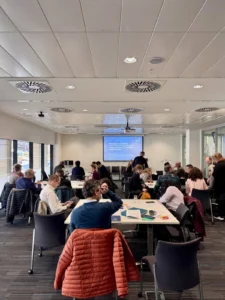
Five parallel groups during the breakout session, focusing on how multi-risk approaches could be framed and applied in practice. Image credit (Mario Bianco)
A recurring theme was the need to stay grounded in real‑world use, with participants stressing the value of clear information and institutional arrangements. Participants also cautioned against adding complexity simply because it is possible, noting that improving procedures, roles and decision‑making processes can often be more valuable than developing increasingly sophisticated models.
The second breakout session turned attention more squarely to the paper itself, focusing on what evidence is still needed, how the paper could be structured, and how a collaborative writing process might work. Together, the breakout sessions captured participants’ perspectives on how the wider workshop discussions could be distilled into clear priorities and messages.
Towards a way forward
The discussions did not point to a single, clearly defined pathway towards multi-risk impact-based forecasting and warning systems. Instead, they revealed a field still grappling with its own definitions, data limitations, and operational constraints. A consistent message emerging from the workshop was that fully integrated, routine multi-risk impact-based forecasting and warning systems are not yet operational at scale. Rather than indicating a lack of progress, this points to a broader recognition that moving towards multi-risk approaches will require more than improved modelling – it will depend on clearer conceptual frameworks, stronger data foundations, and closer integration between science, operational practice, and decision-making.
Overall, the workshop showed that many of the building blocks for multi‑risk impact‑based forecasting and warning are already in place, even if they are not yet well connected. Moving forward means building on these existing elements step by step, keeping a strong focus on user needs and actionability, strengthening collaboration and learning from operational practice.
If you would like to continue the discussion and hear more about this work, the workshop organisers, Christopher White and Mario Bianco, will be presenting related research at the EGU 2026 General Assembly in Vienna, in the following sessions:
EGU26-18533 in NH10.1 on Tuesday 05 May (oral): https://meetingorganizer.copernicus.org/EGU26/EGU26-18533.html
EGU26-4949 in ITS4.24/NH13.8 on Thursday 07 May (oral): https://meetingorganizer.copernicus.org/EGU26/EGU26-4949.html
References
[1] Lumbroso, D., White, C. J., Brown, E., and Kolusu, S. R. (2025). Rethinking Impact-based Forecasts and Warnings (IbFW) for multi-risks. npj Natural Hazards, 2(1), 105. https://doi.org/10.1038/s44304-025-00157-5