Spoiler warning!
Have you ever watched a science fiction movie and thought, huh, I wonder if that is actually possible? Now, I hope by the time the dinosaurs turned up during this film, that this transient thought had departed from your mind, but to satisfy the idle curiosity of those who wondered this during Journey to the Centre of the Earth, and perhaps even impart some geodynamical lessons, I delved into the cinematic world of the Jules Verne adaptation.
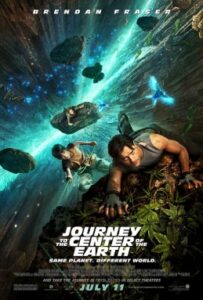
In 2008, a science fiction action-adventure movie was released starring Brendan Fraser and Josh Hutcherson, adapted from the famous 1864 novel of the same name by Jules Verne. The movie follows the adventure of volcanologist Trevor Anderson and his nephew Sean as they search for Trevor’s missing brother. Their journey takes them to Iceland, to an old mine, and then down volcanic tubes into the mysterious, fantastic, and dangerous centre of the Earth.
Of course, they were actors playing a part in a fictional movie; they didn’t really go there, and it is simply a fantastical tale that claims no truth in its telling. You might think it pedantic, fastidious, or pretentious to fact check such a story. You might even see it as a completely pointless endeavour.
You could be right, yet I will do it anyway. For those who were mildly perturbed when Trevor Anderson whispered “muscovite” I present: (almost) everything wrong with Journey to the Centre of the Earth.
Journey to the Centre of the Earth
film poster, New Line Cinema
Hollow Earth?
Let’s start with the most obvious: the hollow Earth. The signal we receive from seismic waves (vibrations that transfer energy through the ground) immediately rules this out. What we see is only consistent with a layered planet, mostly solid with a liquid layer in the outer part of the core. If you want more information about what is really going on down there, check out Prachi Kar’s blog post on the giant blobs deep inside the Earth.
Speaking of liquids inside the Earth, I refer to molten iron and nickel, and not an ocean of water. Despite how cool it would be to sail across an underground ocean while dodging piranhas, the water inside the Earth is mostly locked away as a solid inside minerals like ringwoodite, and liquid water is dispersed in the tiny cracks between rocks, not in giant bodies of water.
Falling into the oven
If you’ve ever been underground, you might have noticed: it gets hot quickly. A main antagonist of our heroes in Journey to the Centre of the Earth is the temperature. Yet, things would be even more drastic than is portrayed on film. When they fall down the lava tube, they travel for an uncertain but lengthy distance, so long in fact, that there is a transition implying the scene was shortened for us. Trevor shouts out that it could be hundreds of kilometres deep as they fall—which would be a death sentence in many ways. From the time spent falling on screen, a back of the envelope calculation tells us they are at minimum seven kilometres deep in the Earth. Even though the movie suggests they are actually somewhere much deeper, this depth is already impressive, and would be the deepest humans have ever been inside the Earth.
We know that temperature increases with depth, and we call the rate at which it does it the geothermal gradient. Beneath a regular colder part of the Earth’s crust like Ireland, where the geothermal gradient is 25°C/km, the temperature at seven kilometres would be a sizzling 175°C, and our main characters would meet a crispy end. Beneath Iceland, things are much worse. Gradients between 50 and 150°C/km in Iceland would mean Trevor and company ride their lava tunnel water slide into an ocean around 600°C. For reference, that’s a touch warmer than the hot springs of Tuscany. On a side note: water boils at 100°C at the Earth’s surface, but at high pressures this reaches much higher—so the presence of liquid water is not the crazy part.
I guess they most have packed SPF 50,000, because they shrug off the blistering heat and continue on. But wait—shouldn’t they be under some serious pressure? And I don’t mean because they are on a perilous quest, but rather the immense pressures that exist at depth in the Earth. At the surface of the Earth, the pressure is 1 atm, or 101,325 Pa. At seven kilometres depth, a cavern that size would be under immense differential pressure. Lithostatic pressure of 2000 times the Earth’s surface would instantly crush the cavern and poor Trevor. Fortunately, they must have fallen into a cave with magical properties because it manages to withstand the weight of the Earth’s crust.
Suspicious rocks
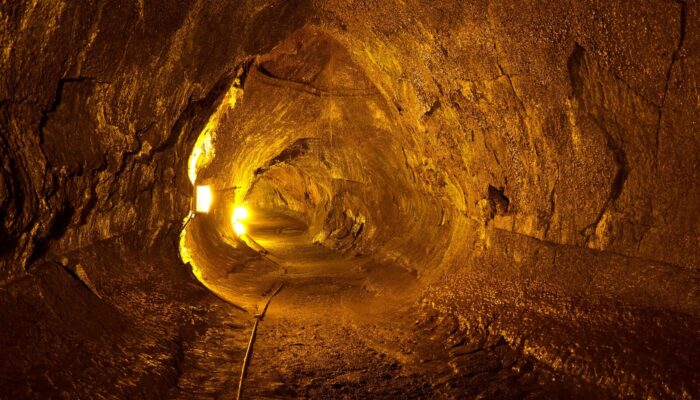
Before their great fall to their physically-assured deaths, our main characters find themselves in a lava tube. Now, lava tubes are a geological phenomenon that do in fact exist—we can see them in nature. However, lava tubes form during lava flows, and are therefore found near or at the surface. They can be very long, so the 7 km length of the lava tube in the film is not strange but its orientation very much is. They form from the flow of lava and thus form horizontally, not vertically!
We haven’t yet addressed the elephant in the room: the muscovite. Muscovite is not a rock, as the film portrays it, but rather a thin platy mineral found in igneous and metamorphic rocks. It is very weak, and even if you somehow constructed a thin floor made of muscovite (a geologically nonsensical idea), it would certainly not support the weight of a human. Fortunately for the characters, the muscovite in the film has a sense of dramatic timing, and only follows the laws of physics when it chooses to!
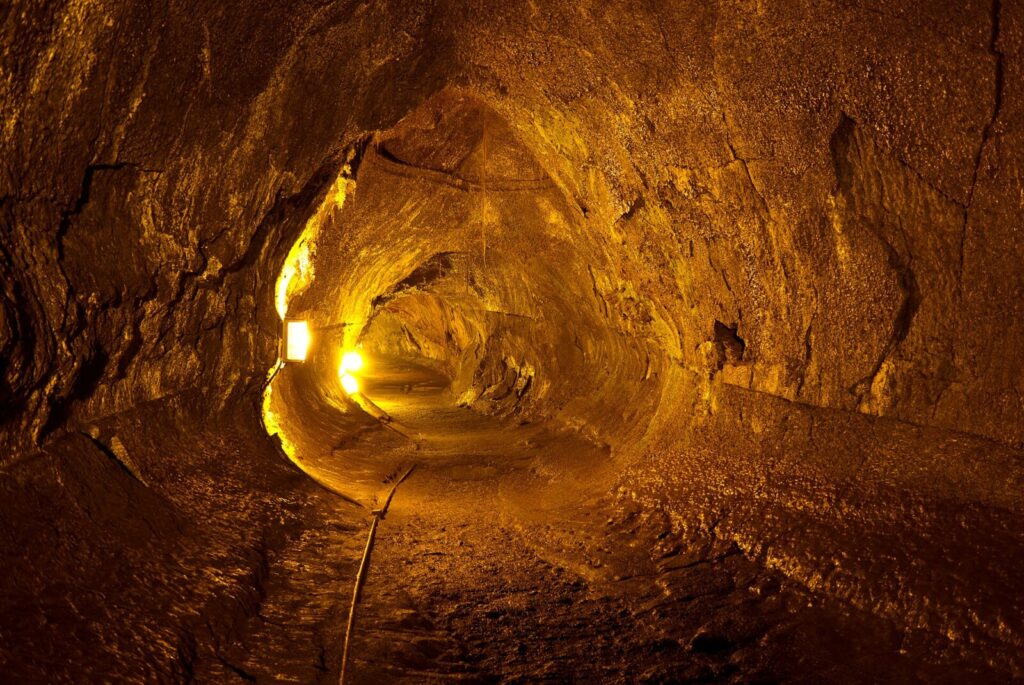
Thurston Lava Tube at Hawaii Volcanoes National Park, Big Island, Hawaii. Author: Frank Schulenburg
At the end of the day, Journey to the Centre of the Earth may violate the laws of physics, contradict our understanding of geodynamics, and even show dinosaurs to be living inside the Earth, but it is a fun adventure, and worth a watch!