NH
Natural Hazards

#EGUblogs

When multiple hazards interact and the data doesn’t: The multi-hazard modelling problem nobody wants to talk about

When multiple hazards interact and the data doesn’t: The multi-hazard modelling problem nobody wants to talk about

There is a quiet contradiction at the heart of natural hazard science. The regions most exposed to multi-hazard events are precisely the regions where we know the least. The Global South (comprising lower- and middle-income countries in Africa, Asia, Latin America and the Caribbean) is disproportionately affected by climate-related natural hazards, yet it is largely underrepresented in climate res ...[Read More]

Same hills, different rules: why urban and rural landslides should not be considered together?

Same hills, different rules: why urban and rural landslides should not be considered together?

Cities are expanding faster than ever, often onto steep and unstable terrain. As urban areas grow, landslides increasingly threaten homes, roads, and critical infrastructure. To manage this risk, scientists produce landslide susceptibility maps, which estimate where landslides are most likely to occur. These maps are widely used by planners and decision-makers. But there is a quiet assumption buil ...[Read More]

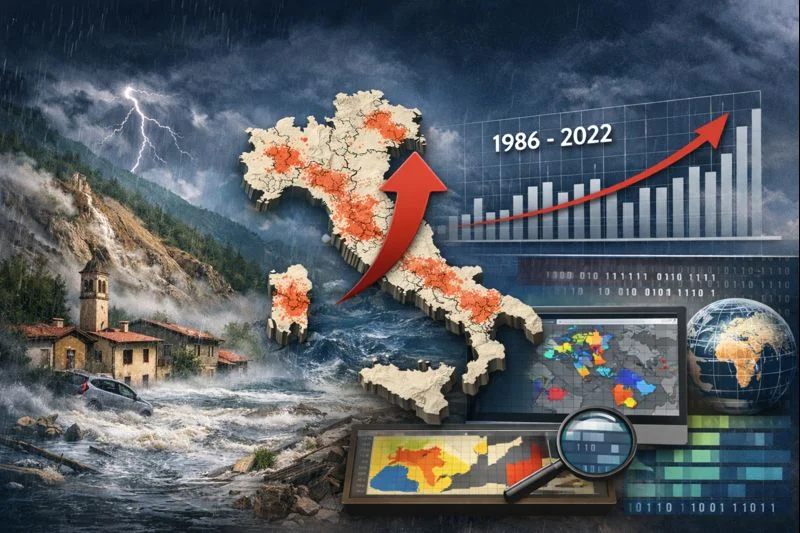
Extreme hourly rainfall is increasing in Italy: insights from high-resolution climate reanalysis

Image generated using ChatGPT (AI-generated image).

Intense rainfall lasting only a few hours is often enough to trigger natural hazards such as flash floods and landslides, leading to severe damage to infrastructure. These short-lived events are among the most dangerous natural hazards in the Mediterranean region, yet they are also among the hardest to study. Their small spatial scale and brief duration mean that they are often missed or underesti ...[Read More]

Hunting for historical Adriatic meteotsunamis

Hunting for historical Adriatic meteotsunamis

Before modern instruments, our only clues about past sea events came from written records and folklore. Along the eastern Adriatic coast, stories of sudden floods and “tidal waves” (locally called šćiga) have been passed down for generations. These waves, described as rapid rises and falls of the sea that could flood or empty harbours within minutes, were carved into Adriatic coastal life as rare ...[Read More]