GD
Geodynamics

how science works

Science. Exploration. Survival.
Shackleton

A scientific career can be a struggle. This week Dave Stegman, Associate Professor at Scripps, draws parallels between being a scientist and being an Antarctic explorer. He dangled in the crevasse, unable to touch the sides; the abyss beneath was hundreds of feet deep; the rope he was suspended from was 14 feet long, connected above to the sledge he had been hauling. Was it luck when his sledge ha ...[Read More]

Is the scientific community ready for open access publishing?

Is the scientific community ready for open access publishing?

How much we pay, as both scientists and the public, for publishing and accessing papers is a hot topic right across the academic community – and rightly so. Publishing houses, and their fees, are big, big business. To which journal we should submit our work is a regular decision we face. But what are the Green, Golden or Hybrid roads? How do pre- and post-prints fit into the journey? In this ...[Read More]

Dancing on a volcano – the unspoken scientific endeavour

Dancing on a volcano – the unspoken scientific endeavour

Doing science is not a walk in the park. In fact, it might be closer to dancing on a volcano. Dan Bower, CSH and Ambizione Fellow at the University of Bern, Switzerland, takes full advantage of the creative freedom of a blog post to reiterate that scientific progress is not a straight-forward endeavour. We all learn early in our education about the scientific method—the scientific approach t ...[Read More]

Writing the Methods Section

Writing the Methods Section

An important part of science is to share your results in the form of papers. Perhaps, even more important is to make those results understandable and reproducible in the Methods section. This week, Adina E. Pusok, Postdoctoral Researcher at the Department of Earth Sciences, University of Oxford, shares some very helpful tips for writing the Methods in a concise, efficient, and complete way. Writin ...[Read More]

On the resolution of seismic tomography models and the connection to geodynamic modelling (Is blue/red the new cold/hot?) (How many pixels in an Earth??)

What do the blobs mean?

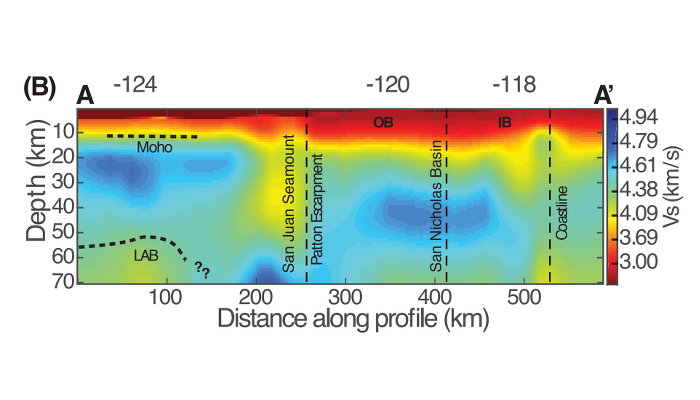
Seismologists work hard to provide the best snapshots of the Earth’s mantle. Yet tomographic models based on different approaches or using different data sets sometimes obtain quite different details. It is hard to know for a non specialist if small scale anomalies can be trusted and why. This week Maria Koroni and Daniel Bowden, both postdocs in the Seismology and Wave Physics group in ETH ...[Read More]

The past is the key

The past is the key

“The present is the key to the past” is a oft-used phrase in the context of understanding our planet’s complex evolution. But this perspective can also be flipped, reflected, and reframed. In this Geodynamics 101 post, Lorenzo Colli, Research Assistant Professor at the University of Houston, USA, showcases some of the recent advances in modelling mantle convection.     Mantl ...[Read More]

Conferences: Secret PhD Drivers

Conferences: Secret PhD Drivers

Conferences are an integral part of a PhD. They are the forum for spreading the word about the newest science and developing professional relationships. But as a PhD student they are more likely to be a source of palpitations and sweaty palms. This week Kiran Chotalia writes about her personal experience on conferences, and lessons learnt over the years. My PhD is a part of the Deep Volatiles Cons ...[Read More]

Demystifying the Peer-Review Process

Demystifying the Peer-Review Process

An important and inevitable aspect of being in academia is receiving a request to peer-review a paper. And much like the papers we write and submit, retaining structure and clarity for the review itself is important. This week Adina E. Pusok, Postdoctoral Researcher at Scripps Institution of Oceanography, UCSD, and our outgoing GD ECR representative, shares some detailed and helpful tips for writi ...[Read More]

Reproducible Computational Science

Reproducible Computational Science

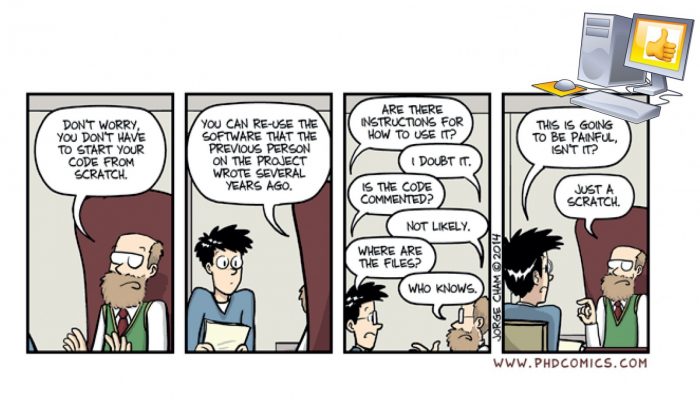
  We’ve all been there – you’re reading through a great new paper, keen to get to the Data Availability only to find nothing listed, or the uninspiring “data provided on request”. This week Krister Karlsen, PhD student from the Centre for Earth Evolution and Dynamics (CEED), University of Oslo shares some context and tips for increasing the reproducibility of you ...[Read More]

Thirteen planets and counting

Thirteen planets and counting

Apart from our own planet Earth, there are a lot of Peculiar Planets out there! In this series we take a look at a planetary body or system worthy of our geodynamic attention, and this week we move back to our own solar system. Many of us will clearly remember the downgrading of Pluto as a planet nearly 12 years ago to the month. In this informative and witty post, Laurent Montesi from the Univers ...[Read More]