Artificial Intelligence has dominated the world across various sectors. However, it is yet to be decided whether the use of AI in Mineral Exploration (and more broadly in Geosciences) will diminish the expertise and know-how of Geologists or instead provide a valuable tool for the years ahead. In this week’s blog, Dr. Nicholas Vafeas shares his perspective on AI technology in the mining industry and how it could reshape the narrative for the betterment of society.

Dr. Nicholas Vafeas is an economic geologist specialising in critical raw materials, mineral supply chains, and energy policy. More of his work can be found on his official website: https://www.nicholasvafeas.com/.
Artificial Intelligence (AI) has become the buzzword of our age, cutting across finance, digital tech, and more recently, mining and mineral exploration. An industry once defined by grit, gut instinct and months-on-end in remote locations now finds itself increasingly shaped by algorithms and predictive models (much to the dismay of some of the older fundamentalists). But like any shiny new tool, the reality is far more nuanced than the hype swirling around it.
To appreciate how things have shifted, it’s worth remembering where you were just three or four years ago, reading fantastical claims about AI exploration, claims most investors (and many geologists) quietly dismissed. AI was seen as a mysterious black box, “unreliable”, “not ready”, or, in some circles, little more than tech-flavoured snake oil. Then, in a perfect pendulum swing, the narrative jumped to the opposite extreme: AI everywhere. Suddenly, it was going to revolutionise exploration, replace human interpretation, and (apparently) solve every geological problem from here to the Archean.
Now, having moved past that inflationary bubble, some are quietly stepping back, concluding (somewhat unfairly) that AI “doesn’t work”. But expecting AI to magically answer every geological question is a bit like trying mathematics once and declaring the whole thing useless because it couldn’t instantly solve your taxes.
The truth is that AI is exceptionally powerful at what it is designed to do, and that is to recognise patterns, process extensive datasets, and flag anomalies the human eye would almost certainly miss. These models can ingest geochemistry, geophysics, mapping, drill logs, and even satellite data in combinations and volumes that far exceed human cognitive limits. And, in doing so, they can reduce unnecessary drilling, optimise planning and steadily push up the probability of exploration success. Not through miracles, but through hundreds of small, compounding gains. The kind nobody writes press releases about, but which reshape margins over time.
In that sense, AI is less a magic wand and more akin to the invention of the spreadsheet. When VisiCalc appeared in 1979, it didn’t “replace” anyone. Instead, it allowed people to work smarter, faster, and with far more insight, and the entire computing industry accelerated as a result. AI in exploration plays the same role. It’s an amplifier of human capability, not a substitute for it, even branching into the world of creativity. Would you believe the lepidolite in Figure 1 was AI generated? Those who have seen lepidolite samples will know that it’s usually a purplish-grey, flaky mineral.
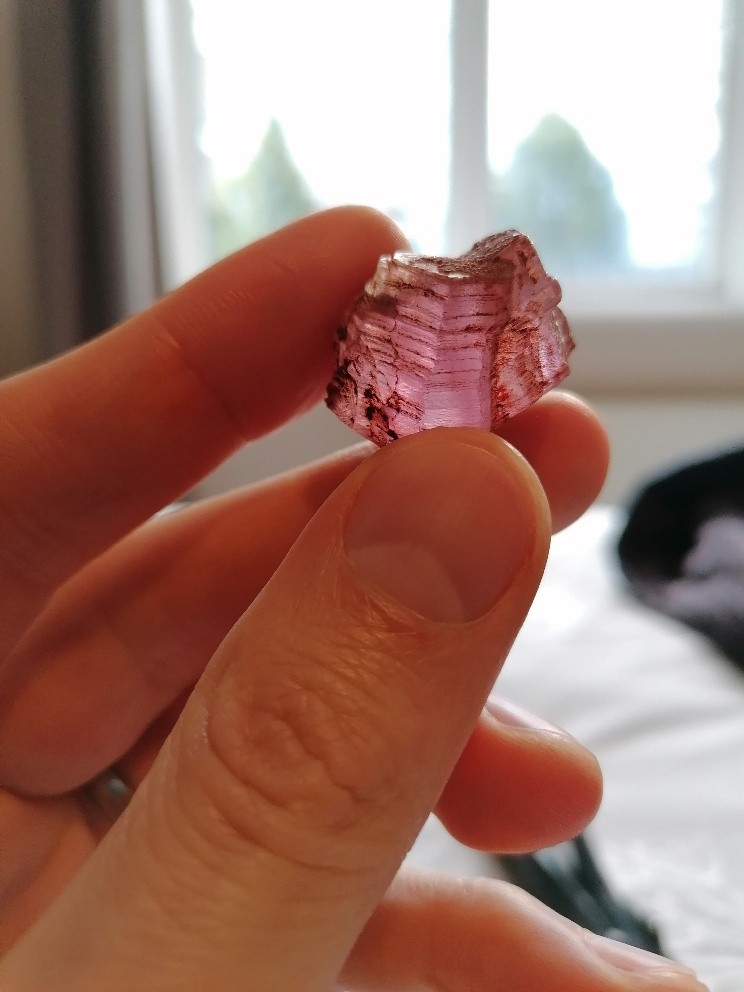
Figure 1. Pink, gem-quality lepidolite from an exploration project in northern Mozambique (Source: Private photograph Nicholas Vafeas).
For those of you who went back to check Figure 1, how sure are you now? Impressive as it may be, the power of AI comes with an important caveat, it is only as effective as the data it is given. Geological uncertainty, incomplete datasets, inconsistent sampling, and the chaotic reality of fieldwork, often expose the limits of algorithmic neatness. “Garbage-in, garbage-out”, as they say.
Historical drill logs are a classic example. They are notoriously unique to each logging geologist and shaped not only by personal interpretation, but also by academic training and local jargon. This is where AI fundamentally struggles, it lacks the human ability to interpret ambiguity and the “feel” of geology. This is particularly challenging in greenfields exploration, where data is sparse by definition. You are often working with limited signals, wide uncertainty, and patterns that may or may not even exist. This environment is brutal for algorithms and it explains why some early AI tools appeared to “underperform”, such as Kobold’s “zero copper” hole (Steinberg and Patterson, 2024). But rather than discarding the technology, Kobold treated the result as feedback, refining its models and improving prospecting strategies. In that sense, abandoning AI after one “misfire” is like throwing away your cake before you’ve finished baking.
Yes, companies like GeologicAI and VERAI now offer real-time, high-resolution core scanning, hyperspectral imaging, and automated structural logging (all genuinely impressive), essentially replacing the need for an on-site geology team. But even these systems can miss the subtle features such as foliation changes, micro-vein sets and metamorphic nuances, the kinds of things a trained geologist spots almost subconsciously. Now what if I told you that I lied, and that the lepidolite in Figure 1 is not AI, and in fact a real gem? That’s the difference between understanding the deposit and knowing the rock.
So while we’ll likely reach a point within the next 2–3 years where most AI project code is written by AI itself, and while the future may involve fewer geologists physically on site, the value of geological experience will almost certainly rise, not fall.
At the end of the day, AI remains a tool. A powerful one, yes, but still a tool. Geology is still (and will always be) about the rocks, the landscapes, the questions we ask, and the societal choices those answers inform.
If we strike the right balance, hammer in one hand, algorithm in the other, a balance that demands not only technological integration but also the willingness to cross social and disciplinary boundaries, the future of exploration will be shaped not by machines or humans alone, but by the partnership between them.
 References

 Steinberg, J., and Patterson, S., 2024. The Silicon Valley Startup Using AI to Scour the Earth for Copper and Lithium. The Wall Street Journal, 28 July. Available at: https://www.wsj.com/tech/ai/kobold-metals-ai-copper-lithium-caad58da?msockid=05c8c5d6a23e6e380f4ad03aa3456fc0