GD
Geodynamics

mantle convection

I’M BRINGING KERNELS BACK

I’M BRINGING KERNELS BACK

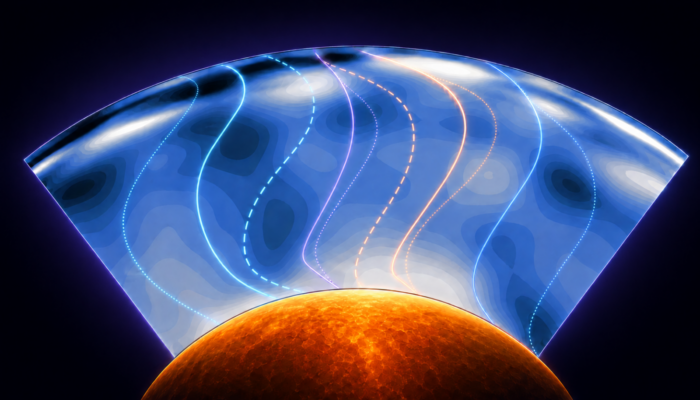
Computational geodynamic models are powerful tools for understanding Earth’s deep interior, but how do we know they are producing realistic results? In this week’s News & Views, Alina Valop, a PhD candidate from Virginia Tech, unpacks the world of geodynamic kernels and shows how these sensitivity functions provide a computationally efficient way to benchmark mantle flow models, te ...[Read More]

Running Models, Chasing Bugs – from Crashes to Convection

Running Models, Chasing Bugs – from Crashes to Convection

Mantle convection may unfold the hidden stories of planetary interiors over billions of years, but geodynamic models can crash in milliseconds. While figures in papers often show smooth convective flows with elegant plumes and slabs, the path to those results is not very easy. This week, Prachi Kar, a PhD candidate at Arizona State University, shares her honest thoughts on the part of geodynamics ...[Read More]

Journey Towards the Centre of the Earth: The Secret Behind the Long-Term Survival of Large Low-Velocity Provinces

Journey Towards the Centre of the Earth: The Secret Behind the Long-Term Survival of Large Low-Velocity Provinces

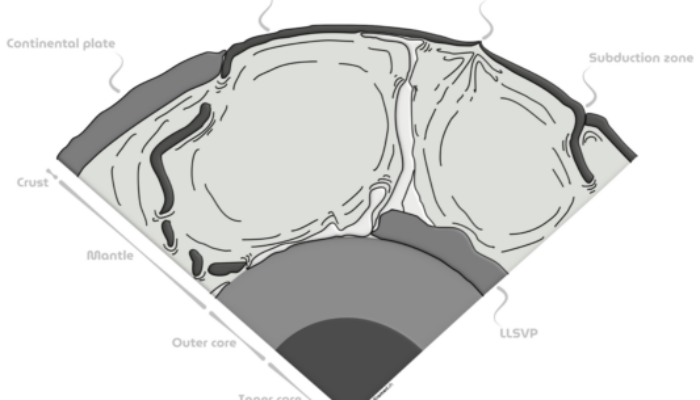
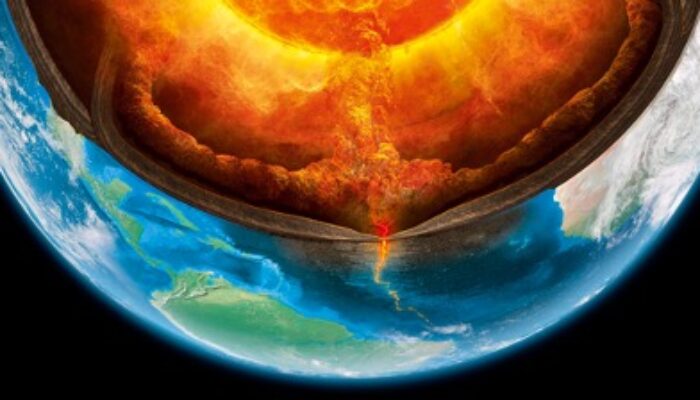
Geophysicists have long been intrigued by the enigmatic “blobs” residing deep within Earth’s lower mantle — the Large Low-Velocity Provinces (LLVPs). Ever wondered what keeps these gigantic thermochemical structures surviving for billions of years despite the mantle’s vigorous convection? In this week’s News & Views, Prachi Kar, a PhD candidate from Arizona State University, delves into Earth’ ...[Read More]

Phase transitions control plume layering during Earth’s secular cooling

Phase transitions control plume layering during Earth’s secular cooling

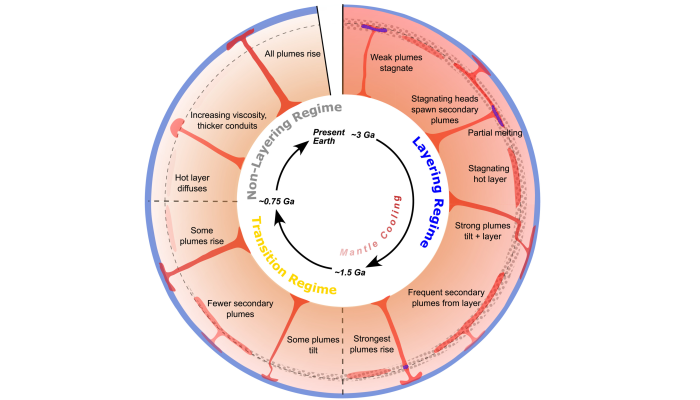
  Earth’s structure and dynamics have evolved quite a lot since its formation, and so has mantle dynamics and convection patterns changed along with it. It turns out that phase transition in certain mantle minerals can be an important driver of this change. Today, Ranpeng Li from GEOMAR Helmholtz Centre for Ocean Research Kiel, Germany explains how coupling geodynamic models with thermodynami ...[Read More]

A journey to the centre of plate tectonics and mantle convection

A journey to the centre of plate tectonics and mantle convection

“Dynamics of Plate Tectonics and Mantle Convection,” is edited by Dr. João C. Duarte and published by Elsevier. The book brings together contributions from more than 40 renowned authors in the fields of geology, geodynamics, tectonics, petrology and geophysics. It offers the unique authors’ perspective on the interconnected processes of plate tectonics and mantle convection and their v ...[Read More]

Regional viscosity variations in Earth’s mantle

Regional viscosity variations in Earth’s mantle

For understanding the dynamics and evolution of the Earth’s mantle, knowledge of mantle’s viscosity structure is very important. In this week’s blog, Kenneth Gourley from University of Arizona discusses the variation of viscosity structure in Earth’s mantle in regional scale.   In order to understand the dynamics and evolution of the Earth’s mantle, geodynamicists model mantle fl ...[Read More]

Mantle, Mountains and Molluscs

Mantle, Mountains and Molluscs

Geodynamic models and landscape evolution models are becoming important tools to quantify the formation and development of paleogeographic features, contributing to our understanding of the patterns of biodiversity evolution. Earth, a dynamic system The Earth’s surface works as a dynamic system and is continuously sculpted through the geological timescale by weathering, wind, rivers, and many othe ...[Read More]

Modelling CPO evolution with D-Rex

Modelling CPO evolution with D-Rex

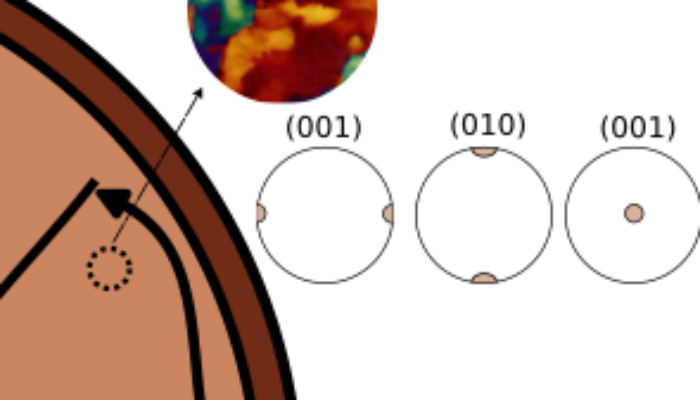
As a result of Earth’s mantle convection, rocks in the earth’s interior flow and develop a crystallographic texture. These textures reveal the planet’s thermal and tectonic history and are responsible for the viscous anisotropy, which can be used to study the planet’s deeper recesses that are not visible through other means. This necessitates the use of models that can pred ...[Read More]

Geodynamics 101: Dynamic Topography

Geodynamics 101: Dynamic Topography

The Geodynamics 101 series serves to showcase the diversity of research topics and/or methods in the geodynamics community. In this week’s post, Fred Richards explains how ‘Dynamic Topography’ is used in the Geosciences, and discusses the knowns, unknowns, and the challenges ahead.  Since shortly after its tumultuous formation 4.5 billion years ago, Earth has been steadily cooling, wit ...[Read More]