
A little over a decade ago, a group of us argued that “it takes a village to raise a hydrologist”. The skills and knowledge any hydrologist should be exposed to during their training goes far beyond what a single person can do and know. Even more, the experience of how water shapes and interacts with diverse landscapes all around the world cannot be obtained by a single person. This is true especially today, when human activity interacts with this landscape and the water cycle almost everywhere on our planet.
But, you might argue, we also have more data than ever before – more satellites circle and observe the Earth, and more powerful AI methods and diverse models analyse, utilize and produce data at incredible speed. Our main knowledge repository, in which we record our hydrological experiences, meaning the papers we publish in our journals, is growing so rapidly that we now publish about 10,000 papers a year just in the main water journals.
Should we just rely on AI?
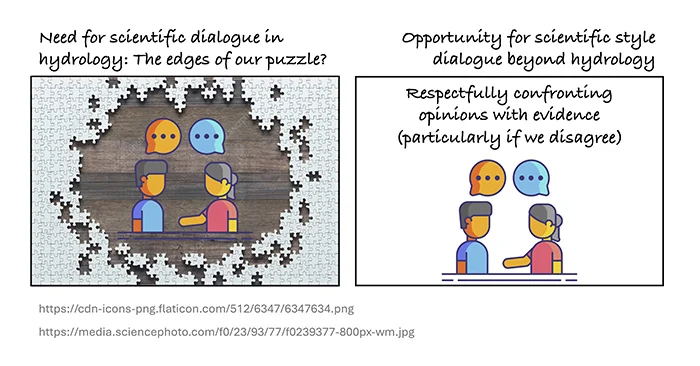
Some argue that knowledge accumulation alone equals scientific advancement, but it is increasingly difficult – and maybe impossible – to know what knowledge we jointly possess and where our knowledge gaps lie. If you think of our knowledge as pieces in a puzzle, then any new student of hydrology would typically start by finding the pieces that make up the edges of the puzzle. Once you have the outside frame of the puzzle, you slowly work inwards because now you can better see where further pieces belong – you have a frame of reference. In hydrology, our puzzle pieces have become so numerous that it is becoming impossible to find the edges. Certainly, for any single person. We can use AI to help us find and organize the puzzle pieces – e.g. Stein et al. used natural language processing to find and geolocate several hundred thousand papers on hydro-hazards out of a corpus of millions. But we are still figuring out how to do this, and it is not satisfying to have our knowledge organized and gaps identified by AI. At least not alone, among other reasons because current AI systems lack epistemic humility, meaning that they are confident even when they are wrong or when the existing database is insufficient.
Scientific dialogue is a complementary path
An important complementary path is dialogue. Scientific dialogue is essential for any scientific community, especially for hydrology where we deal with an incredibly diverse subject – water on our planet. What do I mean by scientific dialogue? Well, underlying all of science is a scientific method in which we use our current understanding to develop new theory, from which we derive testable hypotheses, which we compare with available evidence. If hypotheses and evidence are consistent, then the theory is corroborated, if not, then we have to modify the theory. Every scientific dialogue between two researchers is a small-scale application of this scientific method. In this way, we continuously debate whether our ideas and opinions withstand exposure to evidence. This is often not straightforward given the large uncertainties and biases in our observations. They leave room for debate on whether inconsistencies between hypotheses and evidence should be attributed to poor theory or poor data. Scientific dialogue is also a great equalizer in science. Standing at your poster at a scientific conference, it does not matter whether you are a first year PhD student or a senior professor – both must equally defend their work with reference to available evidence, not based on opinion or authority.
Such dialogue within our community is key to identifying the puzzle pieces that make up the edges of our knowledge, and to decide where new pieces should go. It should help us to identify which puzzle pieces are truly new, which provide further corroboration for previous findings, or which synthesize multiple earlier puzzle pieces into a single new one. It is critically important that this dialogue happens across different generations of hydrologists. When I finished my PhD – about 25 years ago – the amount of literature was dramatically smaller. I could actually read a significant fraction of it and establish the edges of the puzzle I was trying to put together. Thus, adding new pieces was easier then, and it has remained easier for me since because of this original framing. It is vastly more difficult to achieve this framing today. Not because we were smarter then (of course not), but because the puzzle was so much smaller. So, dialogue is more essential today if we want to ensure that our community puzzle is becoming more and more complete, and more transparent to everybody.
And finally, some words about the role of this dialogue beyond science. Outside of science, civilized dialogue is increasingly in decline. While this trend is depressing, I am encouraged by seeing that I can still have scientific dialogues even with people I strongly disagree with. Because we have a dialogue on the same terms. And maybe also because we have ‘epistemic humility’, which means we are aware of the limitations of our knowledge and that our ‘truths’ are tentative – they may be falsified in the future by the emergence of new evidence. I believe that this is an important message we should share with the public. A dialogue that is focused on testing ideas and opinions against evidence – as difficult as this is – is a way to communicate and maybe even advance joint knowledge.
Acknowledgements: Some of these thoughts originate from my Dalton Medal Lecture at EGU 2026. Thanks to Francesca Pianosi for the reference to epistemic humility and critical comments on a previous draft of this blog entry.


Keith Beven
I agree with every word of your piece, Thorsten and I am certainly happy to remain epistemically humble (that inevitably arrives anyway with increasing age and my path in that respect probably started with the 1989 Journal of Hydrology Changing Ideas in Hydrology paper, the lessons of which seem to have been forgotten in the age of ML). But there is the critical question as to just how we might do hypothesis testing in the face of epistemic uncertainties in the data – including in those continental QA’d data sets and the vast quantities of remote sensing data now available. Before the younger generations get carried away by too much predictive success, there are surely methodological questions to be asked as to how robust that success might be, and how that success might be properly tested.
Thorsten Wagener
Absolutely. In my Dalton Lecture I discussed how we struggle with what others have called the “streetlight effect”, i.e. it can be convenient to focus on the data we have (at face value) while key knowledge gaps are left behind (https://en.wikipedia.org/wiki/Streetlight_effect). I find it encouraging that there are studies that assess and highlight these problems and their consequences (e.g. https://hess.copernicus.org/articles/28/4219/2024/ ). More of this is needed.
Thorsten Wagener
I am not arguing that knowledge accumulation does not constitute scientific advancement (I actually think it is an important element of it). I rather argue that assessing knowledge accumulation is increasingly difficult. Hence deciding whether any advancement in hydrological science has been achieved is increasingly difficult, which is a problem for our (and many other) science(s).