HS
Hydrological Sciences

Extreme events

Summary of the August 26th, 2026, Himalayan flash flood

Summary of the August 26th, 2026, Himalayan flash flood
At the time of preparing this blog entry, we are less than 48 hours after the catastrophe which has hit the Himalaya. While the flow of new information continues, it is useful to summarize and clarify the key points around this event. WHAT? The massive destruction was caused by a flash flood. It was such a high energy that is rarely seen. Numerous videos can be found online.   WHERE? The caus ...[Read More]

Drought in Europe

Drought in Europe

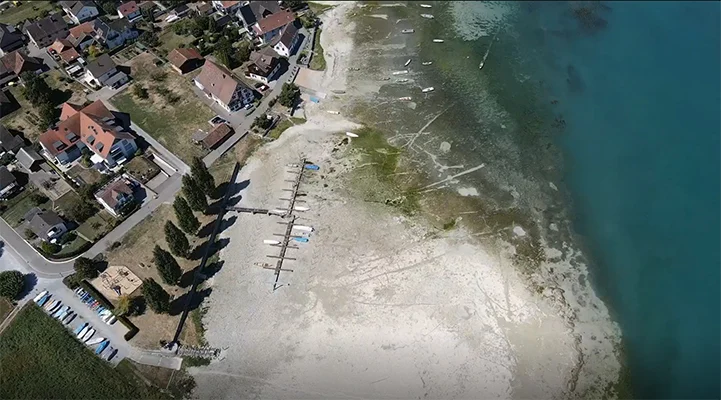
Many of us are experiencing it right now: Europe is suffering from a long lasting large scale drought (Fig. 1), with record heat and low-flow levels that probably nobody of us has seen before; and current forecasts do not announce any relieve for the coming weeks. The pictures of record low levels in the river Rhine  are scaring – knowing how strongly Europe depends on this fluvial transport ...[Read More]

What machine learning can and cannot tell us about floods

Collage based on a picture by Imad Clicks via Pexel

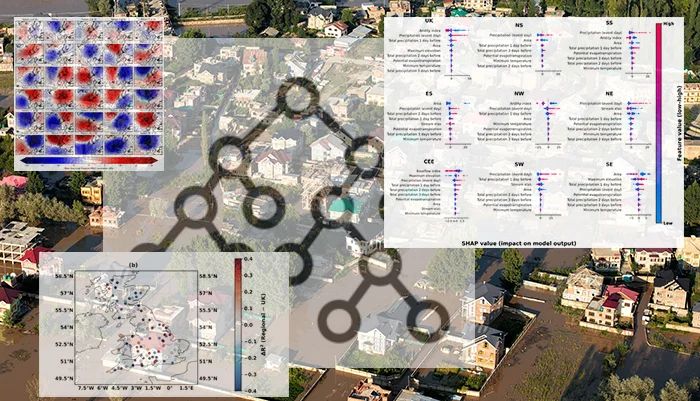
Floods are shaped by complex and nonlinear interactions between weather patterns, rainfall, soil properties, topography, land cover, and how wet a catchment already is. This complexity is one reason machine learning (ML) is increasingly used in hydrology. ML models can learn patterns from large and complex datasets with many variables.  Early in my PhD, while exploring machine learning models for ...[Read More]

HydroTalks: Prof. Thom Bogaard on Water and Landslides, Early Warning Systems, and IAHS-HELPING Decade

HydroTalks: Prof. Thom Bogaard on Water and Landslides, Early Warning Systems, and IAHS-HELPING Decade

For episode 11 of HydroTalks, we welcomed Prof. Thom Bogaard of Delft Technical University and visiting professor at Kasetsart University, Bangkok. His research explores the intersection of hydrology, geomorphology, ecology, and natural hazards. We discussed his work on understanding how water triggers landslides, improving regional early warning systems, and developing practical solutions that re ...[Read More]

HydroTalks podcast: Introducing Ilias Pechlivanidis, the HS Division President-elect

HydroTalks podcast: Introducing Ilias Pechlivanidis, the HS Division President-elect

For this  episode of HydroTalks, we’re thrilled to welcome Dr. Ilias Pechlivanidis, Senior Researcher and Associate Professor (Docent) in hydrology and water resources at the Swedish Meteorological and Hydrological Institute (SMHI), and Visiting Researcher at Uppsala University. He is currently the Vice President of the EGU Hydrological Sciences Division and will serve as Division President for th ...[Read More]

Doing flood frequency hydrology in a non-stationary climate

Doing flood frequency hydrology in a non-stationary climate

A robust estimation of probabilities of extreme floods is the Holy Grail in flood hydrology in view of limited available observations, variability of climate, and complexity of flood generation processes in catchments. Flood frequency hydrology, spearheaded in the past decades by Ralf Merz and Günter Blöschl, offers a powerful toolbox to enhance the reliability of flood probability estimates by co ...[Read More]

Communicating and Managing Residual Risk with Perfect Storms and Other Counterfactual Stories

Communicating and Managing Residual Risk with Perfect Storms and Other Counterfactual Stories

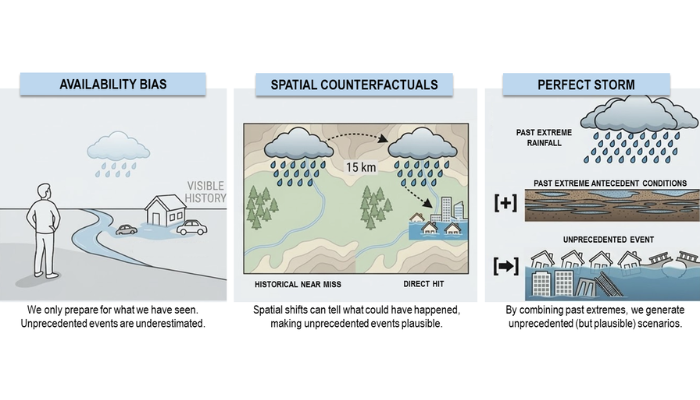
The aim of risk management is to prepare society in order to limit loss and damage when an extreme event occurs and to restore the functioning of society afterwards . While current risk management practices are helpful in many regards, they fall short when it comes to unprecedented events. An analysis of event pairs and recent disasters show that societies often fail to cope with events that are l ...[Read More]

HydroTalks: Prof. Sally E. Thompson on ecohydrology, vegetation, climate change and working across continents

HydroTalks: Prof. Sally E. Thompson on ecohydrology, vegetation, climate change and working across continents

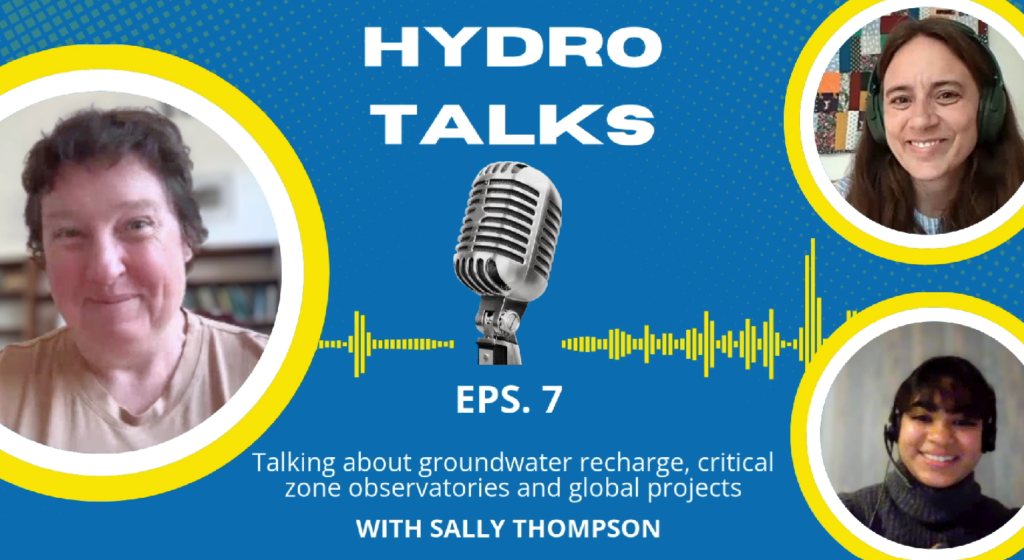
In episode 7 of the Hydrotalks podcast, our guest was Dr. Sally Thompson (Sally Thompson – the UWA Profiles and Research Repository). She is a Professor at the University of Western Australia, and the Co-Director of the Centre for Water and Spatial Science. Her research spans ecohydrology, surface hydrology, and Critical Zone Science, exploring how vegetation and ecosystems interact with wat ...[Read More]

HydroTalks: Heidi Kreibich about Floods, Human-water Feedbacks, and the IAHS Scientific Decade Panta Rhei

HydroTalks: Heidi Kreibich about Floods, Human-water Feedbacks, and the IAHS Scientific Decade Panta Rhei

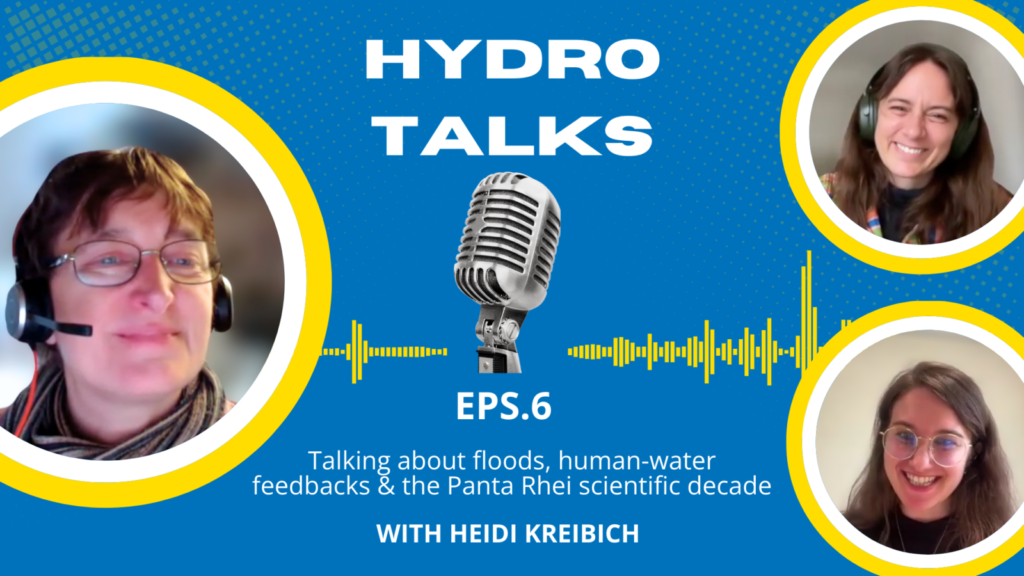
For this month’s episode of HydroTalks, we’re thrilled to welcome Heidi Kreibich. She is  head of the Section Hydrology at GFZ Helmholtz Centre for Geosciences and senior lecturer at the Geography Department of Humboldt-Universitat zu Berlin. Heidi is also president of the Natural Hazards division of the EGU and president of the International Commission on Human-Water Feedbacks in the IAHS. In add ...[Read More]

“What if …?” – Creativity in flood risk management using counterfactual scenarios

“What if …?” – Creativity in flood risk management using counterfactual scenarios

Floods are among the most devastating natural hazards, claiming lives and damaging infrastructure.  The question of how we can be prepared for these extreme events quickly reaches an almost philosophical level: First of all, what is an extreme event? Second, how can we know what the future will bring?  For the last century hydrologists have relied on statistical concepts, which are based on observ ...[Read More]