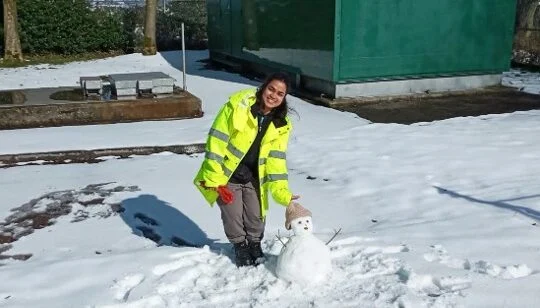
Archita Bhattacharyya is an Environmental Scientist and a research and development fellow at the Department of Environment, Food and Rural affairs, England. For 2026, she is the Early Career Scientist Representative for the Hydrological Sciences division.
Can you tell us about the focus of your research?
In my PhD, I focused on groundwater microbiology, especially how microbial communities change across space and time in different aquifer geologies. This involved studying the aquifer microbiology using flow cytometry and DNA sequencing and relating the microbiology data to aquifer type, and environmental factors like groundwater recharge and chemistry.
After my PhD, I moved into a policy fellowship role, where I looked into the applications of engineering biology for sludge and soil remediation, particularly for emerging contaminants like plastics and PFAS. Recently, I have started another job where I’ll use my science skills to monitor, evaluate and report on the effectiveness of nature restoration policies. So although the research topic has changed, I am still interested in how science can help us better understand and manage environmental systems.
What originally inspired you to go into this field?
I first became interested in this field during my Master’s dissertation on groundwater quality, where I learnt about all the unknowns in the subsurface world. When I came across a PhD project on groundwater microbiology, I was immediately drawn to how novel it felt. I was excited by the idea of learning about subsurface life and combining my hydrogeological background with molecular biology methods.
Looking back, what was the most challenging aspect of your PhD and what was the most enjoyable?
The most challenging part was definitely the time management. It was a large project with several workstreams, and at times I pushed myself too hard trying to keep everything moving.
The most enjoyable part was the fieldwork. I loved travelling to new places and towns, and making memories along the way. I also really enjoyed working with my datasets. Every time I learned a new piece of code or created a figure that clearly showed something meaningful, it gave me a real sense of accomplishment.
How was your experience of post-PhD life so far?
After PhD, I have been working in policy roles, quite different from a typical academic career trajectory. Straight after finishing the PhD, I started an R&D fellowship in the Department of Environment, Food and Rural Affairs, England, where I worked on a project involving engineering biology for sludge treatment, another very novel and exciting topic. After the end of this fellowship, now I am working on another policy role, where I’ll use my science skills to monitor and evaluate nature restoration policies. Overall, these roles allowed me to see how science translates into real-life decisions and shapes regional and national policies.
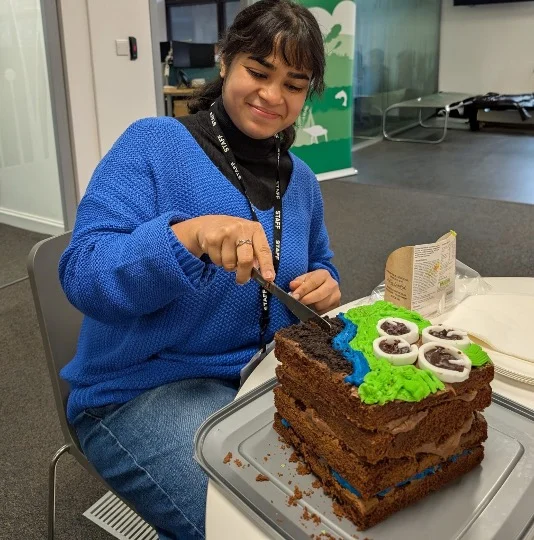
Feeling absolutely stoked by the Sludge-cake, customised by a colleague, on Defra R&D fellowship ending day.
What advice would you give to an Early Career Researcher about the challenges they might face in academic life?
This is advice I also have to remind myself of: not every research career is linear. Everyone faces difficult phases. That is why celebrating small wins really matters. It will help you keep going.
I would also say that science is not strictly limited to academia. The skills we develop as researchers are valuable in many other spaces, including policy and industry. My own move from academia into policy has been eye-opening, and it has made me think more openly and flexibly about what a scientific career can look like.
Why did you decide to become an Early Career Scientist Representative and how has being a part of the ECS team impacted you?
At first, I joined because I wanted to build my skills in organisation, project management, and team-management, while also becoming part of a wider scientific network. Over time, though, my motivation changed and I genuinely enjoy being part of the ECS team.
It has given me opportunities to do creative things like podcasting and blog writing, and it has connected me with a wonderful group of people. It has also helped me grow in confidence, especially in communication. Coming from a non-English-medium school, that has been a very meaningful experience for me.
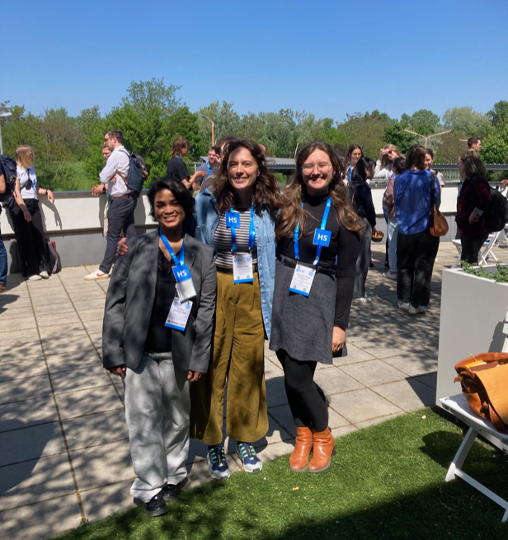
With the outgoing and incoming ECS reps at the Hydromeet event of GA 2025 (from left: Archita, Melissa and Christina)
What do you plan to achieve as the ECS rep this year?
This year, I would really like to maintain and enhance the great work our team is already doing. We run a lot of valuable activities, so one of my priorities is to streamline processes and improve how we manage ongoing projects. I would like us to minimise workload where possible while still maximising the impact of what we produce.
What do you like about the role?
What I like most is the chance to work with talented, motivated, and genuinely inspiring people. The ECS team is full of brilliant scientists, but also kind and creative individuals. Through the podcast, I have had the opportunity to speak with many hydrologists about their research and career experiences, and I have found those conversations incredibly engaging.
What advice would you give to other early career scientists who perhaps want to contribute to the ECS network but are hesitant?
I would say: join us and contribute whatever you can. There is space for different kinds of involvement, from scientific blog writing and podcasting to more creative or organisational activities. You can be involved a little or a lot. It is a great way to build skills outside your own research, meet new people, and be part of a broader community.