
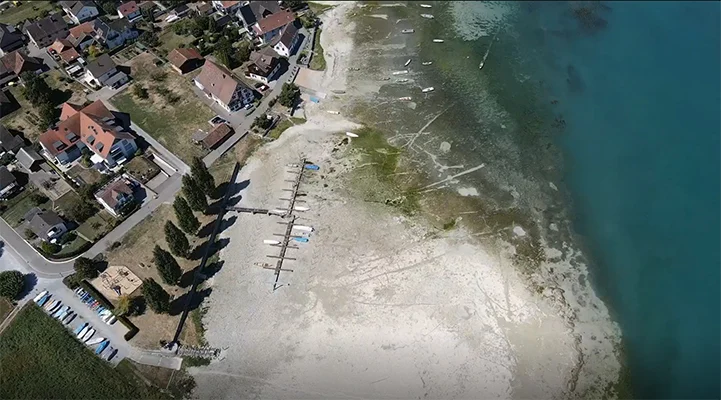
Many of us are experiencing it right now: Europe is suffering from a long lasting large scale drought (Fig. 1), with record heat and low-flow levels that probably nobody of us has seen before; and current forecasts do not announce any relieve for the coming weeks. The pictures of record low levels in the river Rhine are scaring – knowing how strongly Europe depends on this fluvial transport artery to connect the harbor of Rotterdam to the inlands. Many regions severely lack water for irrigation or even for drinking water and forest fire risks are high. Ecosystems are facing potentially irreversible damage.
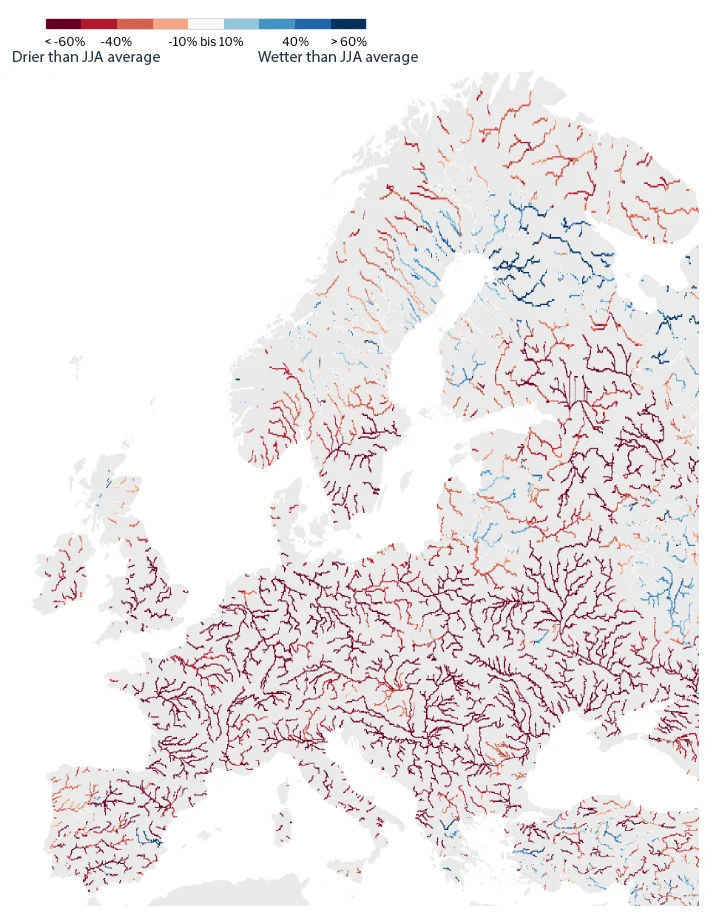
Fig. 1: Relative deviation of summer streamflow (July, June, Aug.) from long term average (1991-2020), on 9 August. Shown are rivers with catchment larger than 1000 km2 with available data; graphic created by Patrick Vögeli , Tamedia, based on data from HydroRIVERS; Copernicus CEMS/GloFAS v4.0 (LISFLOOD); original publication in thisTagesanzeiger article
In Switzerland, the water tower of Europe, only a few high alpine or regulated rivers are not experiencing severe low flows (Fig. 2 & 3). Water and feed are becoming scarce (SwissInfo), cows descend earlier from their alpine pastures and livestock may have to be culled. Forest stands show wide-scale water stress, hydropower production is low and many communities are limiting the use of drinking water (SwissInfo). Almost nobody can remember having seen similar impacts before, except those who experienced the then recording breaking summer 1947 (see a collection of documentaries and papers for Switzerland here).
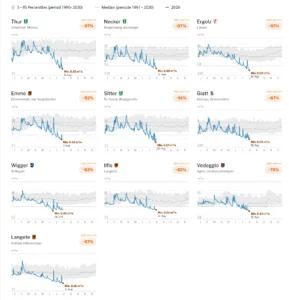
Fig. 2: Daily streamflow (log scale) at Swiss gauging stations that show a record low value in August 2026, compared to long term average (1991-2020); data retained until 13 Aug. 2026; graphic created by Patrick Vögeli , Tamedia, based on data from the Swiss Federal Office for the Environment. Link to the original publication.
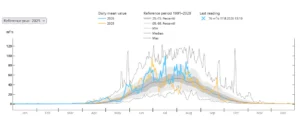
Fig. 3: Above average streamflow in the Massa river, Switzerland (catchment: 196 km2, roughly 55% glacier covered, fed by the Grosse Aletsch glacier that has an area of 75.8 km2). Source of the graphic: Swiss Federal Office for the Environment
Looking at precipitation observations, the Swiss hydrological year 2025/2026 did not start particularly dry (Fig. 4), but because of the winter temperatures, there was little snow accumulation in the mountains (albeit not extremely low, Fig. 5). The snow pack melted away very quickly in spring; streamflow and groundwater recharge during the snowmelt period was much reduced compared to average years. The precipitation deficit started building up early in the growing season, around April (see MeteoSwiss visualisation here), stopping any further groundwater recharge. In Switzerland, the current drought thus results from a combination of winter snow deficits, early and strong melt out, persistent heat and high evaporation and low groundwater storage. In other words, all alpine buffers (snow, glaciers, groundwater) are under pressure simultaneously.
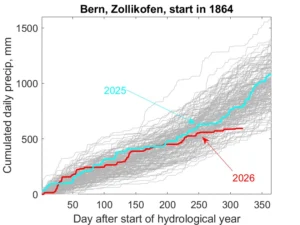
Fig. 4: Cumulative precipitation at the Bern / Zollikofen station, based on data from MeteoSwiss, download: https://data.geo.admin.ch/ch.meteoschweiz.ogd-smn/ber/ogd-smn_ber_d_recent.csv
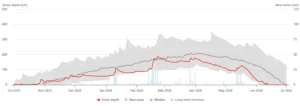
Fig. 5: Observed snow depth at the Weissfluhjoch station, graphic from the SLF whiterisk website , downloaded 18 Aug. 2026
I was recently asked during a radio interview, what I find the most striking when seeing pictures of the current drought in the Rhine basin. My spontaneous answer was: I am surprised that we are surprised – even if the climate change scenarios predict exactly a year like 2026 as the new normal. The most striking thing about the drought of 2026 is therefore not that it is unprecedented. It is that, despite decades of climate projections warning us that such summers would become more frequent and more severe, we are still treating them as surprises.
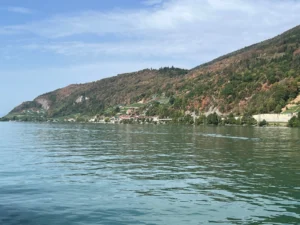
Left shore of lake Bienne: Forest showing signs of severe heat stress, picture taken by Martin Grosjean (9 Aug. 2026)
Acknowledgements: The author would like to thank Patrick Vögeli and the Swiss Tagesanzeiger for the right to re-use the figures published in the Tagesanzeiger.
Further links:
- See further details in the European Drought Observatory (no analysis available for August yet).
- Swiss drought research platform by hydrologists from WSL: https://www.drought.ch/de/start/
- Swiss federal drought monitoring and warning platform: https://www.trockenheit.admin.ch/en



Bettina Schaefli
If you have drought pictures to share, I would be more than happy to receive them by e-mail with date and location and a CC by attribution license agreement.
Bettina Schaefli
The Swiss research centre WLS published a detailed “frequently asked questions” article on the 2026 drought: link