Plate tectonics is a key geological process on Earth, shaping its surface, and making it unique among the planets in the Solar System. Yet, how plate tectonics emerged and which factors controlled its evolution remain controversial. The recently published paper in Nature by Sobolev and Brown suggests new ideas to solve this problem…. What makes plate tectonics possible on contemporary Earth? It is ...[Read More]
News & Views
Searching for future directions in tectonic modelling
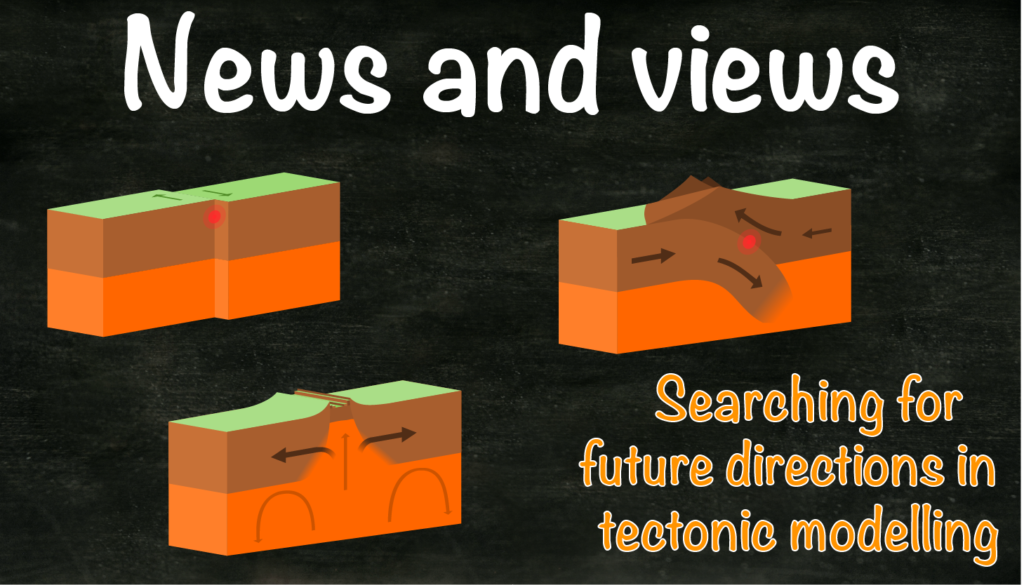
Geoscientists frequently use forward geodynamic simulations to test hypotheses derived from geophysical and geologic observations. While numerical simulations of lithospheric deformation have lead to key advances in our understanding of tectonic processes, in many cases it remains difficult to ascertain whether numerical models reproduce observations for the correct underlying regions. This week, ...[Read More]
Let’s talk about plagiarism
Hey you! Do you have 5 minutes to talk about plagiarism? Have you ever wondered if some parts of a thesis that you have supervised are simply a copy-paste from another thesis or article? This week, an anonymous guest author will tell us about their personal experience with plagiarism in science and what can be done against it. Granted, it is not the most fascinating topic. Until recently, I really ...[Read More]
Production and recycling of Archean continental crust
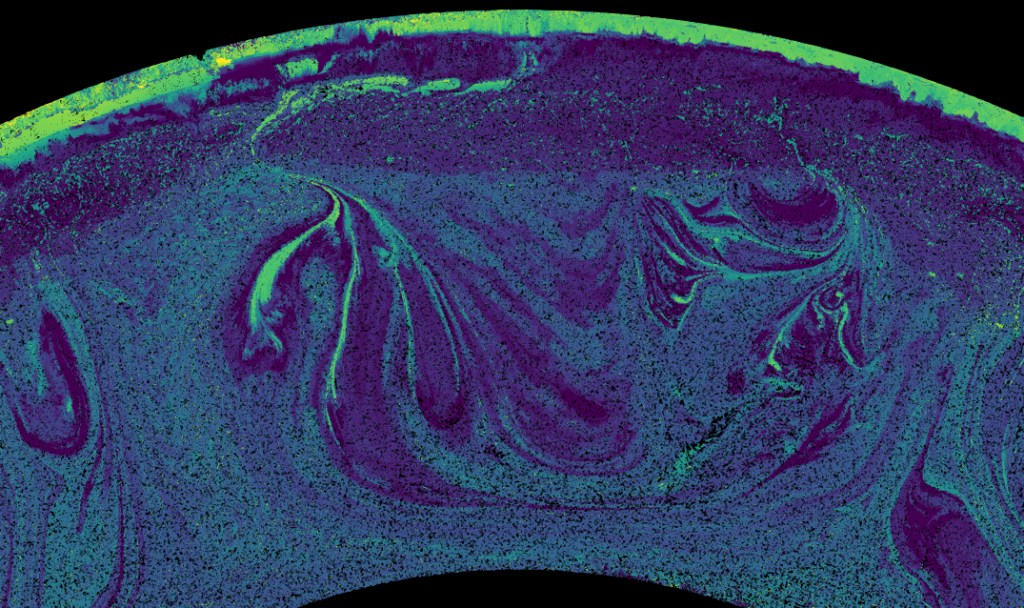
Continents are essential for the development and survival of life on Earth. However, as surprising as it may sound, there did not exist a planetary scale numerical model to show the formation of the oldest continents until the recent study ‘Growing primordial continental crust self-consistently in global mantle convection models‘ in Gondwana Research by Jain et al., 2019. Hot off the p ...[Read More]
How the EGU works: Experiences as GD Division President
In a new regular feature, Paul Tackley, president of the EGU geodynamics division, writes about his role as a president, and gives us an insider’s view on how EGU works and is preparing for the future. Stepping into the role of GD Division President has given me a big learning experience about how the European Geosciences Union is run and about how members are represented and can participa ...[Read More]
The geodynamic processes behind the generation of the earliest continents
The earliest continents played a fundamental role on Earth’s habitability. However, their generation is still not understood, and it requires an integrated approach between petrology and geodynamic modelling. In a new study, Piccolo and co-workers developed a method to handle the effects of chemical evolution on the geodynamic processes. They show that the production of the earliest felsic c ...[Read More]
An industrial placement as a geodynamicist
After years of trying to get a PhD, publishing papers, networking with professors, and trying to land that one, elusive, permanent job in science, it can be quite easy to forget that you actually do have career options outside of academia. To get a little taste of this, Nico Schliffke, PhD student in geodynamics at Durham University, tries out the industry life for a few weeks! When coming close t ...[Read More]
Thoughts on geological modelling: an analogue perspective
In geodynamics we study the dynamics of the Earth (and other planets). We ground our studies in as much data as possible, however we are constrained by the fact that pretty much all direct information we can collect from the interior of the Earth only shows its present-day state. The surface rock record gives us a glimpse into the past dynamics and evolution of our planet, but this record gets spa ...[Read More]
Let’s talk about disability in geosciences
Climbing towards outcrops during fieldwork for your undergraduate studies simply isn’t doable for everyone. However, this doesn’t mean that there are adequate alternative solutions available. This week, Katy Willis, PhD student on strain-localisation in the continental lithosphere at the University of Leeds, UK, discusses disability in the geosciences, because regardless of who you are ...[Read More]
Going with the toroidal mantle flow
Subduction zones host one of the most complex and fascinating tectonic systems on the planet. Numerical models by Király and colleagues recently published in Earth and Planetary Science Letters reveal that the strength of the toroidal flow depends on the mantle viscosity and the magnitude of the slab pull force while the characteristic size of the toroidal cells mainly depends on the size of the c ...[Read More]