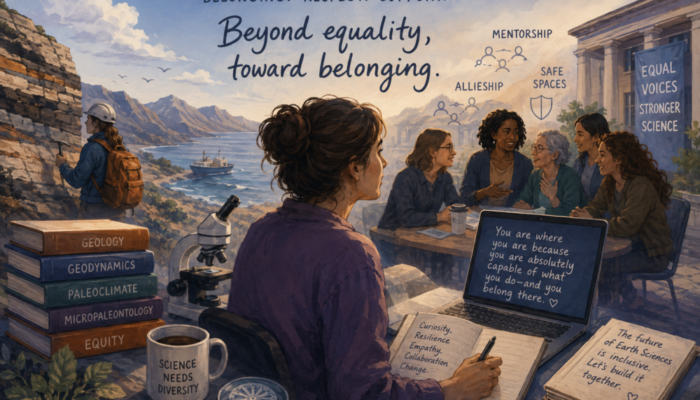
Female support in STEM Earth Sciences. Image generated by IA.
Academia is often imagined as a space driven by merit, curiosity, and scientific collaboration. Still behind publications, conferences, and research achievements, many women in STEM continue to navigate environments shaped by subtle exclusion, normalized inequalities, and power imbalances that are not always openly discussed. In Earth Sciences, where collaboration and field-based research are fundamental, conversations about gender inequality are becoming increasingly visible. However, visibility does not necessarily mean resolution. Experiences such as being underestimated, interrupted, professionally devalued, or discouraged still affect many women throughout their academic careers, many often in ways that are difficult to quantify, but deeply impactful over time. To reflect on these issues, this blog post week, Katherine Villavicencio spoke with Dr. Karen Gariboldi, Senior Researcher from the Department of Earth Sciences at the University of Pisa, whose work focuses on marine micropaleontology and paleoenvironmental reconstruction. Drawing from her personal and professional experience, she shared thoughtful perspectives on impostor syndrome, academic power dynamics, mentorship networks, institutional responsibility, and the kind of cultural transformation that academia still urgently needs. Her reflections remind us that gender equality is not only about policies or representation in numbers. It is also about creating academic environments where people feel respected, heard, supported, and genuinely allowed to belong.
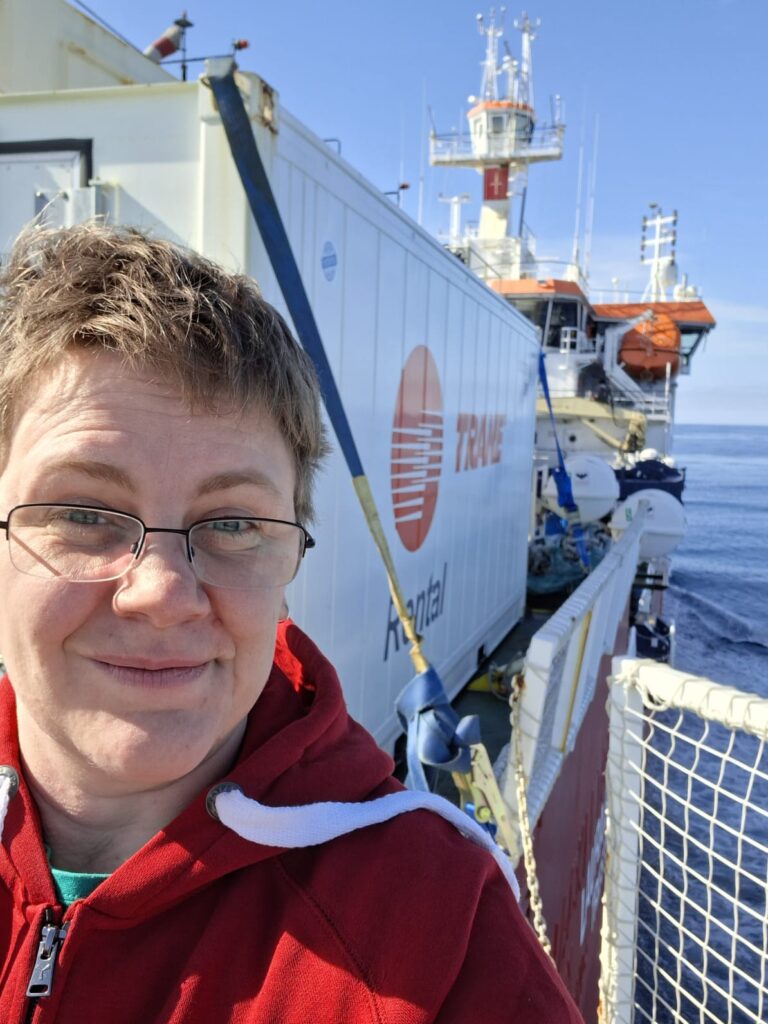
Dr. Karen Gariboldi, Senior Scientist at Department of Earth Sciences, University of Pisa (Italy).
Could you briefly introduce your research background and explain the main focus of your work?
I graduated from the University of Milan Bicocca with a degree in Geological Sciences and Technologies, following the Marine Geology curriculum. My Master’s thesis focused on diatom assemblages (microalgae with a siliceous skeleton) characterizing the rocks of the Miocene Pisco Formation in Peru. I then completed a PhD in Earth Sciences at the University of Pisa, again working on diatom assemblages from the Pisco Formation. I investigated the information they provide from a biostratigraphic, paleoclimatic, and sedimentological/diagenetic perspective. I am currently a Senior Researcher at the Department of Earth Sciences at the University of Pisa, where I continue my work as a marine micropaleontologist, also in Arctic regions, with a focus on the Holocene as well, not only the Miocene. Diatoms, however, remain my main area of expertise.
From your experience in academia, what forms of gender-based inequality do you believe are still most persistent today, even if they are often normalized or overlooked?
I think there is now much greater awareness of gender-based inequalities; however, this doesn’t mean that these issues have been fully overcome. There is still a lot of work to be done, but the fact that these topics are discussed so widely is, in my opinion, a big step forward. Many studies clearly show that in academia—especially in STEM fields—the gap between women and men tends to widen as you move toward higher or more “powerful” positions.
Many women in academia report being subtly dismissed, interrupted, or underestimated in professional settings. How do these behaviors affect confidence, visibility, and career progression over time?
I don’t think there is a single, clear-cut answer; it definitely depends on the individual. Based on what I have observed and on my personal experience, being constantly belittled—or simply not having one’s work properly acknowledged—undermines confidence in one’s abilities and often fuels impostor syndrome, which is already very widespread in academia. This can lead to depressive episodes, sometimes quite severe. You start feeling completely out of place, inadequate; you get the sense that you have wasted your life doing something you are actually not capable of doing. These are very tough moments, and they are hard to overcome. And if this is what you are experiencing right now, please remember that these are distorted feelings, not facts. You are where you are because you are absolutely capable of what you do—and you belong there. On the other hand, some women, in order to assert themselves and advance their careers, begin to adopt behaviors that are typical of patriarchal systems. This is not a positive outcome. Achieving gender equality should instead mean bringing a different model into leadership positions—a model of leadership that is more empathetic, able to build a workplace based on trust, genuine collaboration, and mutual respect. Some women have managed to do this (and it really is appropriate to call it an achievement), but they are still too few. We should probably ask them how they managed it—although I am convinced that the context in which one grows up plays a major role in this kind of development. If girls are trusted from a young age and encouraged to engage in constructive dialogue, they will have no difficulty, as adults, in embodying the role of a positive leader.
Harassment in academic environments is still widely underreported. In your view, what power dynamics or institutional factors make it so difficult for women to speak out?
Quite clearly, the fear of losing one’s position—or, in the case of students, of failing an exam or not completing their thesis—often plays a major role. Universities are starting to put systems in place that allow harassment episodes to be reported and investigated more easily, but until we begin to see real consequences and sanctions for those who commit such behaviors, reports will always remain few. Universities carry a great responsibility in this regard.
How important are mentorship networks and allies in creating safer and more inclusive academic spaces, and how can they be strengthened?
As I mentioned before, the system that I believe women should foster is one based on empathy, trust, and respect. From this perspective, mentorship networks and allies in creating safer and more inclusive academic spaces are clearly fundamental. Specifically, within our department, among female colleagues, we organize lunches together every 2–3 months. Starting these meetings has been very helpful, as it allowed us to discuss issues of discrimination and realize that some of the challenges we personally experienced are shared by other colleagues.Talking and sharing experiences helped us understand that we were not alone and that, together, we could find solutions. Most importantly, supporting each other makes us stronger. To strengthen these networks, it is important to engage in discussions with male colleagues as well, especially younger ones who are sensitive to the issue and can help drive change within the male sphere. It is essential, even if it seems obvious, that they point out to their peers when sexist jokes are inappropriate, and help highlight and overcome problematic or harmful behaviors. Intervening to defuse these behaviors even when no women are present is essential.
As a senior scientist, how do you think established academics can and should intervene when they witness discrimination, harassment, or abuse of power?
They should definitely stand up for the person who is experiencing abuse and help them find the appropriate channels to report it. However, this is not always easy to do. Very often, people worry about the repercussions on their own careers. Even with a tenured position at a university, there are many ways in which others can create obstacles; for example, by ensuring that one of your projects is not approved. This is another example of how, having a strong network behind you is essential, as it allows you to act with greater confidence and support.
What strategies can early-career women adopt to protect themselves from professional devaluation or hostile academic environments, without feeling that they are risking their careers?
First of all, it is important for them to be aware of their own worth, even if someone tries to undermine it. I would advise them to familiarize with the resources and key contacts within their institution in case they witness or experience any form of harassment. However, it is ultimately the responsibility of institutions to monitor these situations and provide people with the tools to protect themselves. As educators, it is our duty to educate.
Do you think formal equality and anti-harassment policies are sufficient, or is a deeper cultural change within academia still urgently needed?
Anti-harassment policies are necessary, but not sufficient. A profound cultural change is required, which will take years, if not decades, and continuous efforts to raise awareness. However, I have faith in the new generations.
What message would you like to share with young women entering Earth Sciences who may already feel discouraged, marginalized, or unsure of their place in academia?
Remember what brought you to this career. If you have become Earth scientists, it is surely because, even from a young age, you felt a deep connection with our Planet. Think about it—can anyone take that away from you? No. This love is a part of you, and no one can take it away!