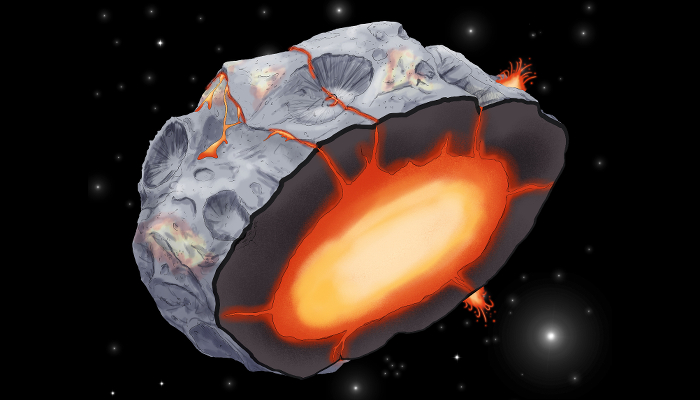
This week, Francis Nimmo, professor in the Department of Earth and Planetary Sciences (University of California Santa Cruz), tells us about volcanism on metallic asteroids! Around and after the formation of the solar system (4.5 billion years ago onwards), volcanoes on some of the gigantic bodies of the asteroid belt might have erupted … iron. Explanations. One way in which we can learn abou ...[Read More]
Geodynamics in Planetary Science
It is a question that humankind has been asking for thousands of years: Are we alone in the Universe or are there other worlds like our own? As of today, it is unknown whether or not inhabited planets exist outside of our own solar system. With the discovery of the extrasolar planet 51 Peg b in 1992, it was confirmed that our sun is not the only star that hosts planets and therefore the search for ...[Read More]
Oceans on Mars: the geodynamic record
Apart from our own planet Earth, there are a lot of Peculiar Planets out there! In this series we take a look at a planetary body or system worthy of our geodynamic attention, and this week we are back to our own solar system, more precisely to our neighbour Mars. In this post, Robert Citron, PhD student at the University of California, Berkeley, writes about the links between oceans, shorelines, ...[Read More]
Thirteen planets and counting
Apart from our own planet Earth, there are a lot of Peculiar Planets out there! In this series we take a look at a planetary body or system worthy of our geodynamic attention, and this week we move back to our own solar system. Many of us will clearly remember the downgrading of Pluto as a planet nearly 12 years ago to the month. In this informative and witty post, Laurent Montesi from the Univers ...[Read More]