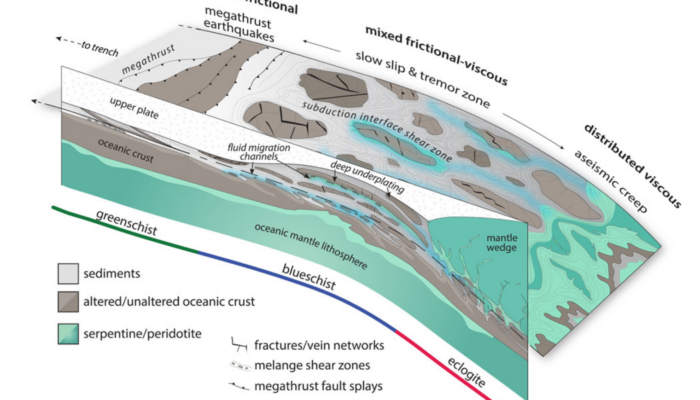
The dynamics of subduction zones are strongly influenced by the subduction interface. Understanding its rheology enables geodynamic modellers to better simulate these systems and unravel the fundamental processes that govern them. In today’s blog post, we explore subduction interface rheology and discuss effective approaches for modelling it.

I am a geophysicist-turned-geodynamicist currently working as an Assis-
tant Professor at the School of Geosciences at the University of Louisiana
at Lafayette (yes, we DO have alligators on campus). I approach geodynam-
ics from a rheological perspective and have mostly focused my research on
subduction interface deformation. My rheology skills are highly transferable,
mainly in baking
What is a subduction interface?
I first met a subduction interface in person in August of 2015, during my first year as a PhD student at GFZ Potsdam, under the supervision of Prof. Onno Oncken. Herr Oncken led a field trip to the Central Alps, tracing the paleo-interface (Bachmann et al., 2009a,b) during the subduction of the Penninic ocean underneath the continental realm of the Adriatic plate (Austroalpine nappes; Froitzheim et al., 1996). The exposed plate interface has experienced frictional and viscous deformation over an extended period of time, reflecting a multistage evolution (Bachmann et al., 2009a).
But first things first! Subduction zones are the largest physical and chemical systems within the Earth, responsible for recycling large amounts of rocks and fluids from the Earth’s surface to its interior and vice versa (e.g., Stern, 2002; Hacker et al, 2003a,b). As the downgoing slab subducts beneath the overriding plate, some portions of the finite thin zone connecting the two plates slide freely past each other. In contrast, others remain mechanically locked due to coupling, resulting in the accumulation of stresses and storage of elastic deformation within and adjacent to their place of contact (interface – aha!). After a certain threshold value of stress is reached, stored elastic energy is released by sudden slip, and thus, decoupling of the interface occurs at a typical depth range between 5 and 45 km, generating interplate earthquakes.
Much of the deformation processes that take place during convergence and subsequent subduction are accommodated by deformation along the interface of the involved plates (Hacker et al., 2003a; Agard et al., 2018). Due to the mechanical coupling of the plates, it is possible that stresses are periodically built up and suddenly released in the form of earthquakes. Important factors that affect the coupling of the interface are the lithology and lubrication of the interface, its rheology, and how these vary with depth. In order to assess these properties in active subduction interfaces, one must look into the rock record of exhumed subduction interfaces (Grigull et al., 2012; Wassmann and Stockhert, 2013b; Agard et al., 2018). The plate interface is intrinsically weak, with low (< 35 MPa) shear stresses acting upon it (e.g., Duarte et al., 2015). A paradox therefore emerges: how can these weak zones store elastic stresses high enough to eventually produce some of the most catastrophic earthquakes ever recorded on the planet? *cue heterogeneity*
Some minerals/rocks are weaker than others and thus can withstand low stresses before yielding (for example, quartz starts flowing at ∼ 350ºC, while feldspar at the same temperature is solid as a rock – pun intended). A useful parameter for describing the rheology of the subduction interface is the effective viscosity, η, which, by definition, is sensitive to changes in the strain rate, ε (η = τ / 2ε), where τ is the second invariant of the deviatoric stress tensor). As such, the effective viscosity of the interface strongly depends on the dominant/faster mechanism accommodating deformation (Stockhert, 2002; Wassmann and Stockhert, 2013b). A diagram commonly used to represent the strength of the lithosphere is given in Figure 1.
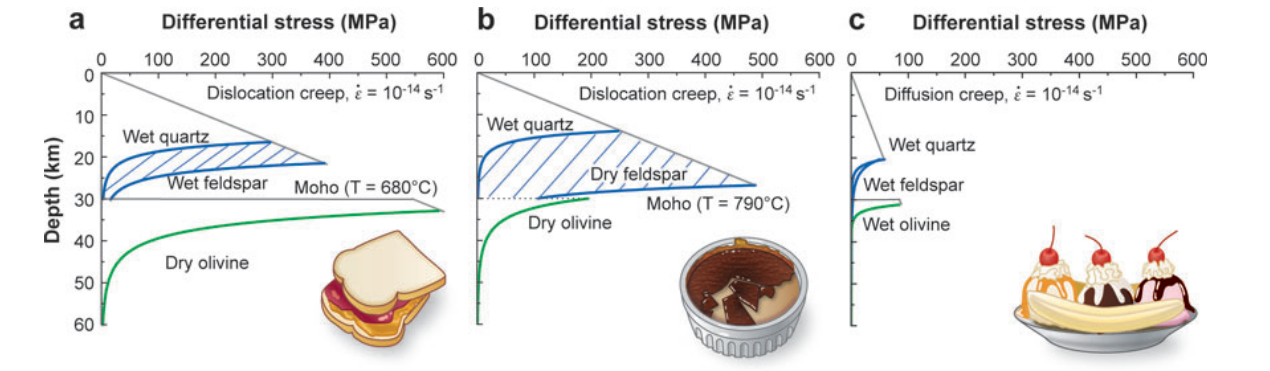
Figure 1: Models of strength through continental lithosphere (also known as
Christmas tree diagrams). In the upper crust, frictional strength increases
with pressure and depth. From Burgmann and Dresen, 2008.
Dissolution-precipitation creep tends to dominate at the shallower parts of the subduction interface, while dislocation creep takes over at higher depths. Concurrently, locally frictional processes and high pore fluid pressures are deduced by the presence of sealed cracks. Frictional and viscous shearing are competing mechanisms responsible for coupling and de-coupling of the interface. From ample field observations, it is evident that the subduction interface is far from homogeneous (e.g., Vannucchi et al., 2008; Fagereng and Sibson, 2010; Grigull et al., 2012, Angiboust et al., 2015; Behr, et al., 2018; Kotowski and Behr, 2019). This heterogeneity implies deformation within the interface at different strain rates and, therefore, some of its components might show frictional behaviour, while others may deform viscously.
Although the previously mentioned flow laws account for one type of deformation mechanism being active at a time, more than one mechanisms can be active simultaneously in a rock. The rheology of an aggregate is, therefore, dependent on the collective deformation of the constituent minerals (Handy, 1990; Platt, 2015).
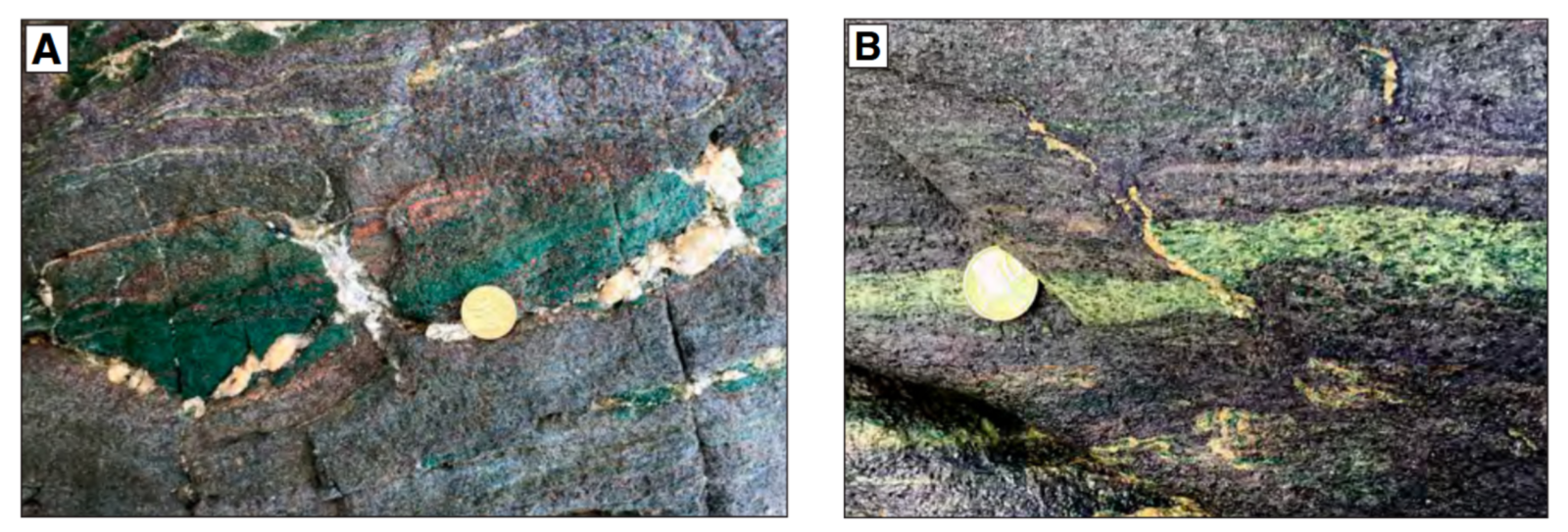
Figure 2: A: Eclogite boudin showing dilational veins at both high and low
angles to the foliation. B: Thrust-sense dilational shear fracture filled with
quartz offsetting an omphacite-rich band and merging into viscous shear in
surrounding blueschist. From Behr et al., 2018.
How do we model such complexity (and beauty)?
It’s all about the rheology! To describe the relation between the stress exerted on a material and the strain rate at which it deforms, flow laws of the following form have been invoked from experimental studies:

where ε is the strain rate, A a material constant, σ the stress, n the stress exponent, d the grain size in μm, m the grain size exponent, f is the water fugacity (this term has been explained to me about a million times, and I swear I still have no idea what it really is), r the fugacity exponent (see previous desperate parenthetical comment), Q the activation energy, p the applied pressure, V the activation volume, R the molar gas constant, and T the absolute temperature.
Flow law parameters are determined from deformation experiments under known conditions (pressure, temperature, strain rate, or stress); then, the microstructures are studied in order to assess which deformation mechanism controls the strain rate. The most commonly studied deformation mechanism that has been reproduced experimentally and is predominantly used in geodynamics models is dislocation creep. However, most field observations in active subduction shear zones point to pervasive pressure-solution creep.
Now it is time to make some executive decisions; otherwise it is very easy to go down the rabbit hole of infinite (oh, the drama!) subduction interface complexity. But don’t panic – pick the processes that are most relevant for your research and focus on them. I always find it useful to make a few Christmas tree diagrams with various flow laws that could describe my geological setting. Are there field observations in your area? If yes, what is the mechanism that accommodates most of the deformation, and at what depth do you see the frictional to viscous transition? If no field observations are available, are there exhumed rocks that are equivalent to your research in other parts of the world? Look at the rock record for inspiration!
…to be continued…
References:

Agard, P., Plunder, A., Angiboust, S., Bonnet, G., & Ruh, J. (2018). The subduction plate interface: Rock record and mechanical coupling (from long to short timescales). Lithos, 320–321, 537–566. https://doi.org/10.1016/j.lithos.2018.09.029

Angiboust, S., Kirsch, J., Oncken, O., Glodny, J., Monié, P., & Rybacki, E. (2015). Probing the transition between seismically coupled and decoupled segments along an ancient subduction interface. Geochemistry, Geophysics, Geosystems, 16(6), 1905–1922. https://doi.org/10.1002/2015GC005776

Bachmann, R., Glodny, J., Oncken, O., & Seifert, W. (2009). Abandonment of the South Penninic-Austroalpine palaeosubduction zone, Central Alps, and shift from subduction erosion to accretion: Constraints from Rb/Sr geochronology. Journal of the Geological Society, London, 166(2), 217–231. https://doi.org/10.1144/0016-76492008-024

Bachmann, R., Oncken, O., Glodny, J., Seifert, W., Georgieva, V., & Sudo, M. (2009). Exposed plate interface in the European Alps reveals fabric styles and gradients related to an ancient seismogenic coupling zone. Journal of Geophysical Research: Solid Earth, 114(5), 1–23. https://doi.org/10.1029/2008JB005927

Behr WM, Bürgmann R. 2021. What’s down there? The structures, materials and environment of deep-seated slow slip and tremor. Phil. Trans. R. Soc. A 379: 20200218. https://doi.org/10.1098/rsta.2020.0218

Behr, W. M., Kotowski, A. J., & Ashley, K. T. (2018). Dehydration-induced rheological heterogeneity and the deep tremor source in warm subduction zones. Geology, 46(5), 475–478. https://doi.org/10.1130/G40105.1

Burgmann, R., & Dresen, G. (2008). Rheology of the Lower Crust and Upper Mantle: Evidence from Rock Mechanics, Geodesy, and Field Observations. Annual Review of Earth and Planetary Sciences, 36(1), 531–567. https://doi.org/10.1146/annurev.earth.36.031207.124326

Duarte, J. C., Schellart, W. P., & Cruden, A. R. (2015). How weak is the subduction zone interface? Geophysical Research Letters, 42(8), 2664–2673. https://doi.org/10.1002/2014GL062876

Fagereng, Å., & Sibson, R. H. (2010). Mélange rheology and seismic style. Geology, 38(8), 751–754. https://doi.org/10.1130/G30868.1

Froitzheim, N., & Manatschal, G. (1996). Kinematics of Jurassic rifting, mantle exhumation, and passive-margin formation in the Austroalpine and Penninic nappes (eastern Switzerland). Geological Society of America Bulletin, 108(9), 1120–1133. https://doi.org/10.1130/0016-7606(1996)108\%253C1120:KOJRME\%253E2.3.CO;2

Grigull, S., Krohe, A., Moos, C., Wassmann, S., & Stockhert, B. (2012). “Order from chaos”: A field-based estimate on bulk rheology of tectonic mélanges formed in subduction zones. Tectonophysics, 568–569, 86–101. https://doi.org/10.1016/j.tecto.2011.11.004

Hacker, B. R., Abers, G. A., & Peacock, S. M. (2003). Subduction factory 1. Theoretical mineralogy, densities, seismic wave speeds, and H 2 O contents. Journal of Geophysical Research: Solid Earth, 108(B1), 1–26. https://doi.org/10.1029/2001jb001127

Hacker, B. R., Peacock, S. M., Abers, G. A., & Holloway, S. D. (2003). Subduction factory 2. Are intermediate-depth earthquakes in subducting slabs linked to metamorphic dehydration reactions? Journal of Geophysical Research: Solid Earth, 108(B1). https://doi.org/10.1029/2001jb001129

Handy, M. R. (1990). The Solid-State Flow of Polymineralic Rocks. Journal of Geophysical Research, 95(B6), 8647–8661.

Kotowski, A. J., & Behr, W. M. (2019). Length scales and types of heterogeneities along the deep subduction interface: Insights from exhumed rocks on Syros Island, Greece. Geosphere, 15(4), 1038–1065. https://doi.org/10.1130/GES02037.1

Platt, J. P. (2015). Rheology of two-phase systems: A microphysical and observational approach. Journal of Structural Geology, 77, 213–227. https://doi.org/10.1016/j.jsg.2015.05.003

Stern, R. J. (2002). Subduction zones. Reviews of Geophysics, 40(4), 1395–1406. https://doi.org/10.1029/2001RG000108

Vannucchi, P., Remitti, F., & Bettelli, G. (2008). Geological record of fluid flow and seismogenesis along an erosive subducting plate boundary. Nature, 451(7179), 699–703. https://doi.org/10.1038/nature06486

Wassmann, S., & Stockhert, B. (2012). Matrix deformation mechanisms in HP-LT tectonic mélanges—Microstructural record of jadeite blueschist from the Franciscan Complex, California. Tectonophysics, 568–569, 135–153. https://doi.org/10.1016/j.tecto.2012.01.009