Seismic waves tell us that something unusual is happening in the lowermost few hundred kilometers of Earth’s mantle. Beneath Africa and the Pacific lie two enormous thermochemical structures known as Large Low-Shear-Velocity Provinces (LLSVPs). These “large blobs” are slower to transmit shear waves, but beyond that, their physical nature remains one of the biggest open questions in deep Earth geodynamics. In this week’s blog, Poulami Roy, postdoc at Durham University (UK), takes us through how these LLSVPs can be numerically simulated.
Although first identified in tomographic images of the mantle over 30 years ago (Dziewonski and Anderson, 1984), many questions still sorround the nature of the LLSVPs. Are they denser than the surrounding mantle? Are they more viscous and mechanically strong? Or are they dynamic, deformable features shaped continuously by mantle flow?
Rethinking the nature of LLSVPs through geodynamic modelling

Poulami Roy is a postdoctoral researcher in the Department of Earth Sciences at Durham University, UK. Her work focuses on understanding Earth from today’s mantle to its earliest days, using numerical simulations. She enjoys connecting geodynamics, seismology, mineral physics, and geochemistry to better understand the processes shaping Earth’s interior. You can contact her via email poulami.roy@durham.ac.uk
Over the past decade, progress in regional shear-wave splitting measurements and global seismic radial anisotropic tomography models (Wolf et al 2024 and references therein) has revealed strong anisotropy near the edges of LLSVPs. This suggests intense deformation, possibly related to mantle flow being deflected around these structures or to plume generation along their margins. But translating seismic observations into quantitative physical properties requires geodynamic modeling.
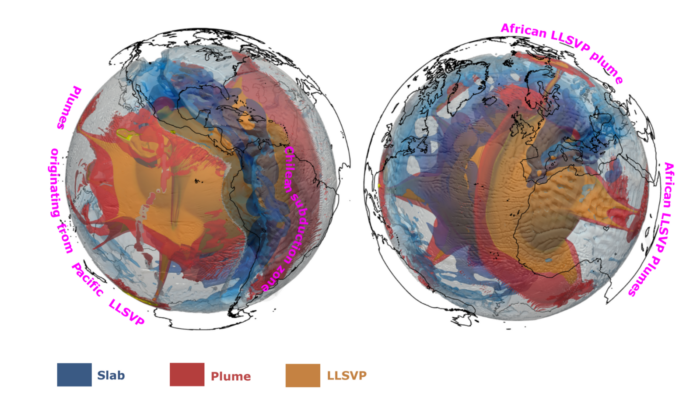
In our recent work (Roy et al. 2025, G-cubed), we combined global mantle convection simulations using ASPECT (Heister et al. 2017) with mantle fabric calculations from ECOMAN (Faccenda et al., 2024) (See our previous blog on modelling of the lower mantle). Importantly, we ran fully 3-D, high-resolution (11 km in the hot regions) compressible (i.e., taking into account the effect of pressure on density) global models that incorporate 250 million years of plate motion history since the breakup of Pangaea (Figure 1). Such simulations would have been computationally prohibitive only a few years ago.
By systematically varying density and viscosity contrasts and thermal properties, we tested how different physical scenarios influence deformation and which configuration would most closely re-create the observed seismic anisotropy. Our preferred model (Figure 2) suggests that LLSVPs are approximately 2% denser and up to 100 times more compositionally viscous than the surrounding mantle. This higher viscosity strengthens their margins, causing mantle flow to be vertically deflected along their edges; precisely where anisotropy accumulates and where plumes are often thought to originate (Roy et al. 2025 GRL, Roy 2024, Steinberger & Torsvik G-cubed 2012).
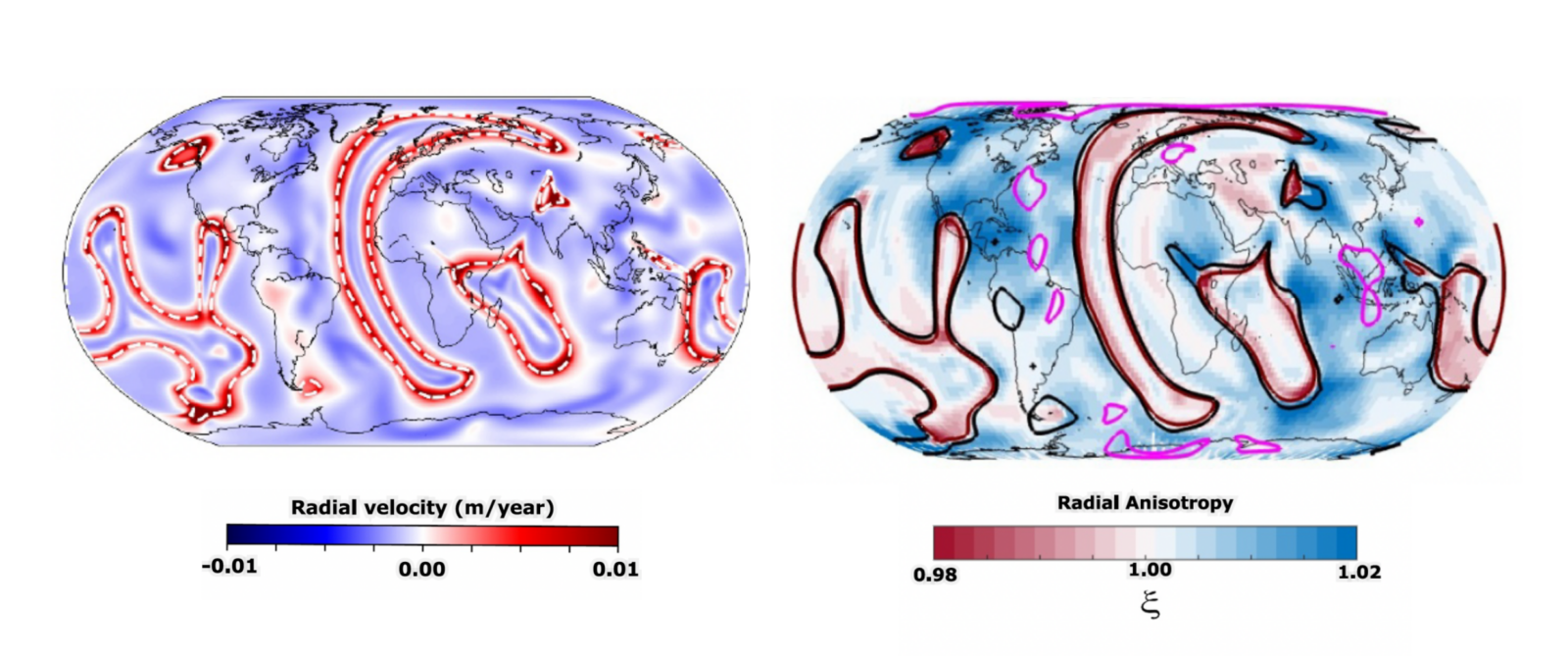
Figure 2: Left: Radial velocity at 2,800 km depth near the core–mantle boundary, with LLSVPs outlined by dashed white lines (compositional threshold ≥0.15). Right: Shear-wave radial anisotropy at 2,800 km depth. Dark red highlights LLSVPs (same threshold), while mantle plumes and subducting slabs are tracked by 350 K (black) and −100 K (magenta) nonadiabatic temperature isosurfaces (taken from Roy et al., 2025).
So how far are we in understanding the physical nature of these deep-mantle large blobs?
We are no longer limited to qualitative descriptions. With advances in high-performance computing and open-source geodynamic tools like ASPECT and mantle fabric calculators like ECOMAN, we can now simulate Earth’s mantle at global scale, over geological timescales, and directly link mineral-scale fabric development to seismic observables (Figure 2). While uncertainties remain, especially regarding composition and long-term stability, we are steadily narrowing the plausible range of physical properties.
In short, these “large blobs” at the core-mantle boundary are becoming less mysterious. Thanks to computational advances and interdisciplinary approaches that combine seismology, mineral physics, and geodynamics, we are moving from detecting them to quantifying them.
And that marks a significant step forward in understanding Earth’s deepest interior.
A final remark: From 2800 km to the surface – How do deep blobs shape shallower volcanic activity?
While the lowermost mantle holds the massive LLSVPs, their influence is felt far above, shaping mantle plumes that rise toward Earth’s surface. In our models, we can track plume-like upwellings at shallower depths, for instance around 440 km (Figure 3). These plumes often originate near the edges of LLSVPs and are dynamically deflected by their strong margins.
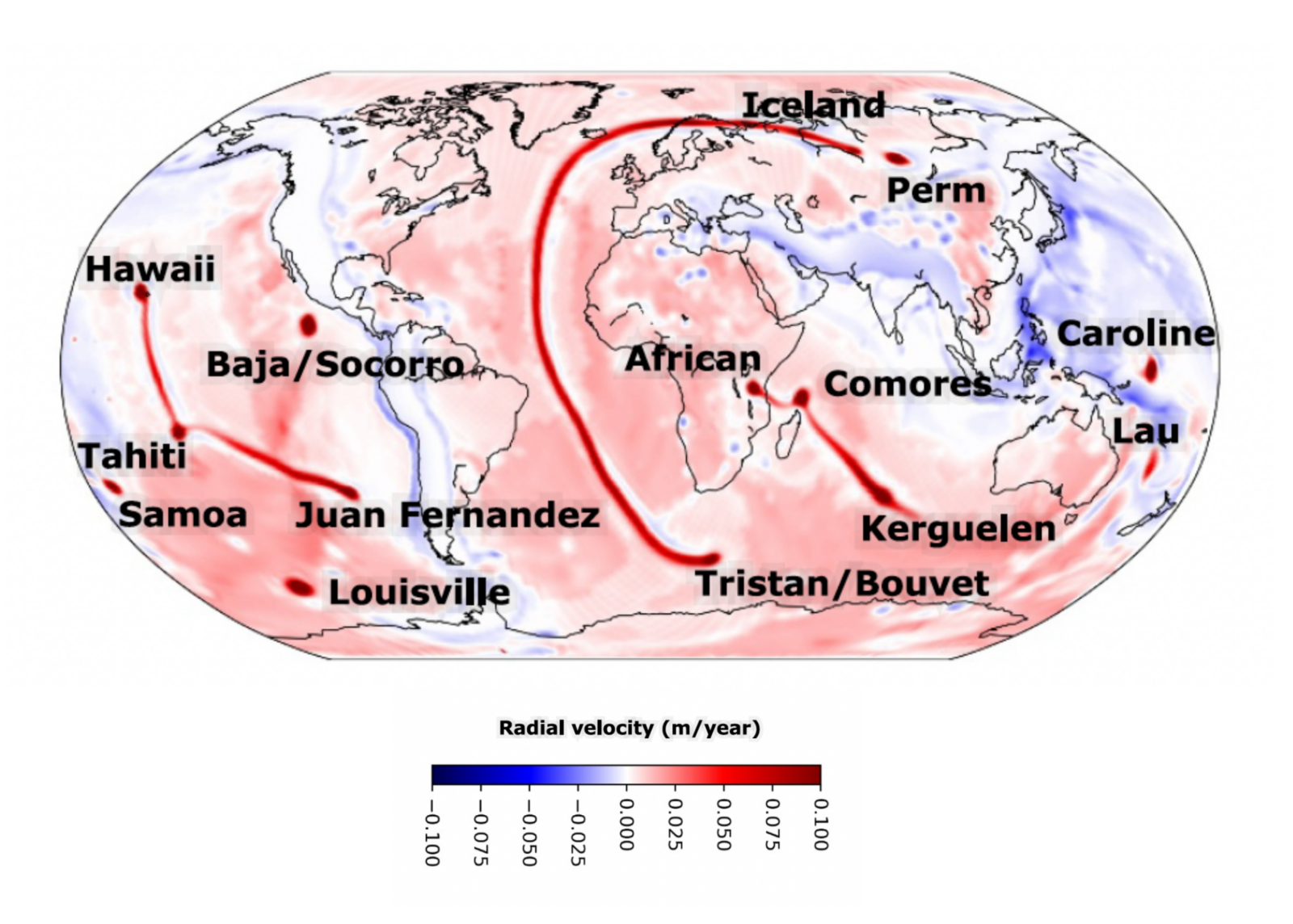
Figure 3: Radial velocity at 440 km depth, showing where mantle plumes rise. Plumes appear as concentrated, rounded upwellings at the tips of ridge-like structures, and we name them after the nearest surface hotspots (taken from Roy et al., 2025).
By following plumes from 2800 km at the base of the mantle to ~440 km depth, we can better understand how LLSVPs guide mantle flow, generate anisotropy, and seed surface hotspots. This multiscale perspective highlights the remarkable power of modern global models: we can simulate both deep-mantle deformation and shallow plume emergence within the same framework.
While we are beginning to quantify the physical nature of these deep-mantle giants, one fundamental question remains:
Are LLSVPs stable, long-lived anchors of mantle circulation ? or evolving structures that actively shape Earth’s volcanic future?
I’ll leave that question open for now, but surely it’s material for future exciting research!.
References

Dziewonski, A. M., & Anderson, D. L. (1984). Seismic Tomography of the Earth's Interior: The first three-dimenstional models of the earth's structure promise to answer some basic questions of geodynamics and signify a revolution in earth science. American Scientist, 72(5), 483-494.

Faccenda, M., VanderBeek, B. P., de Montserrat, A., Yang, J., Rappisi, F., & Ribe, N. (2024). ECOMAN: an open-source package for geodynamic and seismological modelling of mechanical anisotropy. Solid Earth, 15(10), 1241-1264.

Heister, T., Dannberg, J., Gassmöller, R., & Bangerth, W. (2017). High accuracy mantle convection simulation through modern numerical methods - II: Realistic models and problems. Geophysical Journal International, 210 (2), 833–851.

Roy, P., Steinberger, B., Faccenda, M., & Pons, M. (2025). Lowermost mantle flow at thermochemical piles constrained by shear wave anisotropy: Insights from combined geodynamic and mantle fabric simulations at global scale. Geochemistry, Geophysics, Geosystems, 26(10), e2025GC012510.

Roy, P., Steinberger, B., Faccenda, M., & Pons, M. (2025). Modeling anisotropic signature of slab‐induced mantle plumes from thermochemical piles in the lowermost mantle. Geophysical Research Letters, 52(10), e2024GL113299.

Roy, P. (2024). Lower mantle anisotropy due to plume generation from Large Low-Shear-Velocity Provinces (Doctoral dissertation, Universität Potsdam Potsdam).

Steinberger, B., & Torsvik, T. H. (2012). A geodynamic model of plumes from the margins of Large Low Shear Velocity Provinces. Geochemistry, Geophysics, Geosystems, 13(1).

Wolf, J., Li, M., Long, M. D., & Garnero, E. (2024). Advances in mapping lowermost mantle convective flow with seismic anisotropy observations. Reviews of Geophysics, 62(2), e2023RG000833.