
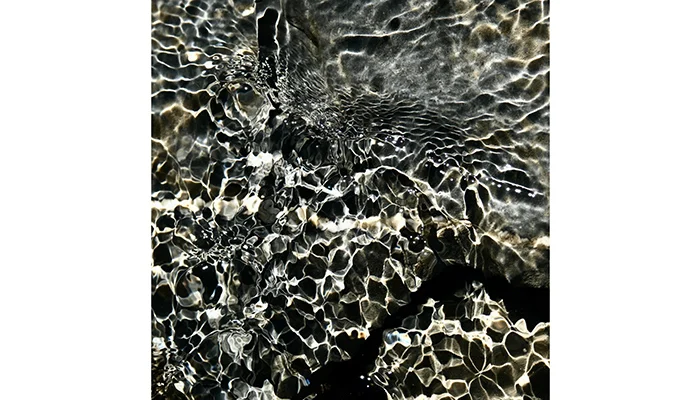
About a decade ago, I formally retired from Lancaster University (albeit retaining an emeritus position and still producing the occasional paper). In that time, I have been able to pursue my interests in the history of hydrology but also devote more time to my other passion which is landscape photography, especially images of water. As a hydrologist, I do understand that to spend my spare time photographing water is definitely on the rather sad side of social behaviour but, on the other hand, some of the results are quite nice (and it is not the only photographic project I have followed – more can be found at the www.mallerstangmagic.co.uk site including series of books of Boring Postcards, Visual Haiku, and the Mallerstang Valley).
The Depiction of Water in Art
Artists have, of course, long been interested in water as a subject, one of the most famous documented examples being the drawings of the nature of turbulence in the sketchbooks of Leonardo da Vinci. He was one of the first people to study the dynamics of flowing water in detail (he even prepared, but never published, a Treatise on Water), though it has been suggested that his interest was driven as much by an interest in how to make practical use of the power of water, how to improve canal design, and how to protect people against devastating floods, than in the artistic potential.
One of the reasons for that artistic interest is surely that water flows are dynamic, changing constantly in response to the changing hydrology and boundary conditions, including the effect of roughness elements and wind. The water will have varying degrees of transparency depending on water quality and sediment loads. Flowing water produces complex and changing patterns of light due to reflection and refraction with skypools, landpools and caustics. The result is that the artistic representation of water is a huge challenge.
Actually, however, the situation is not that much better for the scientist. We do have a really beautiful representation of the dynamics of water in the 3 dimensional Navier-Stokes equations. The problem is that we cannot solve those equations in most applications of practical interest because of the uncertainties associated with the knowledge of the relevant boundary conditions (and also, still today, the sheer computer power needed to produce numerical solutions at useful scales). Another problem for the hydrologist is that a lot of the water flows that are of interest take place under the ground surface where it is very difficult to study exactly what is going on, except in small samples. We often resort to inferring what is going on from larger scale flow and tracer observations.
Some of the artistic difficulties of representing water are discussed in an interesting book by David Clarke (Water and Art, 2010). He suggests that one of the first and most influential treatments of water was by JWM Turner, in part because of his skill in using the medium of watercolour to represent effects of light and water in the outdoors, with a view to representing the sublime (as originally defined by Edmund Burke in the 1750s). Water was an essential part of the sublime – the sound and fury of mountain torrents and the dramatic presence of glaciers adding to the atmosphere as the Grand Tourists passed through the Alps[BS2] . Many of J.M.W. Turner’s most famous large-scale watercolours are of waterfalls in Switzerland he had encountered on his travels. David Clarke also suggests that it was the dissolution of the subject matter in his watercolours (which Turner also carried over into his later oil paintings), using water as a medium to represent water as the subject, that started the path towards a more abstract art, particularly in the water-related art of Monet, Mondrian, Kandinsky, Pollock, De Kooning and Frankenthaler. He suggests that these artists (and others of course) had been all influenced by living close to and interacting visually with, water on a daily basis.
The Challenge of Water in Photography
With the invention of photography, the representation of water has become somewhat easier. Water has been a subject for images made since the very earliest days of photography, even more so once exposure times became short enough to be able to capture waves (e.g.Gustav Le Gray’s images of the sea in the 1880s). Photography has been used extensively in experimental laboratory studies in hydraulics. There are whole books devoted to photographic studies and surveys of water images, and we have now become used to pictures of blurred waterfalls, autumn colours reflected in rivers and lakes and, since the work of Hiroshi Sugimoto and Michael Kenna, of minimalist water stilled by the use of long exposures to emphasise the nature of the light. The challenge now, as with so many aspects of photography is trying to avoid cliché (but there are some striking examples of doing so, see, for example, the River Taw work of Susan Derges, the Atlantic and Scottish Rivers work of Thomas Joshua Cooper, the Thames Studies of Roni Horn, and the early Sea Horizon work of Garry Fabian Miller).
Water moves; it (mostly) flows downhill. In doing so it organises and shapes itself into different forms that are dynamic while also retaining recognisable forms of waves and ripples and curves. The light and the additional dimension of the sound of flowing water would seem to make the recording of these sensations the realm of video and not the still image. Yet video seems to result in a less than satisfactory imitation of the real thing. It has movement, it has sound, but it is, in some sense, evidently false in being flattened to two dimensions.
A still image is also evidently false but somehow those discrete moments of time of the stilled dynamics seem to work quite well. The water is in stasis and no longer flows but the possibility of taking some time to explore the nature of the stilled flow is still somehow satisfying as well as providing wonderful abstract images in their own right. There is something about the nature of the flow being closed in its balance of forces and boundary conditions that produces the intricate self-organised forms and imperfections to provide an image both true to the flow and attractive to the viewer. Yet the underlying ambiguities of a still image of the dynamic reality remain.
Water and a Photographic Practice
In making photographic images of water that I have wanted to show the life and intrinsic beauty of the flow in a realistic way, while recognising the approximate way in which we can represent the dynamics. How has this been done? The compositional possibilities are endless but by trying to capture images that “feel right” – which is clearly a more artistic concept. Uncertainty also plays a role – I find some of the most satisfying images are those that require the viewer to make some effort to understand.
Regarding Flowing Waters is the third book of water images I have published under the imprint of the Mallerstang Magic Press, after The Still Dynamic in 2021 and Panta Rhei – Everything Flows in 2022 (in homage to the IAHS Panta Rhei programme). The images include images taken in a number of bisses in the Canton of Valais in Switzerland: small, man-made channels built to bring water from reliable springs and glaciers to where it was needed for water supply and irrigation of pastures and crops. The bisses are quite variable in size, slope and construction but all represent an enormous effort by both the men and women of the communes involved to both create and maintain them over long periods of time. Some were suspended on the sides of cliffs, others involved tunnelling through rock faces. Some, such as the Bisse de Sion, are still in active use. They offer many opportunities for intimate landscapes of the water within them.
I remain fascinated by the science that lies behind the forms that produce an attractive image of a water flow, but I hope that the images can be appreciated for themselves: simple attempts to capture the essence of different types of flow. Regarding Flowing Waters is published in a limited edition of 100 copies and is available through the shop on the www.mallerstangmagic.co.uk site (or, to keep postage costs down for those of you in Switzerland, contact me directly at k.beven@bluewin.ch).
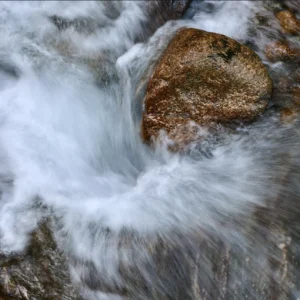
Bisse de Petit Ruisseau, Valais, Switzerland
Related posts:
https://blogs.egu.eu/divisions/hs/tag/history-of-hydrology/
Edited by B. Schaefli