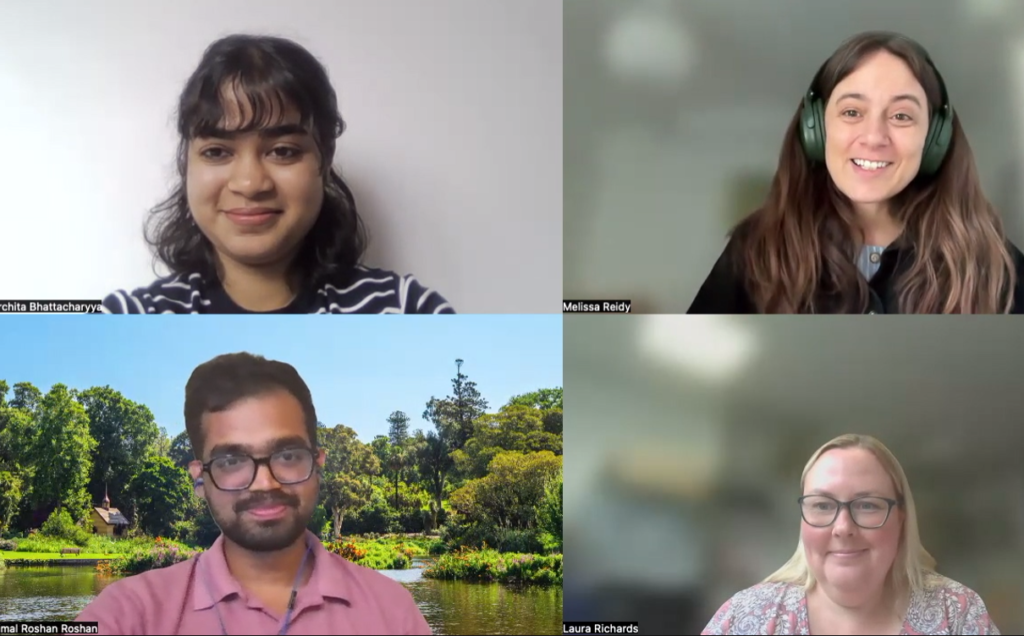
For this month’s episode of HydroTalks, we’re thrilled to welcome Prof. Laura Richards and Ajmal Roshan. Laura is a UKRI Future Leaders Fellow and Professor of Water Resources and Environmental Geochemistry at the University of Manchester. Laura is also the project lead of the AQUAROAD Programme on groundwater quality in the Global South. Ajmal is a Cookson Awardee PhD scholar, and he’s working within Laura’s group as a joint PhD student between the University of Manchester and University of Melbourne.
You can check out the full episode here read the interview summary in this blog!
To kick off, can you quickly tell us about your current research focus?
Laura: My work sits between environmental engineering and environmental geochemistry. I study how contaminants move through groundwater, how human activities affect water quality, and how we can choose better remediation strategies. A lot of my research is field-based, and I’ve had the opportunity to work extensively in South and Southeast Asia, East Africa, and South America.
Ajmal: I work on groundwater arsenic contamination in Bihar, India. My research focuses on improving water security by identifying and managing suitable arsenic remediation options.
What pollutants of concern do you find in the aquifers of the Gangetic Plain?
Ajmal: The Gangetic Plain is quite densely populated. And the groundwater can be contaminated with different geogenic contaminants such as arsenic, fluoride, uranium, and manganese and sometimes microbial contamination. Since many households in Bihar rely on groundwater for drinking, contamination can becomes a public health issue. Since contaminants like arsenic are colourless and odourless, many residents are consuming it without knowing.
Laura: We also find anthropogenic contaminants from human activities, including pharmaceuticals, fertilisers, industrial chemicals, and personal care products. In Patna, one commonly detected emerging contaminant was sucralose, an artificial sweetener. Many of these chemicals still lack guideline values, so their risks are not always clear.
Why is arsenic contamination such a concern?
Laura: Arsenic is naturally present in some aquifer sediments and can be released into groundwater under reducing conditions, often through the breakdown of iron and manganese minerals. It is dangerous because chronic exposure can lead to numerous health effects, and awareness can be low because people cannot see, smell, or taste it in water. Estimates suggest that about 220 million people worldwide are potentially exposed to high concentrations of arsenic in groundwater, and around 94% of them are in Asia. A statewide survey as part of our Far-Ganga project, showed that in Bihar alone, 16% of the samples had elevated Arsenic.
Ajmal: Arsenic is highly variable, even over short distances. Two wells only a few hundred metres apart can have very different arsenic levels, even if they are similar depths. Local geology and redox conditions play a major role.
Do you see any promising arsenic remediation technologies?
Ajmal: In our recent paper we explored different technologies. Filter-based, sorption-based, membrane-based options can be capable, but there is no gold-standard across different regions. The best option depends on effectiveness, local conditions, cost, maintenance needs, material availability, and whether the community is willing to use it.
Do you anticipate that increasing floods and droughts due to climate change can have a cascade effect on arsenic pollution?
Laura: Possibly. Arsenic release is linked to microbial activity, iron minerals, and organic carbon, all of which may respond to changing flood and drought patterns. However, the links are complex and highly redox-sensitive. In our research in Cambodia, we have seen seasonal changes in redox conditions, organic matter and microbes, but not strong seasonal changes in arsenic. So, spatial and depth controls may be more important than seasonal patterns. But it’s a really important area for future research.
How are you using AI and citizen science to tackle water quality issues?
Laura: Citizen science can support both data collection and public engagement. In Bihar, around 600 students helped collect groundwater samples, which greatly expanded the scale of sampling. It also helped raise awareness and show young people different pathways into STEM.
Ajmal: AI tools need good data. In many low- and middle-income regions, groundwater data are limited or uneven. Citizen science can help generate better datasets, which may later support AI-based decision tools.
What is the aim of AQUAROAD?
Laura: AQUAROAD aims to develop a roadmap for better groundwater quality management in the Global South. We are starting with Bihar and Uganda as contrasting case studies. The project brings together experts in groundwater science, remediation, decision science, social science, machine learning, and modelling. This breadth of expertise is needed to tackle some pressing issues, and trans-disciplinary global challenges.
What are the biggest breakthroughs in the past 10 years and what are the biggest trends in upcoming years?
Laura: Over the past decade, water research has increasingly moved beyond disciplinary and sectoral silos. Future progress will depend on connecting groundwater, surface water, engineering, and social science perspectives, while using tools like AI responsibly to address complex water and climate challenges.
Finally, what is the career advice that you’ve received and want to share with early-career scientists?
Laura: Do not let naysayers define what you can do. Embrace opportunities, be persistent, and find the path that works for your own priorities and values.
Ajmal: Be flexible. Research and career paths do not always go as planned, so it helps to have a broad blueprint rather than a rigid plan.
Check out the full episode here.