GD
Geodynamics

ASPECT

What’s blobbing inside the Earth? – insights from numerical modelling
What’s blobbing inside the Earth? – insights from numerical modelling

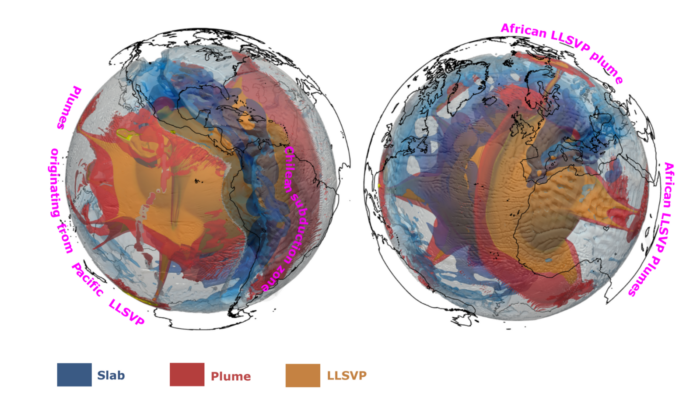
Seismic waves tell us that something unusual is happening in the lowermost few hundred kilometers of Earth’s mantle. Beneath Africa and the Pacific lie two enormous thermochemical structures known as Large Low-Shear-Velocity Provinces (LLSVPs). These “large blobs” are slower to transmit shear waves, but beyond that, their physical nature remains one of the biggest open questions in deep Earth geod ...[Read More]

From Mountains to Oceans: How the memory of ancient orogens guides the rupture of continents

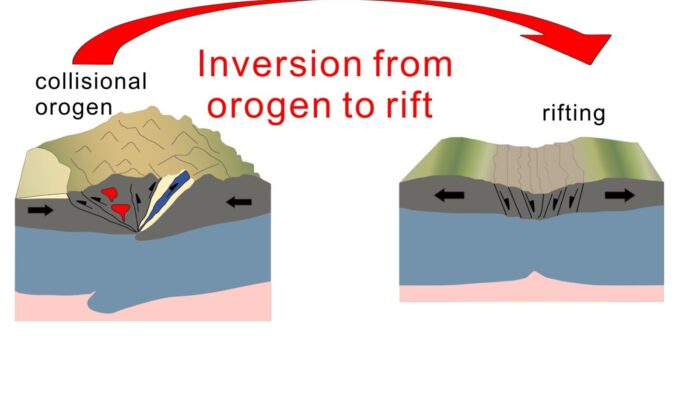
Picture showing an orogen that transform in a rift

In this new blog, Dr. Kai Li (GFZ Potsdam) talk about his PhD work, where he used accordion numerical models to explore the tectonic history of the South China Sea. His PhD research focuses on the impact of orogenic inheritance on rifts and rifted margins, employing advanced geodynamic modeling techniques. Have you ever tried to fit the west coast of Africa and the east coast of South America toge ...[Read More]

Phase transitions control plume layering during Earth’s secular cooling

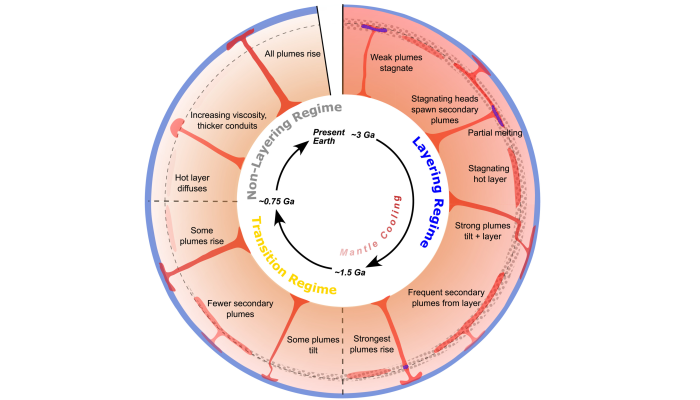
Phase transitions control plume layering during Earth’s secular cooling

  Earth’s structure and dynamics have evolved quite a lot since its formation, and so has mantle dynamics and convection patterns changed along with it. It turns out that phase transition in certain mantle minerals can be an important driver of this change. Today, Ranpeng Li from GEOMAR Helmholtz Centre for Ocean Research Kiel, Germany explains how coupling geodynamic models with thermodynami ...[Read More]

New Insights into Plume Buoyancy Fluxes and Dynamic Topography from Numerical Modelling

New Insights into Plume Buoyancy Fluxes and Dynamic Topography from Numerical Modelling

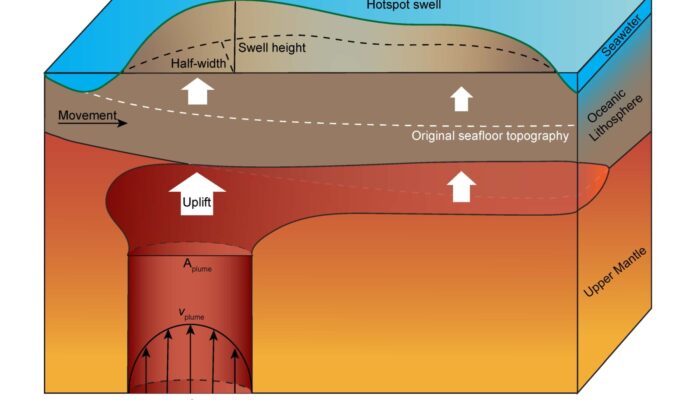
Figure 1. Illustration of the hotspot swell and plume buoyancy flux. White dashed line shows the original seafloor topography due to half-space cooling. Dark green line represents the surface dynamic topography caused by the dynamic uplift of the plume. One of the main surface expressions of dynamic topography are hotpot swells formed by mantle plumes. In this week’s post, Ziqi Ma, PhD candi ...[Read More]