
The huge amount of data produced in Geosciences is increasing exponentially, and numerical modelling has become a key tool for understanding tectonic evolution over time, which also increases the volume of data produced. Here, I, João Bueno (PhD student at University of São Paulo, Brazil) will present how a machine learning technique known as Self-Organising Maps can be used to understand the int ...[Read More]
Mathematical closed-form solutions in Geodynamics: insightful or detrimental?
Mathematics is certainly not every scientist’s cup of tea. Despite the latter, they are, for the most part, very important, since most problems, regardless of their complexity, start and end with a mathematical equation (or set of equations). In this week’s blog, Dimitrios Papadomarkakis (student at the National Technical University of Athens), discusses the subject of closed-form (analytical) sol ...[Read More]
Cratons: building blocks of continents and their economic importance
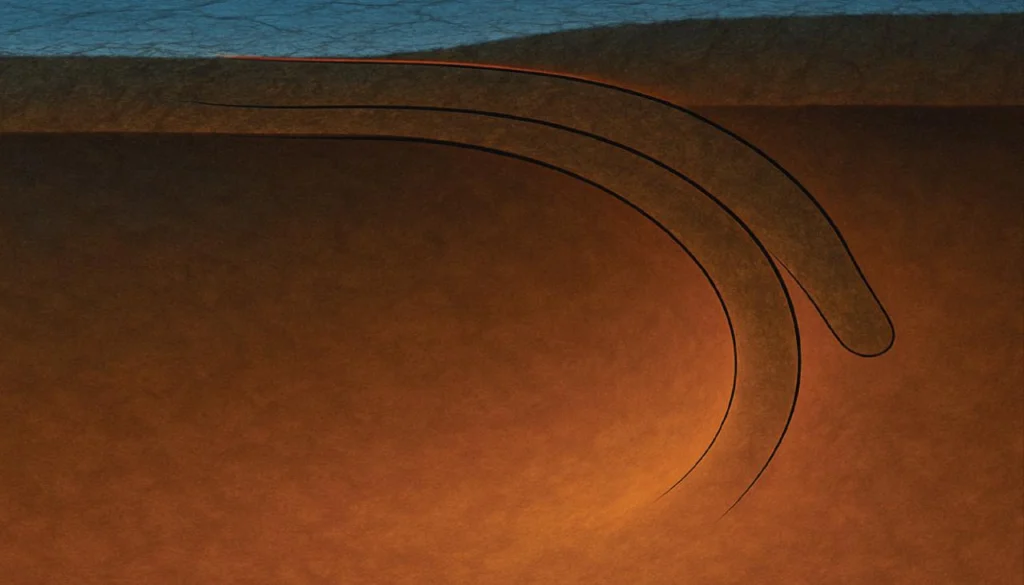
The 4.5 billion years of geologic evolution has shaped the tectonic processes in Earth we see today. Over the span of time, Earth has changed from being a magma ocean to a tectonically active planet, by transitioning through different tectonic regimes. A silent witness of this journey have been cratons which have survived for billions of years. Therefore cratons preserve clues of past tectonic pr ...[Read More]
The hidden effects of academic excellence: workaholism in Academia
Years have passed since I started my academic career, and I have come to realise that, in academia, excellence appears to come with a price tag. Stress and pressure have become commonplace for academics, often normalising certain behaviours such as workaholism. This essay explores how workaholism have become a common practice in these working environments. It was late, the library lights were blin ...[Read More]