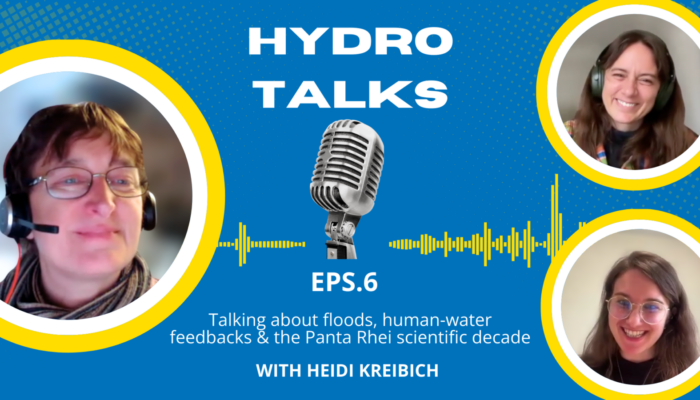
For this month’s episode of HydroTalks, we’re thrilled to welcome Heidi Kreibich. She is head of the Section Hydrology at GFZ Helmholtz Centre for Geosciences and senior lecturer at the Geography Department of Humboldt-Universitat zu Berlin. Heidi is also president of the Natural Hazards division of the EGU and president of the International Commission on Human-Water Feedbacks in the IAHS. In addition, Heidi was chair of the Panta Rhei Scientific Decade during the last biennium of 2021-2023.
You can check out the podcast below, or read the interview summary in this blog!
Click here for the full episode
To kick off, can you quickly tell us about your current research focus?
As a bit of background, I’m an environmental engineer by education. My research is focused on understanding, modeling, and mitigating flood damage processes with a focus on residential buildings and companies.
A main innovation of my research is the collection of empirical data on flood damage processes and vulnerability, as well as analyzing this empirical data with machine learning and probabilistic approaches, especially Bayesian statistics and Bayesian networks.
We started with this collection of empirical data in 2002 already and have developed a unique database – which is called HOWAS 21 – focusing on object-specific flood damage data. I also use this empirical data to identify what motivates both private people and companies to undertake precautionary measures. And I use the data to quantify the damage-reducing potential of these measures, also in combination with structural measures, so in the context of integrated flood risk management.
Can you tell us about one flood event that played an important role in your career, and what it taught beyond the technical aspects?
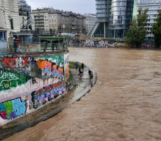
One important event was at the beginning of my studies – the extreme floods that affected the Elbe and Danube regions in 2002. This was a quite unprecedented event at the time and it was when I first started to collect empirical flood damage data.
This was not long after the reunification of Germany and particularly in the Elbe catchment, no really severe or damaging flood had occurred since the 1950s. As a result, not only the affected people, but also the officials in the administration were not well prepared.
We could even quantify this effect. In 2013 another event also affected these two catchments, which was even more severe in hydrological terms. However, because of the measures that had been implemented since the 2002 flood, it only had about half the economic consequences. So this really shows what integrated flood risk management is able to achieve and how strongly these human interventions can mitigate flood damage.
All of this shows how society and hydrology are intertwined. Over the past decade, the field of sociohydrology has emerged to study interactions between the two domains. Can you tell us about how you see its evolution and its future?
I think the main innovation was that the community conceptualized and provided models and approaches for assessing the co-evolution of human water systems and looking at these long-term developments. This has also made it possible to identify unintended consequences of human interventions, such as the levee effect.
Going forward, I think it is quite important that this social hydrological knowledge is increasingly integrated into flood risk management.
Talking about IAHS scientific decades, you were one of the leaders of the previous one – Panta Rhei. Can you tell us a little more about it?
The overall aim of these scientific decades is the coordination of efforts in order to accelerate research progress on a specific hydrological problem. So far we have had three such scientific decades.
The first one was PUB, focused on the predictions in ungauged basins, which ran from 2003 to 2012. Then the Panta Rhei decade followed – Everything Flows, Change in Hydrology and Society – from 2013 until 2022. And then now we are currently in the decade of HELPING, Hydrologists Engaging Local People IN one Global world.
During the Panta Rhei decade, more than 30 international working groups formed on specific topics, all related to change in hydrology and society. It is really a large international and inclusive initiative where more than 1,000 scientists and practitioners were involved.
What have been the main outcomes of Panta Rhei?
From my personal perspective, there are three key products from this decade, which by themselves are providing a synthesis of all the various different results which came out of this initiative.
The first one is the Panta Rhei benchmark data set, which provides hydrological data of paired events of floods and droughts. This is an open access data set, also associated with an open access data paper, which presents an initial analysis and suggests many more possibilities for how it can be used. There is also a first paper about this dataset which was published in Nature.
Then the second key product, I would say, is the Panta Rhei synthesis paper, which was published in the Hydrological Sciences Journal.
And then finally, the most comprehensive synthesis of the decade is the Panta Rhei book, which has just been published under the title Co-evolution and Prediction of Coupled Human Water Systems. And this is fortunately also available open access.
Can you give us a few highlights of the Panta Rhei book and how it might be used?
This book brings together the contributions of 160 authors, so it was really a community effort bringing together natural and social scientists as well as practitioners.
It provides a holistic social-hydrological framework and it also has several chapters describing the theories and methods which were developed during the Panta Rhei decade. There is also a chapter on data, which I think is quite important because of the large focus on qualitative and social sciences data during the decade. Furthermore, there are deep-dives into major human water systems like human flood systems and transboundary rivers as well as detailed descriptions of worldwide case studies. The book concludes with a grand synthesis and future vision for sciences and practice in the field of social hydrology and the co-evolution of human water systems.
As for the target audience, the book was developed in such a way that it can be used for education and teaching and by people who are just starting to work in this domain. Our vision is that lecturers from various disciplines are using it for their classes and teaching activities so that it hopefully will be used a lot.
Finally, can you share some advice for Early Career Scientists that you’ve found particularly useful yourself?
I would say, don’t work on trending topics but focus on what you are really interested in. I believe that you can only truly be excellent if you’re passionate about what you work on.
Also, celebrate your achievements. As scientists, we often face rejections and disappointments – papers that get rejected or funding we don’t get. So it’s important to celebrate even small successes.
And finally, make friends in your community. I think it’s enjoyable, it’s what keeps you going, and it’s also very important for making a career in science.