HS
Hydrological Sciences

Bettina Schaefli

Bettina Schaefli is a professor for hydrology at University of Bern (Switzerland). She was the head of the Catchment Hydrology Subdivision of EGU from 2016-2019 and was editor of the Hydrology and Earth System Sciences journal (2008-2022). She has been the lead editor of the Hydrological Sciences division blog since 2018.

How to include AI methods in your next proposal
How to include AI methods in your next proposal
For all those of us who write research funding proposals, the massive avenue of powerful AI methods poses a serious challenge: how can we appropriately include such methods in our next research project? Is it mandatory, or can we happily focus on our field, lab or numerical methods that we used to always work with? For proposal evaluators, on the other hand, there is this feeling that many proposa ...[Read More]

Hydrology Highlights at EGU25: Your Pocket Guide!

Hydrology Highlights at EGU25: Your Pocket Guide!

The EGU General Assembly 2025 is just around the corner! It will take place on 27 April – 2 May 2025, with more than 19,000 presentations (orals, posters, and PICOs) that will be delivered and viewed both on-site in Vienna (Austria Center Vienna) and virtually (through Zoom & Gather Town). The Hydrological Sciences Division offers a myriad of interesting sessions, as well as networking e ...[Read More]

History of Hydrology@EGU2025 and beyond

History of Hydrology@EGU2025 and beyond

You are certainly aware of the continued efforts of a group of hydrologists, with the lead of Keith Beven, to shed light on the history of hydrology, including the History of Hydrology Wiki . Looking back to those who shaped our science, the questions they addressed and those that remain open is essential to understand the role of hydrology in earth system sciences, in the development of field res ...[Read More]

Mapping the Future of Freshwater: An Interview with Niko Wanders on the World Water Map Project

Mapping the Future of Freshwater: An Interview with Niko Wanders on the World Water Map Project

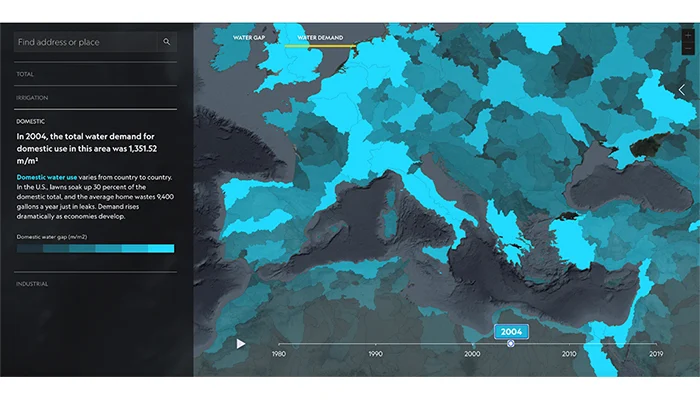
Back in 2022, two hydrologists and water resources specialists from University of Utrecht launched the World Water Map  in collaboration with the National Geographic Society and ESRI. Based on the outputs of their global hydrological model PCR-GLOBWB, the team of Marc Bierkens and Niko Wanders map global water resources and identify the regions most at risk of water scarcity. The maps combine stat ...[Read More]

Hortonian overland flow: when theory becomes reality

Hortonian overland flow: when theory becomes reality

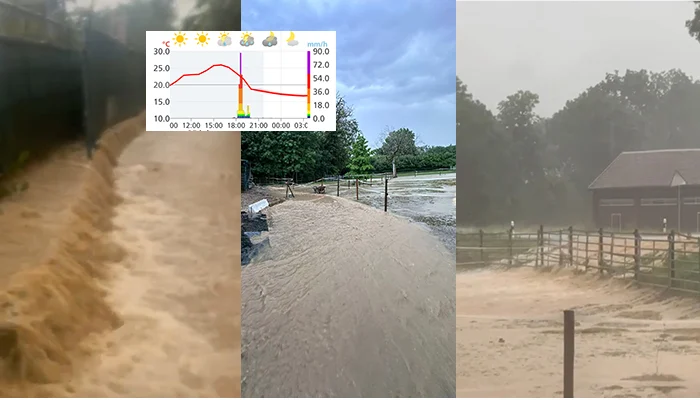
Hortonian overland flow – if you have ever followed a hydrology class, you have certainly come across this jargon:  this is the name of a hydrological process – when rainfall flows off at the terrain surface because the rainfall intensity is so high that not all the water can infiltrate into the soil (rainfall intensity is higher than infiltration capacity). Almost every hydrological m ...[Read More]

Call to participate to the public consultation for the Water4All-Partnership

Call to participate to the public consultation for the Water4All-Partnership

Those of you who are active in proposal writing might know the programme Water4All Partnership – Water Security for the Planet. It is a funding programme for scientific research in freshwater with the goal to address urgent water-related challenges. The programme is co-funded by the European Union within the frame of the Horizon Europe programme (lasting until 2027) and includes 90 partners ...[Read More]

EGU24 – A Hydrologist’s Look Back

EGU24 – A Hydrologist’s Look Back

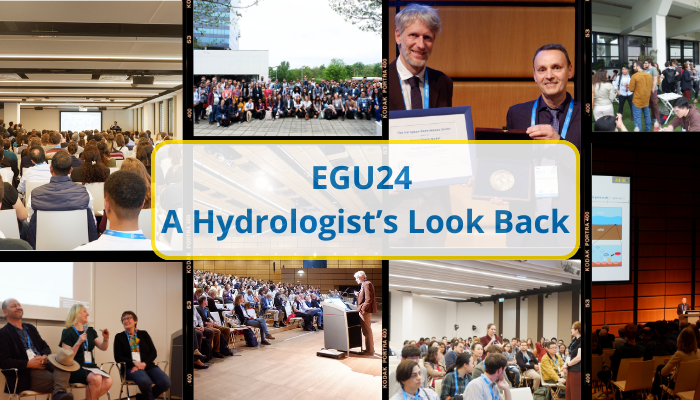
With almost 21,000 participants, the 2024 EGU General Assembly, held from 14-19 April, in Vienna and online, was the biggest one yet. For hydrologists, there were hundreds of sessions to enjoy, networking events to join, short courses to learn from, and colleagues to meet. Here’s a look back at the highlights! A look back at EGU24. Thanks to the video editing service Tasty Edits for the fantastic ...[Read More]

How has ChatGPT changed the way you teach hydrology?

How has ChatGPT changed the way you teach hydrology?

Have you ever used ChatGPT to teach hydrology? If so, when did you start? I opened my account on openai.com in November 2022, out of curiosity, to test GPT-3 (Generative Pretrained Transformer generation 3). This was shortly before ChatGPT was launched (30 November 2022). Now, I even have a paid account to speed up the preparation of non-scientific texts, e.g. teaching materials on the use of Exce ...[Read More]

Wrapping up EGU23: A Hydrologist’s Look Back

Wrapping up EGU23: A Hydrologist’s Look Back

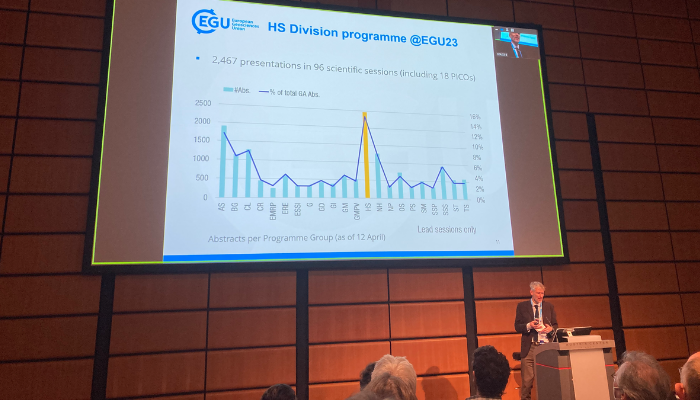
Summarising such a week is almost an impossible task. First, it is worth highlighting that, on-site, we were back to a format with oral presentations, PICOs, and posters. Virtual participants could join the oral sessions and the PICO pitches via Zoom. Virtual boards were also available for the online poster sessions and PICOs. The format of 10-min oral presentations (questions included) was a chal ...[Read More]

New spheres of scientific publishing

New spheres of scientific publishing

Many of you have noticed that EGUsphere went online, the new preprint repository hosted by EGU, as a service for the entire geosciences community. This repository can be used by any geoscientist to deposit their preprint even those that are not submitted to Copernicus journals. If you submit a preprint, your manuscript will receive a DOI number,  the EGUsphere logo and – most importantly – a discu ...[Read More]