HELPING and the co-creation of a working group
In 2023, the International Association of Hydrological Sciences (IAHS), inaugurated a new Scientific Decade, called HELPING – IAHS Science for Solutions decade, with Hydrology Engaging Local People IN one Global world. This third decade was established through a bottom-up process, by investigating the interests and the urgency of local hydrologists and scientists, leading to an outcome that envisioned creating solutions of local water problems by considering local data, methods and community values. Within this framework, there is the need to build on local knowledge, in “co-creation” approaches. But what does this mean, and how could it be defined for water resources management and hydrology?
Through the merging of multiple bottom-up proposals, we assembled a unique, large, group of researchers that wanted to take the step of dealing with this topic in an open and reflexive way, reconsidering the way we deal with hydrological problems and disrupting the traditional ways in which we conceive “water knowledge”. The IAHS WG on “Co-creating Water Knowledge” was born.
Why should hydrologists pay attention to co-creation?
Imagine you’re standing alongside a living dike in the Netherlands, pointing out enthusiastically how adding vegetation will slow erosion during storms and save money on concrete reinforcement. But the water board official looks sceptical, who will maintain these plants over winter? Will the current mowers even work on the new slope? Meanwhile, a local farmer interjects: for generations, sheep have grazed these dikes, keeping the grass short at no cost. Will these new plants poison their animals? Can they still use this land?
You feel overwhelmed. Your models were focused entirely on wave attenuation and root structure. You hadn’t thought about sheep or winter maintenance or the reality of 180 kilometres of dikes needing practical, affordable care.
But then you remember the participatory workshop where everyone mapped their on game boards, and together, you saw where goals overlapped: your erosion control, her grazing needs, his maintenance budget. The farmer knew about soils better than any of your textbooks: which areas stay waterlogged, where ground freezes deepest, which plants sheep won’t touch. This reshaped your entire design. The new three experimental sections that you built will test different approaches, integrating scientific models with operational realities and local practices. The farmer’s daughter monitors returning bird species for both her school project and your ecology data. A shellfish harvester from two dikes over suggested planting patterns based on traditional windbreaks, improving your predictions by 15%. Monthly feedback sessions mean you’re all figuring it out together—monitoring, learning, adapting. The dike will be more resilient not despite the complexity of multiple perspectives, but because of them. This is co-creation: weaving scientific expertise together with operational knowledge and local wisdom to create solutions that actually work in the real world.
This dialogue and transformation could take place in countless examples around the world where scientists, land users, traditional knowledge holders, officials, and everyone else come together around a water issue, and as climate change exacerbates and changes our water issues, this will undoubtedly need to happen more and more often and more and more urgently. The members of our group shared different experiences like this, and all feel the urgency to work together, trying to develop a common understanding, or at least a critical mass of knowledge, on co-creation.
A community perspective
As a first objective in 2024, we aimed to write a “baseline paper”, defining core co-creation concepts. Using a bottom-up approach, we invited all WG members (at that time) to contribute. The response exceeded all expectations.
We started developing our main points through brainstorming sessions, including one in person at EGU, then began writing. Our author group spanned from water science researchers to practitioners who employ diverse multi-, inter-, and transdisciplinary approaches and epistemological domains, including hydrology, geography, and social sciences. By bringing together varied experiences in knowledge co-creation, we articulated a common view and shared principles.
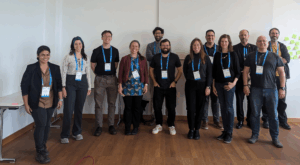
In person (Splinter) Meeting at EGU 2024
In our latest community perspective paper Co-creating water knowledge: a community perspective, we defined co-creation as “a collaborative process that is more focused on an iterative interaction leading to new knowledge – e.g., a new understanding of a problem – where collaboration is essential from the strategic or initial phases of the process”. This formulation serves as a starting point for a discussion rather than a definitive statement, yet aligns with theories developed by scholars like Elinor Ostrom, and Bruno Latour.
We defined four overarching principles for co-creation of water knowledge, namely: Inclusivity, Openness, Legitimacy and Actionability.
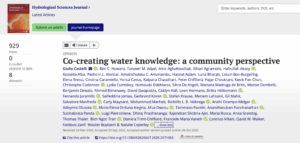
Co-creating water knowledge: a community perspective.
Our perspective paper that can be found at: Castelli, G., Howard, B. C., Adyel, T. M., AghaKouchak, A., Agramont, A., Aksoy, H., … Ceperley, N. (2025). Co-creating water knowledge: a community perspective. Hydrological Sciences Journal. https://doi.org/10.1080/02626667.2025.2571065
In Part 2 of this blogpost, we will discuss more on the achievements of our working group and our ongoing activities that you can be involved in.
Until then, stay tuned, comment below your opinion or questions about “co-creation of water knowledge” and keep the conversation going.
[The fictional case study scenario is based on Box 1 in the perspective paper. Story courtesy: Leon Hermans, Land and Water Management Department, IHE Delft.]