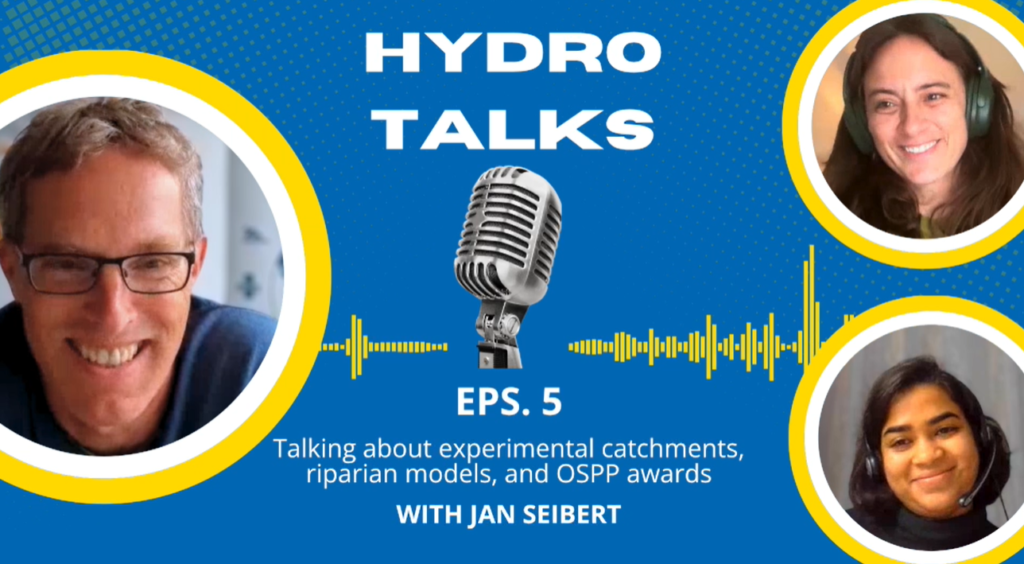
For this episode, we’re thrilled to welcome Prof. Jan Seibert, based at the Department of Geography, University of Zurich. His research focuses on hydrological modelling under landscape change, citizen science through the CrowdWater app, and large-scale modelling studies. He is also the Henry Darcy medal winner of 2025.
You can check out the podcast below, or read the interview summary in this blog!
Click here for the full episode of Hydrotalks.
What’s your current research focus?
In our group we do studies from experimental work at the plot-scale to modelling at the global scale. My main interests are the value of data in modelling and, related to that, large-sample hydrological modelling studies and citizen science in our project CrowdWater App.
Hydrological data and experimental catchments
Why is high-quality data so important for hydrological models?
They let us study real processes. Well-calibrated models aren’t just useful for current conditions, they help us study change, like climate impacts or extreme events. Large datasets from many experimental catchments make models robust. Without good data, we’re mostly testing how well models can compensate for gaps.
Why do we need experimental catchments?
We can study the ‘real’ processes at experimental catchments. At larger scales, local processes average out. We need long-term data in experimental catchments partly to observe processes as well as long-term trends, for example extreme weather events, which are most interesting. Unfortunately, it is getting more difficult to secure long-term funding to run the base-infrastructure.
Small and large-scale models
What differences do you observe between small catchments and large regional scales?
At smaller scales, we can look into differences in run-off generation in individual catchments. For instance, we expected Swedish and Swiss catchments to behave similarly because of snowmelt. Instead, Swedish sites showed deeper groundwater upwelling, while Swiss sites had shallow flow just 20–30 cm deep, even above unsaturated zones.
At larger scales, we look for patterns. But classifying catchments by runoff generation is ongoing work. Despite local differences, similarities exist. like isotope studies from the ’80s and ’90s showing groundwater’s key role in runoff, though its contribution varies widely between catchments.
How does your work on the Riparian Flow Concentration Integration Model (RIM) fit into the rapidly changing boreal landscape under changing climate?
Riparian zones are critical because water passes through them before entering streams. RIM explains flow path variations, while the DRIPS (Discrete Riparian Inflow Points) model captures horizontal riparian differences. Understanding these zones matters because climate change alters groundwater dynamics, flow paths, and solute chemistry.
Work-life balance and PhD supervision
You have supervised many PhD students, how has your supervision style changed over time?
My values are the same, but experience taught me that every student needs different support. My goal is always their best performance, but “best” looks different for each person.
How have you maintained a work life balance in your career?
I do not like the term work-life balance so much as this implies that work and life are two different things. For me, work is part of life. The boundary between work and no work is a bit fuzzy. I often think of science when skiing, and I think of skiing when I am in the office.
What non-technical skills helped your career most?
Getting things done and staying focused. I accept that work can be stressful. Of course, sometimes days get too long or weekends too short.
Messages for ECS
You took initiative to establish the OSPP (Outstanding student and PhD candidate presentation) awards for EGU’s ECS members. What motivated you?
In EGU, posters were seen as low status. With the awards, each poster gets evaluated and thus looked at by several established researchers is the true main benefit of the OSPP. In the early years, I personally chased people to make sure evaluations happened. Seeing the award grow has been one of my best investments of time.
How should other ECS pursue any big ideas they might have?
Believe in your ideas. Start big, but do what’s feasible, even if this is much smaller. An important skill is to be “frustration-tolerant” even after multiple rejections.
What has been the biggest breakthrough in hydrological research in the last 10 years? And where do you see the trend going in the next 10 years?
Besides the constantly increasing computer power, breakthrough has been the increased availability of data, like the CAMELS datasets. In the future AI and machine learning will be an important aspect of research. There’s also an increasing prospect of research on climate change and micropollutants.
What’s the best career advice you’ve ever received?
Have fun in what you are doing and try to keep an open, curious mind. I also got the good advice that, in the long run, it pays off to be a ‘good citizen’.
Listen to the full conversation Hydrotalks Ep-5