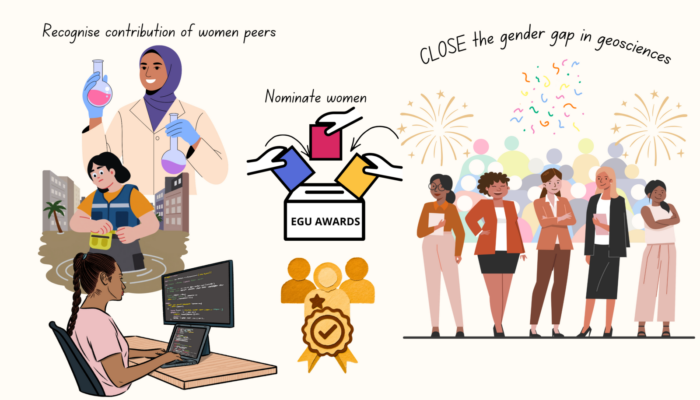
Scientists are often imagined through a narrow and gendered stereotype. This matters because society’s image of scientist shape who is seen, remembered and valued as a role model. When recognition, leadership and awards are skewed towards male scientists, scientists from underrepresented genders are less likely to feel that they belong, or see a future for themselves in the field.
In geosciences, this imbalance is especially visible. EGU itself describes its awards programme as a way of identifying role models for future geoscientists. The organisation champions Equality Diversity and Inclusion (EDI) – from gender equality to LGBTQIA+ representation. Yet an analysis shows that the vast majority of awards at both Union and Division level go to men every year.
The origin of such biases is not entirely clear. But implicit biases and a biased composition of the award committee can play a role, an effect that is well known in hiring committees. But just as for hiring committees, having a diverse pool of applications is a prerequisite for more diverse selection outcomes. In other words: there is a lack of diversity in nominations!
Here is what EGU members can do, as a global scientific community, to help break the cycle of skewed gender representation.
What our analysis of previous EGU awardees shows
We reviewed the breakdown of medal recipients at both the union-scale across divisions for the period of 2004-2024. We focused on twenty-five medals, awarded annually, and typically targeted at senior researchers. There is, of course, an important limitation to acknowledge: in this review, gender was inferred from names and publicly available photos on the EGU website. We are aware that this is imperfect and does not adequately capture diversity in its full sense. Still, we hope this analysis can serve as a starting point for a broader and more nuanced conversation.
Our analysis shows that for the union-wide awards, only 25% of the Jean Dominique Cassini medal winners were female. This becomes more skewed as female to male medal winner ratios were 1/11 for the Arthur Holmes medal and 1/12 for the Alfred Wegener medal. For the Alexander von Humboldt medal, there has never been a female winner.
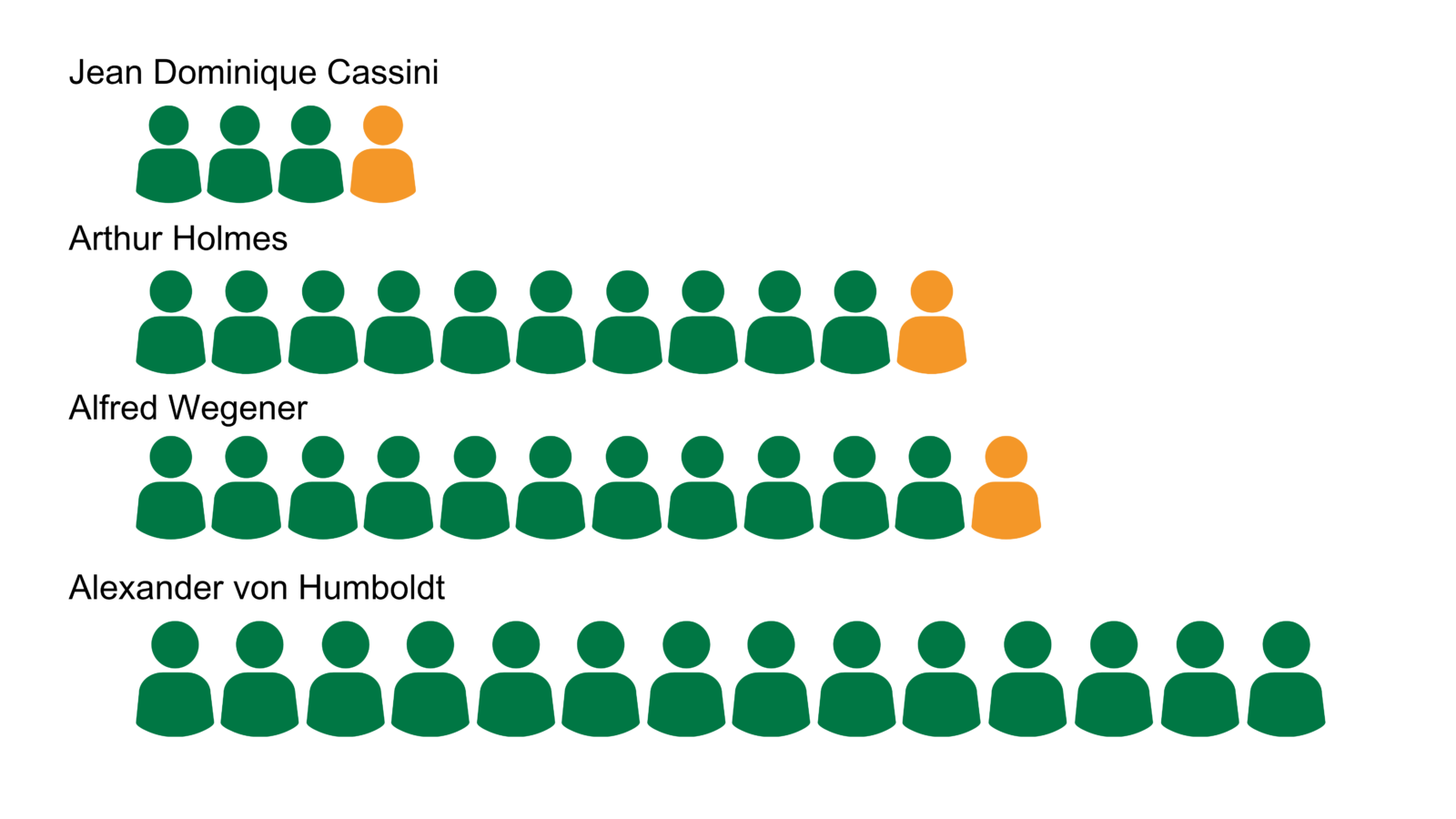
Figure 1: Union-wide medal winners showing the proportion of male recipients in green and female recipients in orange, 2004-2024.
On the level of the 22 divisions of EGU, we found similar gender gaps (Figure 2). Only nine out of twenty-five medals had 25% or more female awardees. Nine more division awards, including the Henry Darcy medal of the HS division, only had 14-20% female recipients. The seven remaining awards, including the John Dalton medal, had less than 11% female winners between 2004-2024.
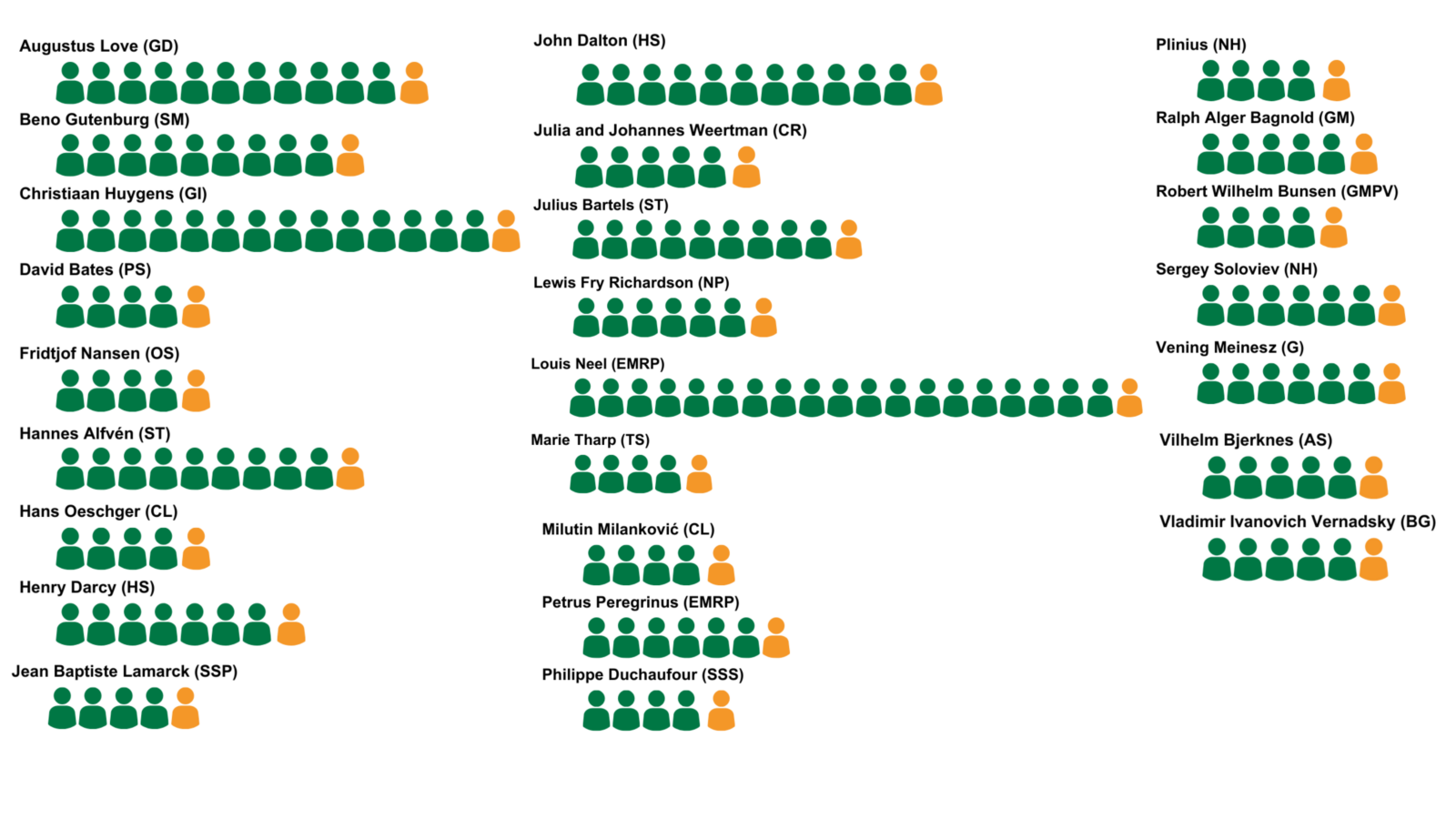
Figure 2: Winners of 25 awards across 22 EGU Divisions showing male recipients in green and female recipients in orange from 2004-2024.
Why nominating more women matters
One of the most straightforward ways to change this picture is to make the nomination pool more diverse. According to SheFigures, women hold about 30% of senior research positions across the EU. Yet an analysis by EGU, shows that between 2014 and 2023, only about 20% of nominations across union and division awards were for female candidates. Simply put, if fewer women are nominated, fewer women can win.
So, does submitting more female nominations actually make a difference?
Our experience says that yes, it does!
After it was pointed out at the HS Division Meeting at EGU25 that all Division awards had gone to men for the second year in a row, the Early Career Scientists team came into action. We made an attempt to coordinate nominations for prominent women scientists for two senior scientist awards and the Outstanding Early Career Scientist award. We received encouraging responses from the colleagues we reached out to, who provided enthusiastic letters of support, and helped put together competitive nomination packages. As a result, two out of three of this year’s awardees are women! (see EGU – Division on Hydrological Sciences (HS) – Awards & medals recipients).
How can you nominate your colleagues?
The good news is that nominating someone is not especially complicated – and any current EGU member can submit a nomination! This year’s nomination period is now open until 15 June 2026.
For union and division medals, the package generally includes a nomination letter, three to five letters of support (all 5,000 characters max including spaces) as well as a two-page CV, and a two-page selected bibliography.
For early career awards, the package is even shorter, consisting of a brief letter of nomination (2,500 characters), a one-page CV, and a half-page selected bibliography.
Here is what to do:
- Reach out to the woman you would like to nominate to check if it is alright with them. (Sometimes, surprise nominations may not be appreciated!) Ask them for their CV.
- Reach out to colleagues who can support the nomination. These are typically people who have worked closely with the nominee and can highlight their achievements best. Ideally, the person submitting the nomination should also be a close collaborator of the nominee!
- Compile the bibliography, unless the nominee already has one to hand.
- Upload the nomination package to the platform before the deadline (15th June 2026).
- And finally… keep your fingers crossed!
Writing a letter of motivation or a letter of support can seem daunting at first, but it is actually fairly straightforward. Do not hold back your enthusiasm in talking about your colleague’s work. Emphasize their achievements – their outstanding papers, leadership roles, awards won, projects coordinated, grants won etc. – as well as their personal qualities. The latter can include everything from being an outstanding MSc and PhD supervisor to always being there to lift up colleagues.
Are you, or the woman you are hoping to nominate, in doubt about whether they qualify for an award? We suggest most definitely give it a go!
Nominations are reviewed by the relevant committee before final approval by the Council in autumn. Importantly, nominations are not automatically rolled over to the next year, so strong candidates need to be resubmitted if they are not selected!
Please visit the nomination submission process page for details about the nomination packages.
What needs to change – what you can do
Tackling the global issue of the under-representation of scientists from diverse backgrounds needs a holistic approach by the global geosciences community and nominating more women to make the geoscientist role-model pool more diverse is just the first step. EGU is committed to advancing EDI and to making sure the future of geosciences is diverse and inclusive.
What you can do – today! – to help this effort is to look around your circle of peers and nominate women whose work you admire for the awards they more than deserve!
If you have any questions or need any support, you can reach out to the ECS team. (hs-ecs@egu.eu)