The aim of risk management is to prepare society in order to limit loss and damage when an extreme event occurs and to restore the functioning of society afterwards . While current risk management practices are helpful in many regards, they fall short when it comes to unprecedented events. An analysis of event pairs and recent disasters show that societies often fail to cope with events that are larger than what they have experienced or what they can imagine.
(Flood) risk analysts have argued again and again that risk assessment and management should encompass the entire range of events, from frequent events to very rare events, and even the worst-case scenario. However, this plea is not heard. Why?
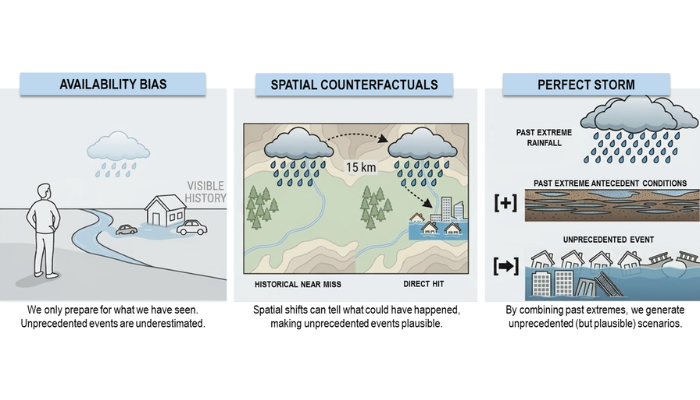
One part of the answer is of a psychological nature. Humans are bad at thinking outside their experience. Psychologists have identified a large suite of cognitive biases that humans fall prey to. One of them is availability bias: Confronted by the (difficult) question of assessing the probability of an event, we tend to answer another (much easier) question: How easily can I recall or imagine such an event?
How to Imagine Extreme Events
Thus, we underestimate the probability of events that we have not experienced, but overestimate their probability as soon as we have seen them.
How to overcome this unwillingness to think and to prepare for unprecedented events? We need stories that speak to people. Presenting the 1,000-year flood or the worst-case scenario does not help much here.
Counterfactuals – past events that could have occurred – seem like a good tool to develop such stories. In a previous blog post, Paul Voit has discussed spatial counterfactuals; here the idea is to shift a recent rainfall event in space and quantify what the consequences would have been.
Even small shifts can lead to dramatically larger flood peaks and consequences. The story behind this is simple: This time you have been spared from havoc, but look what could have happened if the rainfall had fallen only 15 km further to the east!
There are many ways to construct counterfactuals. We have used the Perfect Storm analogy to develop unprecedented, but plausible flood events.
Introducing Perfect Storms
This term became famous through the movie ‘The Perfect Storm’, directed by Wolfgang Petersen, which refers to a storm in 1991 characterized by an extraordinary combination of weather conditions that created a catastrophic situation for a fishing community in Massachusetts.
More generally, the Perfect Storm metaphor describes a situation where several adverse factors come together to produce a disastrous outcome. In our case, we recombined historically observed extremes in precipitation and soil moisture to generate new flood scenarios. In this way, we produce events whose severity and damage can strongly exceed those of the observed events.
While our Perfect Storm approach is limited to event rainfall and antecedent catchment conditions, it is (conceptually) straightforward to include additional factors, such as breaching of flood protection or failure of evacuation. We feel, and our discussions with practitioners support this, that tweaking a recent (important) event is something that lay people can much more easily understand compared to a more technical approach, such as the 1,000-year flood.
How Perfect Storms Can Help Prepareness
If we accept that such events are easier to communicate: What to do with them? They are not associated with a probability, and they are not helpful for cost-benefit analysis. And we cannot build protection measures that high.
However, there are many measures that are worth thinking through on the basis of such scenarios. For example, we can use them for disaster management training and awareness campaigns.
One of the problems during the Western European floods in July 2021, with 240 fatalities, was that both, laypeople and experts, did not believe that the flood could be that severe. Many people died not because they didn’t receive a warning, but because they started with mitigation measures, for example going down to the basement to secure assets.
Another approach is to use them to identify hotspots of sensitive and critical infrastructure. A local inundation can have widespread network effects – flood-proofing key network elements can decide whether a local disruption spreads excessively or not. Or we can use them to design fail-safe systems; systems that fail in such a way that the damage is minimized.
In view of increasing climate extremes and changes in vulnerability and exposure, we need to put more emphasis on unprecedented events. Perfect Storms and counterfactuals are worth exploring as a basis for communicating risk and for identifying risk reduction measures beyond technical protection.