“The number one piece of advice I would give anybody is to pick a problem and go after that problem. Ideally, you should pick a problem that requires a lifetime to solve.”
Prof. Siva Sivapalan, episode 1
“A lot of greybeards telling us what we should be doing is absolutely the wrong way to do science. Science is anarchic, it’s bottom-up.”
Prof. Mike Kirkby, episode 2
“I wrote to the journal editor asking what the record of rejected papers in a row was, because now that I had five in a row I really wanted to go for the record. “
Prof. Keith Beven, episode 3
“Curiosity and fun are the main drivers of any scientific endeavor.”
Prof. Georgia Destouni, episode 4
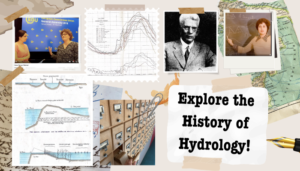
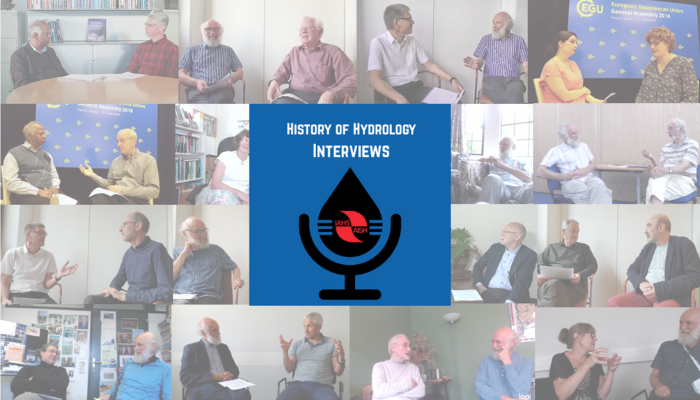
These are some of the inspiring, insightful and often funny quotes that you can now hear in the newly-launched History of Hydrology Interviews podcast.
In each of the 19 episodes, a member of the IAHS History of Hydrology working group interviews a senior hydrologist that has put their mark on the history of our field.
Here is everything you need to know about this interview series, why there is now a podcast, and how you can contribute by recording an episode yourself!
What are the History of Hydrology Interviews?
Operating within the International Association of Hydrological Sciences (IAHS) and initiated by Prof. Keith Beven and Prof. Okke Batelaan, the History of Hydrology working group is a global community effort to document the development of hydrology as a scientific field (see this previous blog post for more details).
As part of this initiative, members of the working group have conducted interviews with hydrologists who have written this exact history. They explain what drove them to become hydrologists in the first place, discuss the challenges and achievements of their careers and share advice for young hydrologists.
Since the series’ launch in 2019, 19 interviews have been recorded and posted on the History of Hydrology YouTube channel. They are generally between 45 minutes and an hour long. As an example, here is the latest addition:
Why is there now a podcast?
The goal of the podcast release is to make these interviews easier for the global hydrology community to access. Video’s are not the easiest format to fit into a busy schedule while a podcast is easy to listen to during a commute or on a walk.
In addition, we have cleaned up the audio quality where possible to improve speech clarity and reduce background noise. The interviews are now available on Spotify, Apple Podcast, or “wherever you get your podcasts”.
How is this different from the EGU HydroTalks podcast?
The monthly HydroTalks podcast of the EGU Hydrological Sciences division, as often featured on this blog, focuses on discussions with hydrologists about recent advances, challenges, and opportunities in their domain.
In contrast, the History of Hydrology interviews focus on the broader trajectory of influential hydrologists: their careers, motivations, and reflections on the development of the field.
Can I propose and conduct an interview myself?
Yes! Interviews are open to contributions from the community. The main requirements are that the interview be conducted in English and that the interviewee has been involved in hydrology over several decades.
We particularly encourage interviews with female hydrologists, hydrologists from the Global South, and other hydrologists currently underrepresented in our interview series. For guidance on conducting an interview, feel free to contact the interview coordinator, Professor Okke Batelaan (okke.batelaan@flinders.edu.au).