

Today – while preparing my latest Sience – CV (SciCV) version for a proposal submission – I noticed that I will soon celebrate my 20th net-academic-age birthday* (see below). No worries, my editorial is not about looking back on my career, but about offering some hints on how to keep up with evolving research evaluation practices. One of the things that is evolving quickly (for academic standards!) is the analysis of publication lists and of research output: for many job applications or proposal submissions, you are no longer asked to produce a full list of publications but to provide a selection of your most important works. This is to follow modern research assessment standards as e.g. defined by the DORA declaration or the Coalition for Advancing Research Assessment, COARA: with a focus on quality and diversity of scientific outputs rather than on quantity and journal-based metrics.
The role of ORCID in research evaluation
Some selection or evaluation committees go a step further and do not formally allow their members to consult web-based publication lists of candidates other than the data provided by ORCID. The rationale for this is to evaluate only the material that the candidates provide themselves – ORCID being an acceptable extension since your ORCID entry is under your control. And ORCID does not contain unwanted metrics such as impact factors.
However, ORCID needs to be curated to facilitate the work of people who evaluate your academic profile. You can add a short bio (free text) and links to your websites or to other scientific databases. The core part of your ORCID-entry is the employment & education history, your scientific output (“works”, see figure below), acquired funding and professional activities (e.g. memberships, service work), including peer-review.
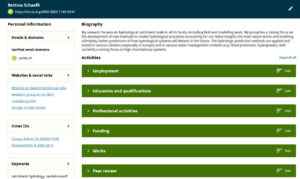
View of the ORCID entry with database categories
These categories cover the type of information that is needed to assess your academic profile and all of them should be populated with information that gives a complete picture of your activities and achievements. You can also (temporarily) sharpen your profile by selecting which entries are publicly visible and which entries you deem less important (hidden or deleted) for your current profile.
Show the diversity of your output
Most importantly, you need to manually add “works” other than journal papers and conference abstracts (imported automatically) to demonstrate the diversity of your work. This includes datasets, codes and preprints but also outreach or teaching activities (see figure below).
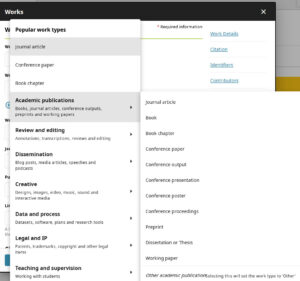
Options to manually add works to your ORCID entry
You can also highlight your 5 most important works. Do not forget to check all automatically added / imported items and replace those that are confusing: for example, if you have abstracts from EGU conferences (published on egusphere), they appear automatically labelled as “preprints”. If you have many of those, a potential reviewer might think that you produce more preprints than actual papers. To avoid this, you can delete an imported entry and replace it with a manual entry that is labelled “conference paper” (attention: you cannot edit imported entries, only replace them). Another typical problem: some imported entries do not show the contributors – annoying for someone who wants to see your first author papers. Again, the solution is to replace it with a manually added entry.
Contribute to change
If much of the above is new for you: discuss these new research evaluation standards with your peers, within your university, research institute or evaluation committee. If we want to make a change, we need a collective effort. I am a member of different committees that do not yet fully adopt these modern evaluation standards. This implies regular discussions on how to focus on the quality of the work rather than on the number of papers or on the name of the journal. And do not forget to check if your university or your national funding agency signed the DORA declaration or is a member of COARA – this might be a strong argument for your colleagues to evolve towards these new standards.
* Academic age: the time someone spent doing research in academia or public research institutions after completing their PhD. Usually, the net academic age is used in profile evaluation or for eligibility windows for career grants such as ERC starting grants. The net academic age is the academic age minus any time period with a justified interruption such as for care duties, illness, non-scientific work etc. See e.g. the official definition of the Swiss National Science Foundation, SNFS, pdf.).