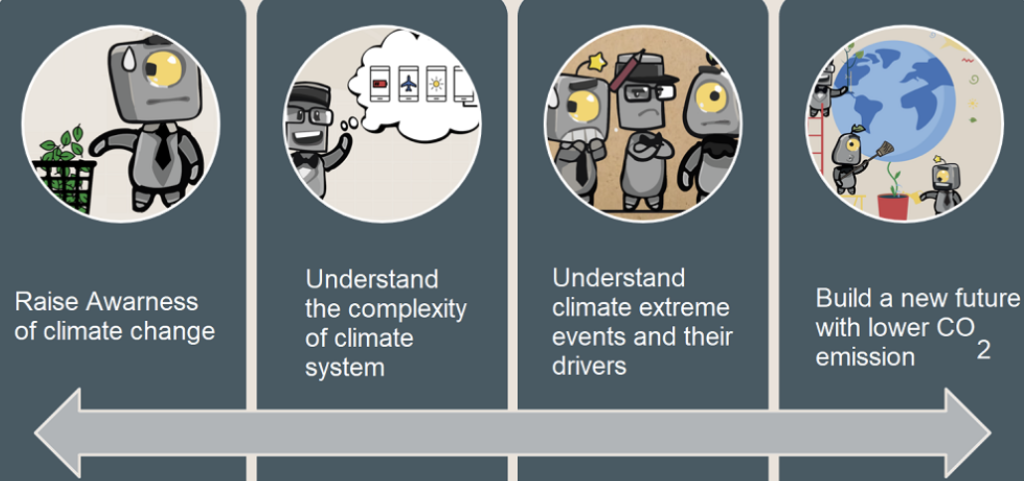
ClimarisQ is a smartphone/web game from a scientific mediation project that highlights the complexity of the climate system and the urgency of collective action to limit climate change. It is available in four languages: English, French, Spanish and Italian. It is an app-game where players must make decisions to limit the frequency and impacts of extreme climate events and their impacts on human s ...[Read More]
NPG Paper of the Month: “Inferring the instability of a dynamical system from the skill of data assimilation exercises”
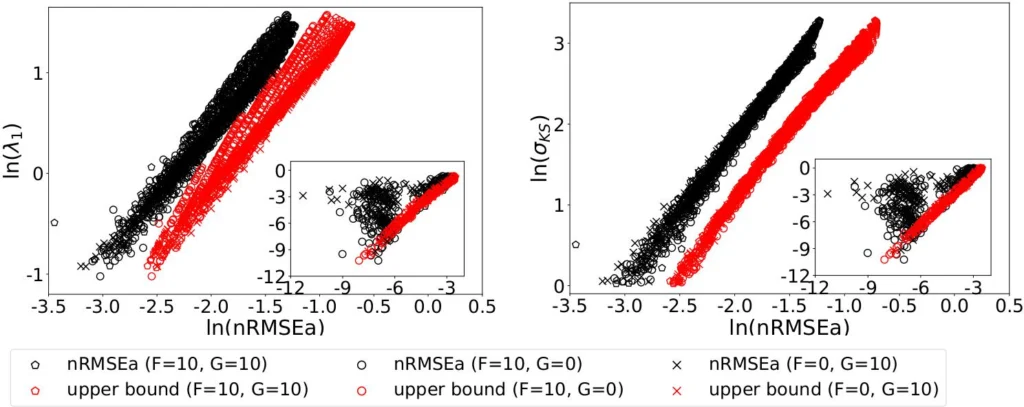
The NPG paper of the month was awarded to “Inferring the instability of a dynamical system from the skill of data assimilation exercises” by Yumeng Chen, Alberto Carrassi, and Valerio Lucarini. Geophysical systems are usually described by a set of dynamical equations that are often non-linear and chaotic (Ghil and Lucarini, 2020). Errors about the initial state can grow, shrink, or sta ...[Read More]
When weather extremes meet climate change: how do scientists attribute single events to climate change?
One of the main new points of the IPCC reports AR6 with respect to the previous ones is the increased confidence that global climate change induced by anthropogenic emissions is critically affecting the dynamics of weather extremes. For summer, and specifically over Europe, the AR6 report states that we are already observing prolonged periods of extremely warm conditions with increased droughts bo ...[Read More]
NP Campfire: “Scaling and multifractals : from historical perspectives to recent developments”
Scaling law behaviours are ubiquitous in geosciences both from a theoretical and practical point of view. They are required to better understand, analyse and simulate the underlying processes, which yields the observed variability of geophysical fields over wide ranges of spatio-temporal scales. A group of scientists within the Nonlinear Processes in Geosciences (NP) Division of the European Geosc ...[Read More]
NPG Paper of the Month: “Comparing estimation techniques for temporal scaling in palaeoclimate time series”
The NPG paper of the month of July was awarded to Comparing estimation techniques for temporal scaling in palaeoclimate time series by Raphaël Hébert, Kira Rehfeld and Thomas Laepple (https://doi.org/10.5194/npg-28-311-2021). Raphaël Hébert is currently a post-doctoral researcher at the Alfred-Wegener-Institut in Potsdam (Germany) in the Earth System Diagnostics group of Thomas Laepple, where he a ...[Read More]
Exploring the multistable and multiscale climate system via noise
Could our present day “warm” climate turn into a frozen fully glaciated one, as if the whole Earth is a huge “snowball”? That was a question put forward independently by Mikhail Budyko and William Sellers in the late 60s [1,2] who made a first estimate of the necessary changes of incoming solar radiation, such that either the Arctic ice sheet completely melts, or the planet gets fully frozen. Base ...[Read More]
NP Interviews: the 2021 Lewis Fry Richardson Medal Berengere Dubrulle
Today’s NP Interviews hosts the 2021 Lewis Fry Richardson Medal Berengere Dubrulle. Berengere is senior scientist at the Centre National de la Recherche Scientifique and presently Director of the Les Houches Physics School. She received her PhD in astrophysics in 1990 under the supervision of J.-P. Zahn. She is a specialist of turbulence, and its application to astro and geophysical flows using th ...[Read More]
NPG Paper of the Month: “Empirical evidence of a fluctuation theorem for the wind mechanical power input into the ocean”
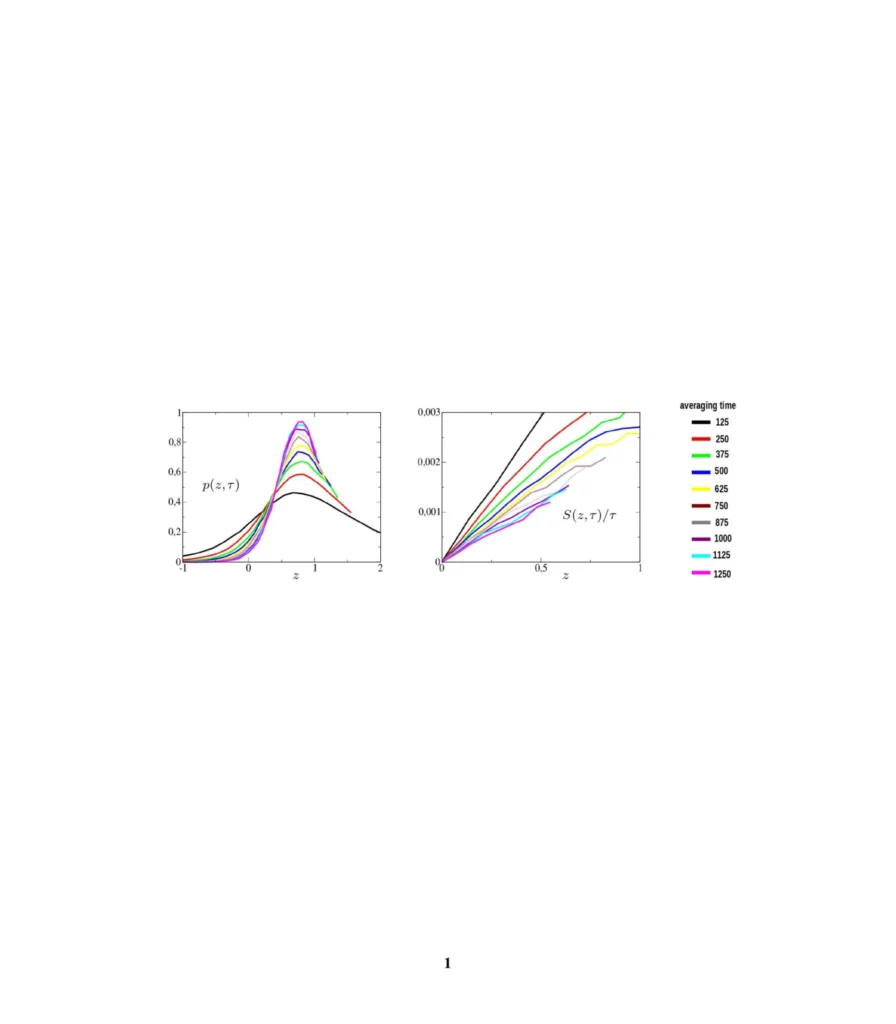
This month the NPG Paper of the Month award is achieved by Achim Wirth for his paper “Empirical evidence of a fluctuation theorem for the wind mechanical power input into the ocean“. Achim obtained his PhD at the University of Nice (Franc), doing research on turbulence theory. He then moved to oceanography working at UCLA (USA) and Geomar (Germany). Since 2005 he holds a permanent position a ...[Read More]
From the eyes of tropical cyclones to flooded strands : how climatologists use weather events to make climate predictions?
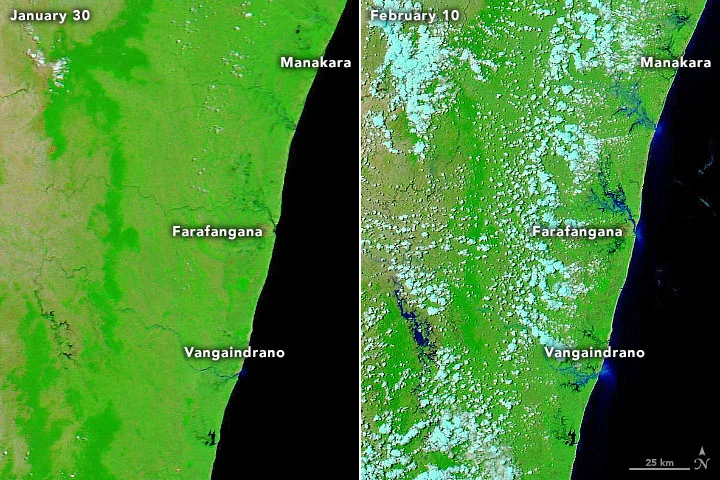
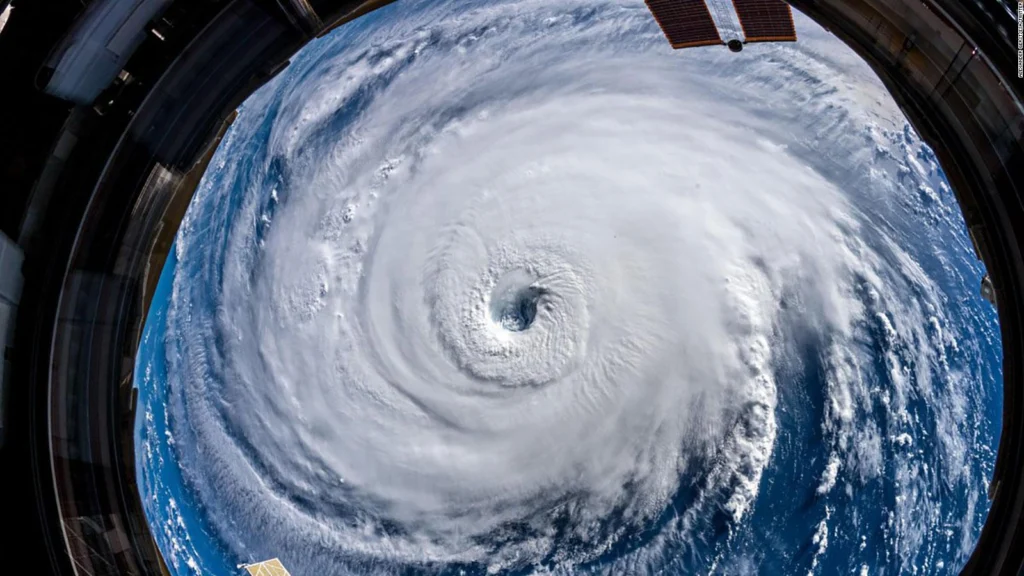
While extreme events are meteorological in nature, climatologists collect them to draw conclusions about the state of the present climate and to get clues how they possibly change in the future. Thus, climate and weather find common ground. If we consider an event alone, we are not studying the climate, we are in the field of meteorology, the goal of climatologists is therefore to put extreme even ...[Read More]
The 2021 Nobel Prize on Physics awarded to the physics of complex systems!
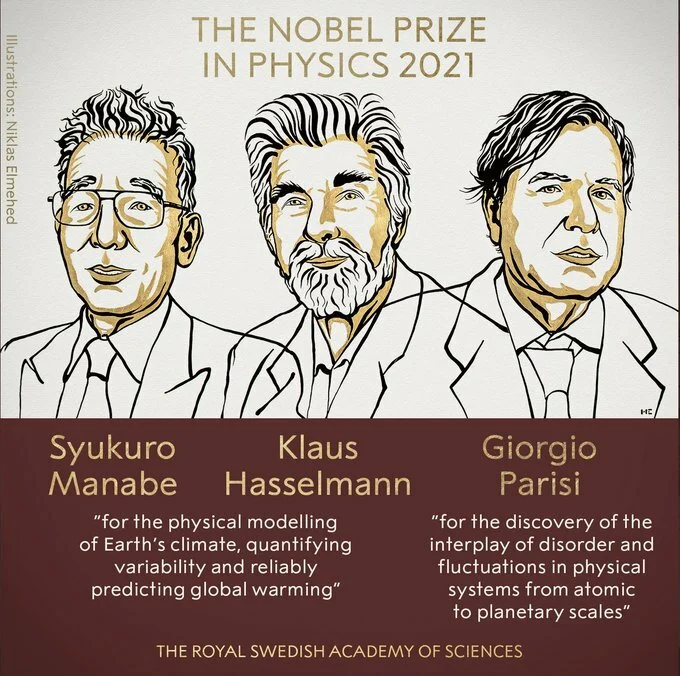
On October 7th, the Nobel Prize in Physics 2021 was announced. It came as a stunning surprise for the Non-linear Processes and Climate communities, the recipients of this year’s award being two outstanding senior climate scientists, Klaus Hasselmann and Syukuro Manabe, and a theoretical physicist specialized in complex systems, Giorgio Parisi. For many, this award was welcomed as a long-awaited re ...[Read More]