HS
Hydrological Sciences

Pieces of history

Urban streams can provide water sources for climate change mitigation
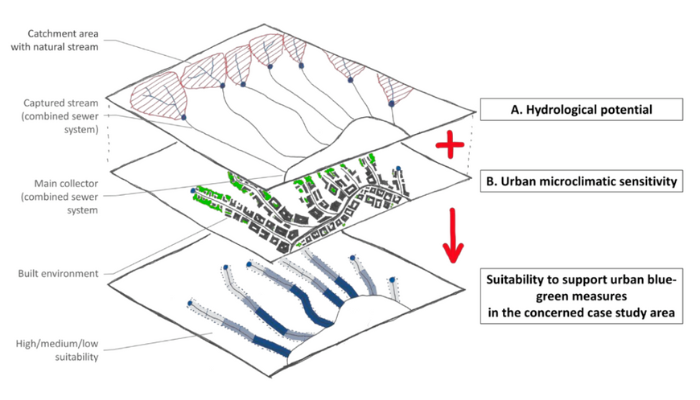
A schema of the ProBach methodology.

With advancing climate change, mitigation measures are necessary to fight urban heat islands. Reactivating urban streams as blue-green infrastructures can contribute to this mitigation, and serve as an invaluable water resource.  Urban streams – banned to the underground In urban areas, hydrological conditions have been modified, impacted or completely changed for centuries.  Rivers and stre ...[Read More]

Timeline of historical highlights of the EGU Hydrological Sciences Division

Timeline of historical highlights of the EGU Hydrological Sciences Division

Do you know when the Hydrological Sciences Division had their first Early Career Scientist representative? Or who the division president was in 2016? Check the answers below, where we list these and other historical highlights over almost 20 years of the Hydrological Sciences (HS) Division. Overall, the most striking fact is certainly the steady growth and diversification of the community and the ...[Read More]

Listening to a bouquet of articles: review papers

Listening to a bouquet of articles: review papers

Let me guess from which city in the world you are reading this post: Lima, Lahore or Louisville? It might be that you are modelling one of these rivers: Nile, Rhine or Lena? Or studying the Caribbean Sea, the Arabian Sea or the Caspian Sea? The country you live might be Uganda, Philippines or maybe Iceland and your home continent could well be Europe, Latin America or even Antarctica. I assume you ...[Read More]

“Everything is interaction and reciprocal”

“Everything is interaction and reciprocal”

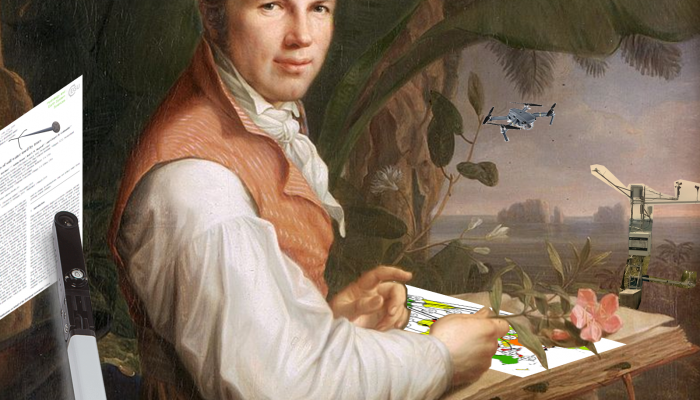
The first time I came across Alexander von Humboldt I was a freshman at the University of Bayreuth. We were proudly told that we were studying environmental science in a region where Humboldt used to work in, prior to his adventures in the Americas. Within EGU, von Humboldt is well known, in connection with the Union medal for “scientists who have performed research in developing regions for the b ...[Read More]