Greenhouse gas emissions from urban waterways
Every field scientist knows to never go to the field without ample supplies of duct tape and cable ties. We utilised this notion daily within the University of Bristol’s Watershed Carbon Lab team, as we undertook a 2-year long field campaign across the UK, Europe and China collecting data for our FLF funded ‘Urban Waterways’ project.
Rivers are known to be sources of greenhouse gas emissions to the atmosphere, however an understanding of the magnitude and controls of these emissions, specifically form urban waterways (rivers and canals) is limited. So, how do we accurately measure methane emissions from urban waterways and where do methane emissions from urban waterways originate from?
Novel methods for catching dissolved and diffusive gasses
With these questions driving our research, we needed to find ways to measure diffusive and ebullitive methane fluxes and collect samples of methane gas for further isotopic analysis (including stable and radiocarbon isotopes). While we heavily rely on our trusty Li-7810 Trace Gas Analyzer to record methane concentrations in the field, the vessels that facilitate the collection of methane gas are somewhat less high-spec and come with a much smaller price tag. For example, the floating chamber we use for measuring diffusive methane and carbon dioxide fluxes from urban rivers and canals is constructed from an upside-down ‘really useful’ box and four toilet cistern floats.
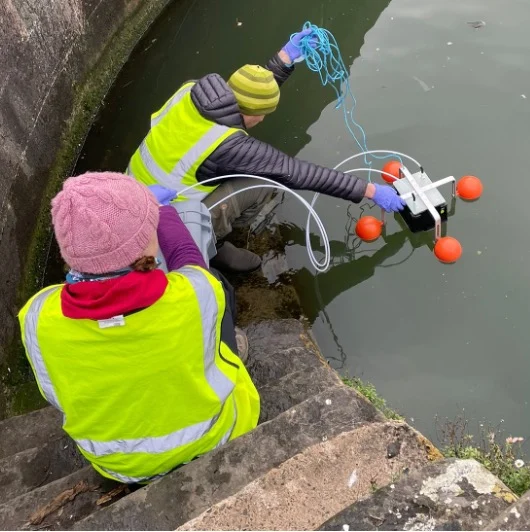
Floating chamber used to estimate diffusive methane fluxes from urban waterways
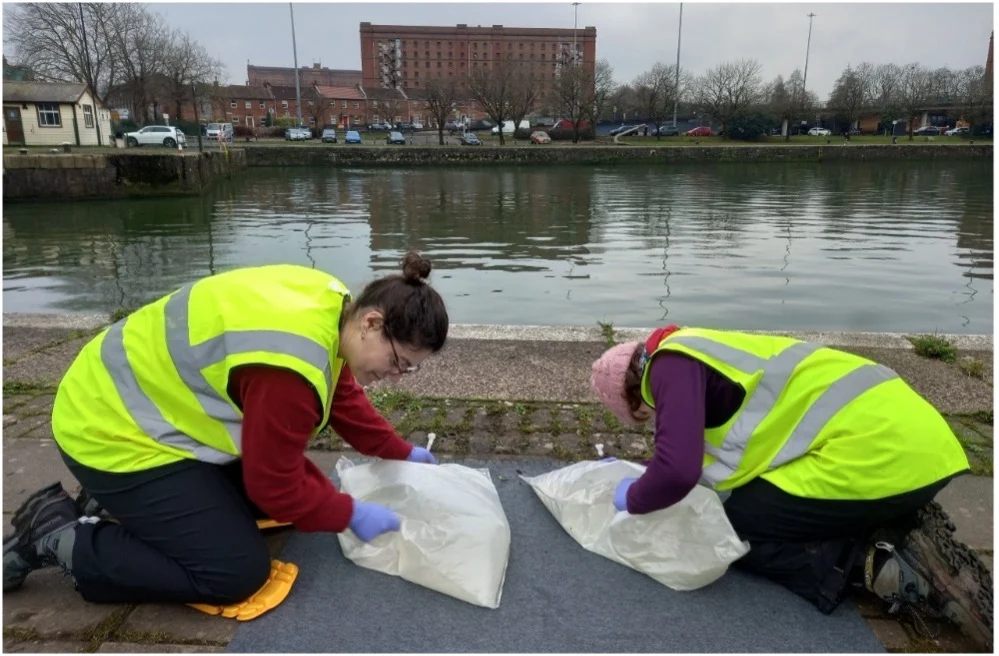
We also hand shake repurposed wine bags (or cider, depending on your preference) filled with both river or canal water and a headspace filled with inert ambient headspace to obtain larger volumes of gas that can then be used for isotopic analyses undertaken either here at the University of Bristol, the British Geological Survey or the National Environmental Isotope Facility (NEIF)
We have also routinely deployed an ‘ebullition raft’ overnight, in the hope that we can collect ebullition bubbles rising to the water surface from sediments and estimate the proportion of methane emissions ebullition versus diffusion. This raft is constructed from eight inverted washing up bowls, each with a valved sampling syringe and with swimming noodles (‘pool noodles’) attached as floats. These floating bowls are then held together using, you guessed it, duct tape and cable ties. The benefits of low-tech field equipment is not only the more reasonable price tag, but also the ease in which components can be purchased. We have made numerous mercy dashes to inner city tool shops and supermarkets for fixing and making spares.
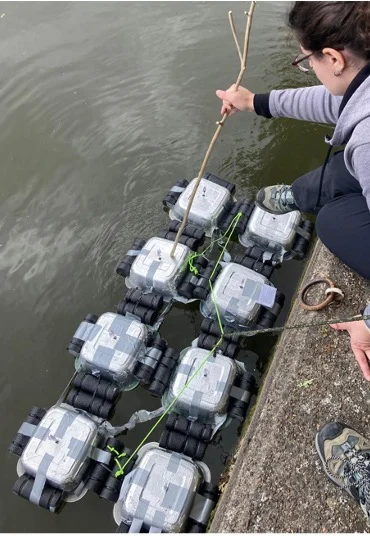
Ebullition raft made from inverted washing up bowls, swimming noodles, duct tape and cable ties. Note: a stick is always handy as an arm extension!
A surprising benefit of low-tech equipment
One benefit of these rather eye-catching methods is their ability to attract attention of the public. As a team we have found that shaking of wine bags and the extra-terrestrial-esque looking rafts and chambers we deploy as good conduits for public engagement and educational conversations around water quality and greenhouse gas emissions from rivers. The knowledge exchange has also worked both ways – with many residents local to these waterways giving us interesting and relevant information on the management and history of the sampling location.
Next steps
After a significant, and creative, field campaign, this project has now moved into its sample and data processing phase, including microbial and radiocarbon analyses of water, biofilm and sediments, with our extensive and growing dataset spanning multiple cities across different countries and continents. Keep your eyes peeled for upcoming publications later this year!
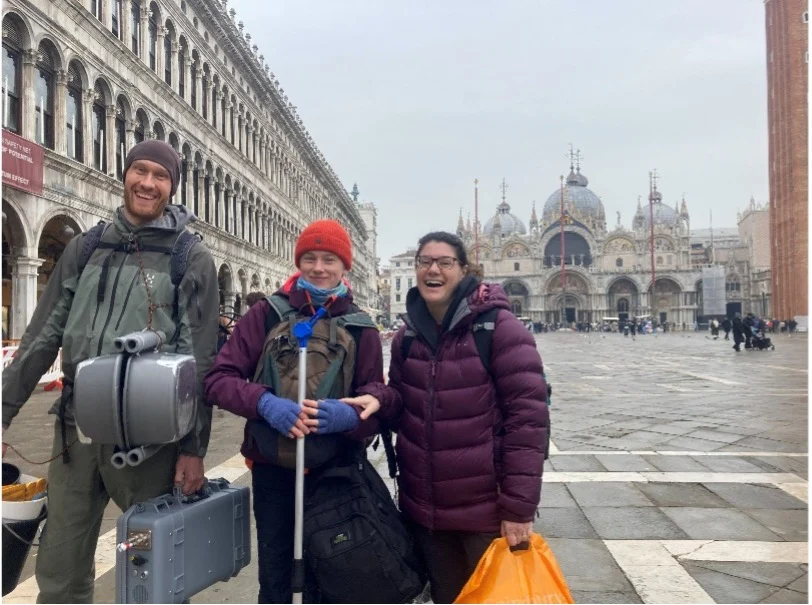
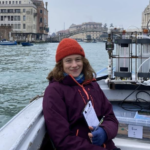
Some members of the Watershed Carbon Lab team in Venice, 2026 (L-R: Ove Meisel, Liz Flint, Hanni Vigderovich).