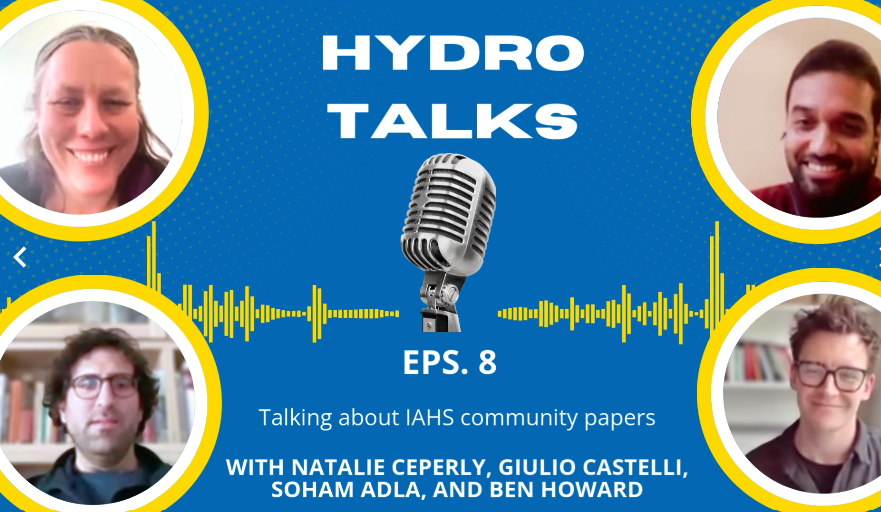
In episode 8 of the Hydrotalks podcast, we hosted four coordinators of working groups of the HELPING hydrological decade. We warmly welcomed Dr. Giulio Castelli (University of Florence) and Dr. Natalie Ceperley (University of Bern), group co-leaders of Co-Creating Water Knowledge working group; Dr. Soham Adla (ING Bank, Netherlands), a coordinator of Science communication, outreach, and promoting Digital Water Globe working group; and Dr. Ben Howard (Imperial College London), a coordinator of both working groups. We cover various topics such as their working group activities, writing their recent community papers and how to get involved.
Click here to watch the full episode.
Explain main goals of HELPING hydrological decade.
IAHS runs decade-long themes to concentrate its scientific efforts. HELPING stands for Hydrology Engaging Local People in One Global World, and runs from 2023-2032. The decade focuses on linking hydrological science with society to deliver solution-focused water research centered on people, practice, and policy. Scientists can join working groups, engage in events, and contribute to case studies and community papers.
What are the goals of your respective working groups?
Co-creation: Our group is bringing co-creation concepts into hydrological research. We are raising awareness and integrating traditional, scientific, policy, and private-sector knowledge to solve real problems, while building an interdisciplinary network across natural and social sciences.
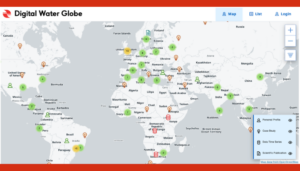
Science-communication: Communication is vital for the HELPING decade. Our working group supports outreach, documents challenges and best practices, and promotes the Digital Water Globe platform to connect researchers and practitioners, linking hydrology to broader initiatives like the SDGs and unsolved hydrological problems.
What motivated you to merge diverse skillsets in your working group activities?
Co-creation: To have transdisciplinary discussion and co-create across roles, we need as much representation as possible. That is why multiple people with different skill sets, perspectives, and networks are important.
Science-communication: When working across-sectors or for different research projects, one common factor which can make or break a project is communication. When done well, science communication can really catalyze collaboration and impact. That recognition motivated us to merge diverse skill sets.
Can you give a quick overview of your most recent community papers?
Co-creation: Our recent community paper, Co-creating water knowledge: a community perspective brings together diverse authors to argue for co-creating water knowledge across scientific, community, and Indigenous systems. It is structured around four principles, i.e., inclusivity, openness, legitimacy, and actionability. It outlines practical tools to make co-creation actionable.
Science-communication: Our community paper Effective science communication in the face of water crises: a community perspective on challenges and best practice in HELPING was recently published. It synthesises challenges and best practices for communication using inputs from across the globe. Key barriers include platform overload, jargon across disciplines, and limited recognition, training, and funding. The best practices that emerged were audience-tailored messaging, plain-language layers, transparency about uncertainty, trust-building, and co-produced knowledge.
What was your data collection strategy for a broad community perspective?
Co-creation: We gathered in person first and did a big brainstorm with post-its), sharing what mattered most from our different co-creation experiences. Then we grouped ideas by themes, iterated the structure, and kept reorganising until we agreed on a framework of those overarching principles. It’s a perspective paper, so it was less “data collection” and more structured sense-making across experiences.
Science-communication: We used a multi-pronged mixed-method approach across IAHS and beyond. First, we spoke with long-term IAHS volunteers from past decades to learn what worked and what didn’t. Second, we ran three online workshops (staggered across time zones) as focus groups. Third, we interviewed science-communication actors outside IAHS like mayors communicating flood projections, NGOs working on water quality, and government officials on adaptation. Fourth, we ran an online survey for a quantitative view. In total we collected ~200 inputs and did a simplified thematic analysis, while being mindful that the inputs were heterogeneous.
What were your biggest challenges and lessons learned from writing community papers with a large number of co-authors?
Co-creation: It could have been harder, but motivation of the people was the big reason it worked. A major lesson was to take time and have a core writing group responsible for sections to streamline the text. The biggest challenge was cutting down the content, everyone wrote great ideas, and we had to save some of them for future papers.
Science-communication: The main challenge was coordination logistics, tracking contributions, affiliations, timelines, and an evolving author contribution at different stages. Another challenge was organising the three global workshops, bringing people from different sectors and time zones together, and keeping them engaged for two-hour focus groups. The process was a big learning-curve and capacity-building experience.
What are the upcoming activities of your working groups and how can someone get involved?
Co-creation: The community paper is a kickoff, not an endpoint. We’re moving from framing ideas to operational work and developing joint projects, including co-supervision of PhDs. We will focus on applying co-creation principles into practice.
Science-communication: We share updates via a mailing list and invite people to join meetings, conference sessions (e.g., EGU), and upcoming activities. Plans include webinars, an EU COST proposal, cross-cutting initiatives, a second community paper, possibly a summer school.
Would you like to share the best career advice you’ve ever received?
“Say yes to people, not just projects.”
“It’s worth spending time and energy to get to the right questions to work on.”
Visit IAHS collaboration page to learn about ways to collaborate and HELPING Working Groups page to get involved in working groups.
Listen to the full HydroTalks podcast for more insights on HELPING decade groups. Stay tuned for upcoming episodes exploring the frontiers of hydrology.