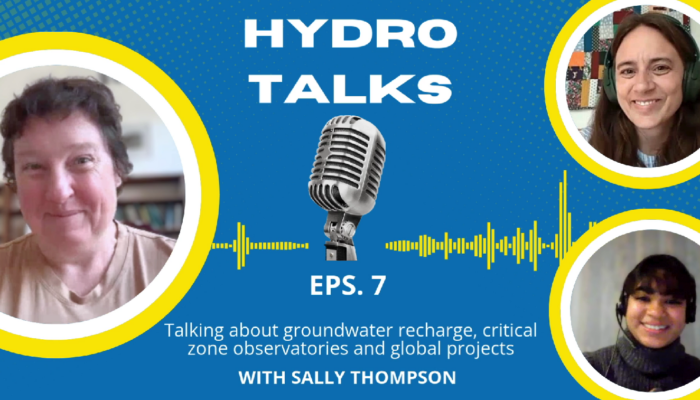
In episode 7 of the Hydrotalks podcast, our guest was Dr. Sally Thompson (Sally Thompson – the UWA Profiles and Research Repository). She is a Professor at the University of Western Australia, and the Co-Director of the Centre for Water and Spatial Science. Her research spans ecohydrology, surface hydrology, and Critical Zone Science, exploring how vegetation and ecosystems interact with water cycles under climate change. She is the EGU Henry Darcy medal recipient of 2026.
You can check out the podcast below, or read the interview summary in this blog!
What is your current research focus?
Western Australia is on the front line of climate change, with pronounced heating and drying. Rainfall is declining, driving major shifts in water resources, especially groundwater. I am working to understand what climatic drying means for groundwater recharge, where both people and plants compete for limited water, and how these demands will balance under climate change.
How do you combine analytical tools to answer questions in eco-hydrology?
To study recharge, we use field observations to build datasets, calibrate groundwater movement models, and test different management scenarios. For basin-scale insights, we combine remote sensing and geospatial datasets, using machine learning to train large-scale models. Our focus area, the Swan Coastal Plain, spans roughly 200 km north to south.
What are critical-zones and why are CZ observatories important?
The critical zone is the thin vertical layer of Earth where most terrestrial life exists. CZ observatories provide a holistic view of transfers of water, energy, carbon, nutrients, pollutants, eDNA, and more across this life-supporting interface.
How does CZ behaviour in the Northern hemisphere differ from Australia?
Australia’s critical zone is very old. With limited tectonic activity since Gondwanaland broke apart, we retain an ancient geological record. Whether this leads to fundamentally different processes across hemispheres is still an open research question.
How does vegetation change the water cycle under the changing climate?
In arid and semi-arid regions, vegetation is the dominant water user: around 70–90% of water can return to the atmosphere via evapotranspiration. During extremes, drying can trigger forest and woodland mortality, even in drought-adapted native vegetation. We do not yet know what happens as ecosystems approach tipping points, but vegetation strongly modulates how climate change affects the water cycle.
What is the canopy resilience project and the lessons learnt from it?
The project began in 2023–24 during an exceptionally hot, dry summer, when stressed urban trees were visible to the public. We asked residents to locate neighbourhood trees, document canopy health, and pin sites via a web app. The goal was to help validate remotely sensed vegetation indices. Participation in Perth was large and extended beyond the city. A key challenge is quality control while using citizen science data, so we are now refining the approach with specialist arborists.
Have you witnessed differences in ecohydrological interactions in different continents with unique landscapes?
Places differ, and researchers need humility and attention to local knowledge. Often, local insights map back onto foundational hydrological principles. For example, a student working in Ethiopia found that water conservation plans designed for semi-arid regions were counterproductive in humid highlands, increasing soil erosion. Understanding local hydrology has to come before defining problems, methods, and solutions.
For ECS, how can we tackle challenges of running projects in different countries?
Start by finding a trusted local partner. Strong collaborations leverage local university and stakeholder connections and should be genuinely two-way: sharing skills, learning from each other, and giving back.
Have you noticed public perception of water resource usage playing a part in management?
Everyone needs water, but people are adaptable and their practices, beliefs, cultures, and taboos influence how water is used. Some norms can change, but shifting them can be difficult, and those working in sanitation and behaviour change can likely speak to this in depth.
What have been the biggest scientific breakthroughs in hydrological research in the last 10 years? What is to come in the next 10 years?
Data is abundant and the way that data is used in causal statistical models and machine learning models is becoming more useful for policymakers. I also want to see more of the decision space, that is using science as an enabler of decision making. Also, we need more ecological data to decide how to best manage ecosystems.
Could you share the best and worst piece of career advice you ever received?
The worst advice was to decide between a career and a family. Good advice is follow the path you are passionate about, be your own person, follow your passion and your love for your work.
Listen to the full HydroTalks podcast. Click here for more insights from Prof. Sally E Thompson. Stay tuned for upcoming episodes exploring the frontiers of hydrology.