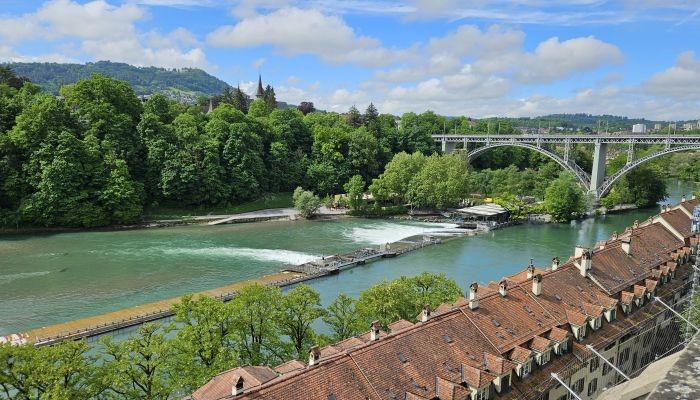
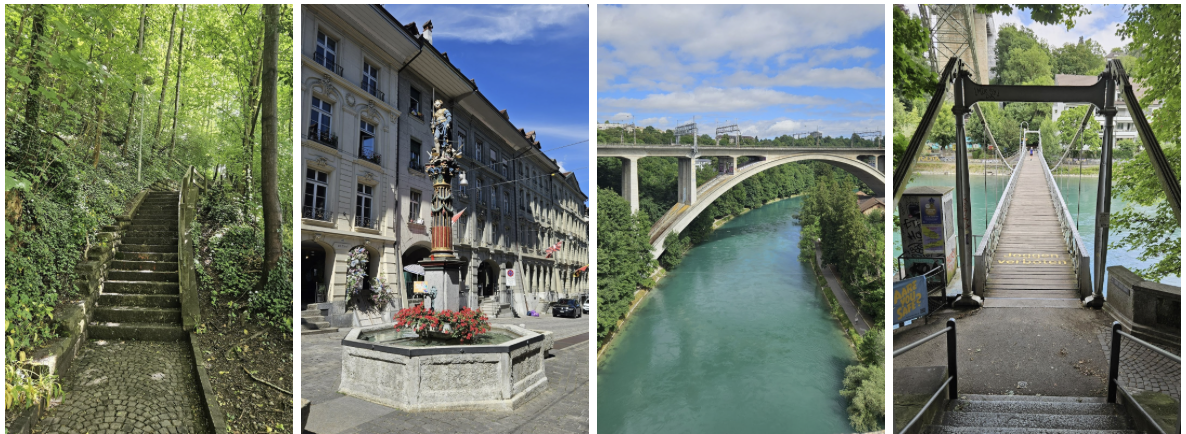
Imagine walking through the Swiss capital, Bern, a city full of water. While you walk, a voice from your headphones guides you along the way and tells you interesting facts about the river and other water sites. You discover the Matteschwelle dam, pass by several fountains, visit a historic weather station, and have a closer look at the clear blue water of the Aare River and its old bridges. This is possible with audio-guided tours – you can discover cities from a new perspective, without even looking at your smartphone.
And now imagine walking through your city, and this time you can share all your favourite sites and facts about the city because you developed the tour! In this blog post, we provide guidance on designing your own tour and on sharing your enthusiasm for water in your city. By sharing our experiences from creating tours in Zurich, Bern, Baden, and the smaller town of Reichenau in the Grisons, Switzerland, we hope to inspire others to develop water-related tours. Audiotours are a useful tool for increasing public understanding of water issues and raising awareness of the challenges and opportunities of water management – an increasingly important topic due to climate change and population growth, especially in cities.
We used VoiceMap (www.voicemap.me) to create our audiotours. While there are other providers for self-guided excursions, we have had a good experience with this company and appreciate the functionality of their smartphone app and website interface.
How do audiotours work?
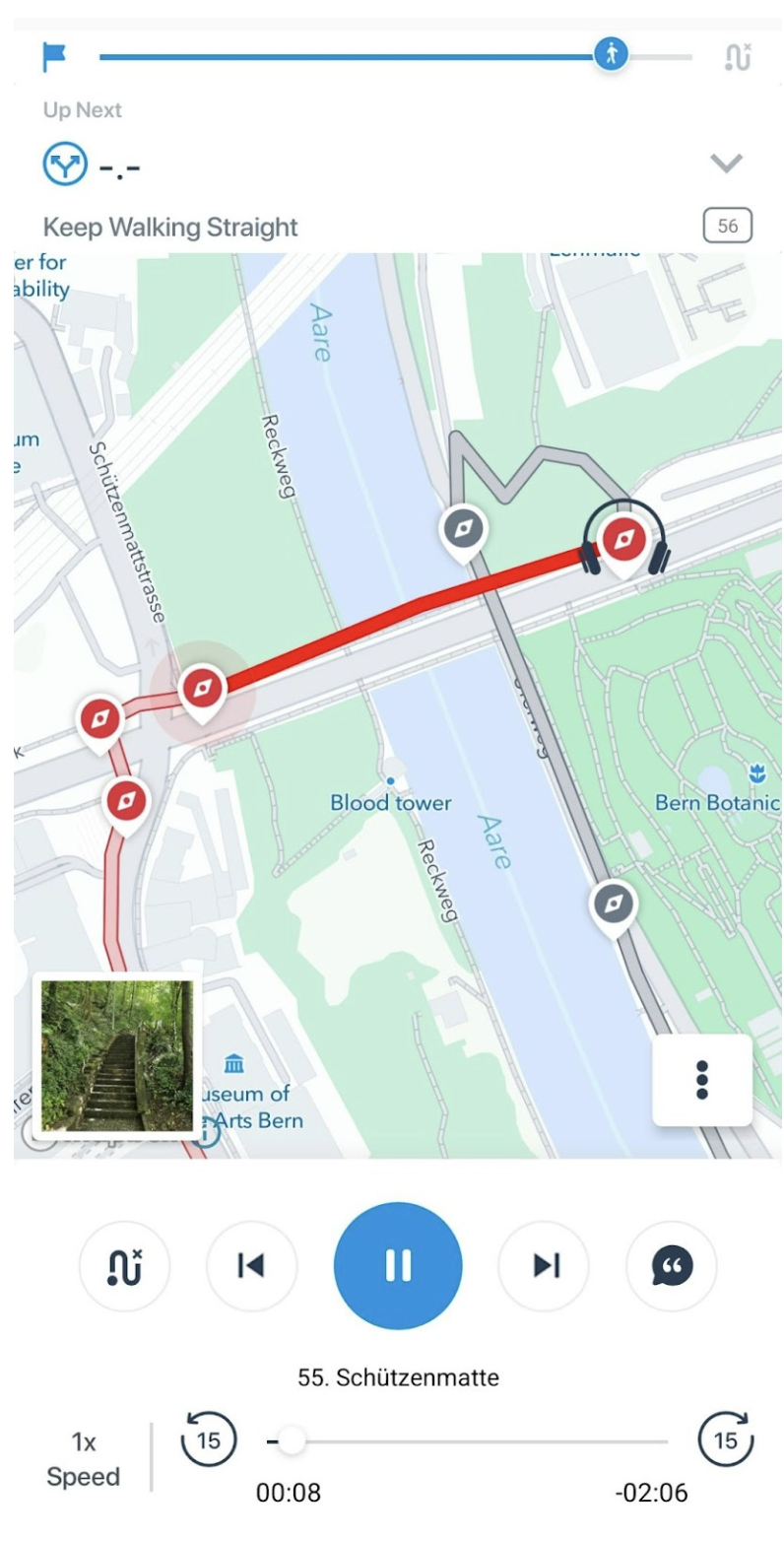
Audiotours are an interesting and fun way to explore a city or area without looking at a smartphone. The tours consist of locations and audio files. As the user passes by these locations, the right audio file is played at the right time using GPS tracking. At each location, the user hears directions, content, or both. The directions can ask the user to stop somewhere, but most of the audiofiles play while walking. If you walk too far away from the actual route, the app tells you.
Audio tours can be visited flexibly, at any time and independently. The tours can be done alone or in groups, but all users listen to the audio separately on their headphones. Users can pause, skip, or repeat the audio and adjust the speed to personal preferences. That’s why the tours are suitable for a broad audience, from tourists and excursion fans to water enthusiasts, and locals who enjoy discovering new things.
The preparation to do a tour is minimal: You only need a phone, headphones, the VoiceMap app, and the downloaded tour. The costs of a tour depend on the publisher’s choice and subscription plan (that’s you if you create your own tour, see below). Users can download a tour for free with a voucher code or by sharing promotional links with their friends.
How can I create my own tour?
Do you want to create a tour to make your research subject more visible to the public? Or do you want to include a tour as part of one of your courses? The VoiceMap editors assist you throughout the tour creation process, which explains why almost all VoiceMap audiotours are of high quality. On the VoiceMap website, all steps in the tour creation process are explained in detail.
Creating a new tour requires some time investment, but once published, no further work is needed when people take the tour. For our tours, we invested between 45 and 80 hours per tour, depending on their length and the amount of content already available. However, the efforts will be distributed over at least three months due to the feedback from the VoiceMap editors (which is mostly very helpful).
Based on our experience, we would recommend the following points:
- Provide clear directions. For orientation, use buildings or similar structures (e.g., traffic lights) that are unlikely to change in the near future. Tell people to ‘keep walking’ or ‘stop here for a moment’.
- Assume that the users have little to no knowledge of the topic beforehand.
- Focus on diverse, interesting facts and on what is visible on the tour to make it suitable and enjoyable for everyone.
- Highlight points along the tour that one would overlook otherwise.
- Where possible, make the tour personal by talking, for instance, about your own experiences or opinions (but clearly mark those as such).
- Test the tour early in the process. Ideally, someone who does not know the route beforehand also tests the tour.
- Choose a route in a familiar area that is not too far away.
- Reusing materials from similar tours in the area or existing course materials saves a lot of time.
- Make an accurate estimate of the tour duration, as people like to prepare for the time it takes.
- If you decide to translate the tour into another language, start translating only after the English version has been published. Minor changes at the end (usually more than expected) must be made twice if the tour was translated too early.
While there are many advantages to audiotours, some challenges should be kept in mind as well:
- You are dependent on accurate GPS tracking. The GPS connection may be less accurate in areas with tall buildings and underground (or if the power-saving mode is on). This directly affects where the audio is played and could lead to users feeling lost. However, one can always look at the map in the app and play the audio manually.
- If there are construction sites or other changes along the route, the directions might become unclear, or the context of the content might be lost. For short-term changes, you can only leave a note in the tour description.
- There is no tour guide on site to answer technical or thematic questions. Feedback is only possible at the end of the tour by leaving a rating or a comment.
- While we would like to provide our tours for free, Voicemap wants, quite understandably, to make some money. Thus, if we want to make our tours free, we need to pay an annual fee. For specialised tours where one expects limited usage, a better option is to charge a fee for the tours and buy vouchers that you provide to potential users.
Try it out!
Audiotours are often simpler and more flexible than other excursion formats and require no prior knowledge of the participants, which makes them well-suited for the public. Based on the (still limited number of) ratings and comments, users have enjoyed our tours and learned a lot while having fun and discovering new spots in the cities. That’s why we highly recommend that other researchers create their own tour. Please do not hesitate to contact us if you have any questions! We look forward to joining you on an audio tour in YOUR city soon.