
The Atlantic Meridional Overturning Circulation — the AMOC — has become one of the most discussed elements of the climate system. It is often portrayed as a looming tipping point, a potential disruptor of European climate, and a symbol of the uncertainties that still surround climate projections. We spoke with Didier Swingedouw, a leading researcher in ocean–climate interactions from the CNRS and ...[Read More]
ECS Spotlight: When “Day Zero Drought” Dries the Tap: How Drought is Reshaping Water Scarcity in the Anthropocene
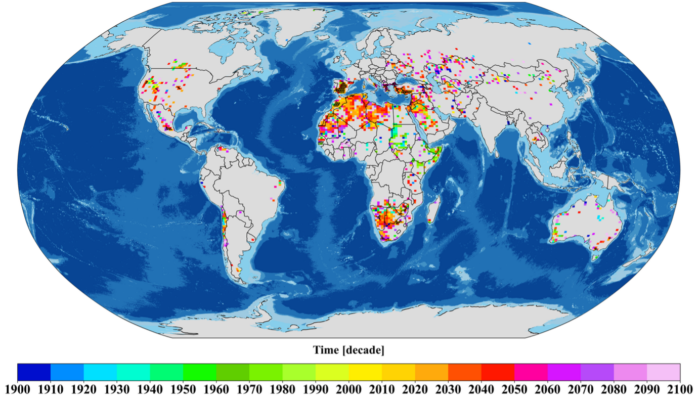
Spatial distribution of the decadal ToFE of DZD events across the globe from 1900 to 2100. Colored shading indicates the first decade during which DZD becomes statistically attributable to anthropogenic climate change, defined as the first decade in which the Fraction of Attributable Risk is greater than 0.99 (FAR ≥ 0.99). Gray regions indicate grid cells where no DZD event attributable to anthropogenic climate change is projected to emerge before 2100. For regions with reservoirs, the ToFE is considered to be the first decade after the year of completion of their respective reservoirs, when all DZD criteria are simultaneously met. By aligning the emergence timing with the operational onset of water storage infrastructure to reflect the real-world system resilience dynamics. The black stars denote the locations of the reservoirs threatened by DZD emergence.
Extreme events are becoming increasingly observable, intense, and interconnected. Drought, traditionally viewed as a regional and temporary phenomenon, is now undergoing a fundamental shift. We introduce the concept of “Day Zero Drought” to describe a threshold where water demand exceeds available supply under persistent drought conditions. This study shows that water scarcity is no longer confin ...[Read More]
Nonlinear Processes in Earth System Dynamics
www.earth-system-dynamics.net
Earth System Dynamics (ESD) is an open-access EGU journal focussing on an interdisciplinary view of the functioning of the Earth system and global change. Due its broad focus, ESD receives submissions of relevance to several different EGU divisions. Here, I would like to highlight five thought-provoking ESD papers that cover topics spanning environmental governance, extreme events, palaeo-climates ...[Read More]
ECS SpotLight: The link between European warm-temperature extremes and atmospheric persistence
Credit: ESA, CC BY-SA IGO 3.0
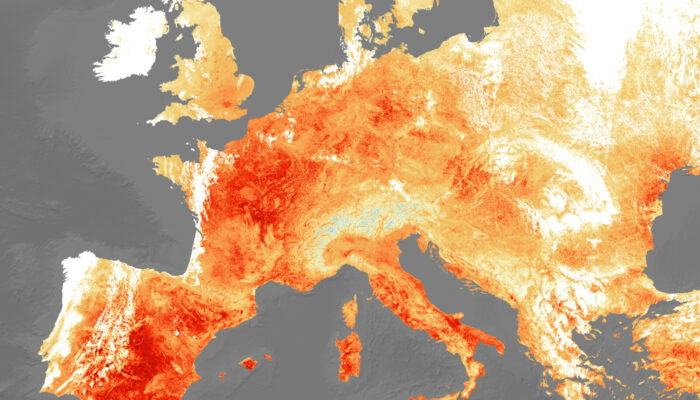
Persistent atmospheric circulation patterns are not a necessary requirement for warm temperature extremes in Europe. This key finding from a recent study led by Emma Holmberg challenges a more traditional meteorological view of persistence, which typically considers summertime heatwaves, especially in northern regions of Europe, to be synonymous with persistent atmospheric flow patterns. Furthermo ...[Read More]