Extreme events are becoming increasingly observable, intense, and interconnected. Drought, traditionally viewed as a regional and temporary phenomenon, is now undergoing a fundamental shift. We introduce the concept of “Day Zero Drought” to describe a threshold where water demand exceeds available supply under persistent drought conditions. This study shows that water scarcity is no longer confined to isolated regions but is emerging as a synchronized global signal driven by the combined effects of climate change and human pressures.
“Day Zero Drought” represents a compound multi-year event arising from the joint exceedance of multiple critical thresholds in atmospheric, hydrological, and socio-economic indicators, combined with reservoir depletion constraints. This multivariate, threshold-based framework reflects the nonlinear interaction between water supply and demand, where changes in climate forcing or consumption can trigger disproportionate impacts. The detection of the Time of First Emergence using the Fraction of Attributable Risk further allows us to identify when the system transitions beyond its historical variability into a new regime. Importantly, we quantify not only the emergence of these events but also their temporal structure, showing that waiting times between events decrease while their duration increases, indicating reduced system resilience and more persistent water scarcity. Together, these elements provide a process-based framework to diagnose how coupled human–climate systems evolve toward drought-driven water scarcity events.
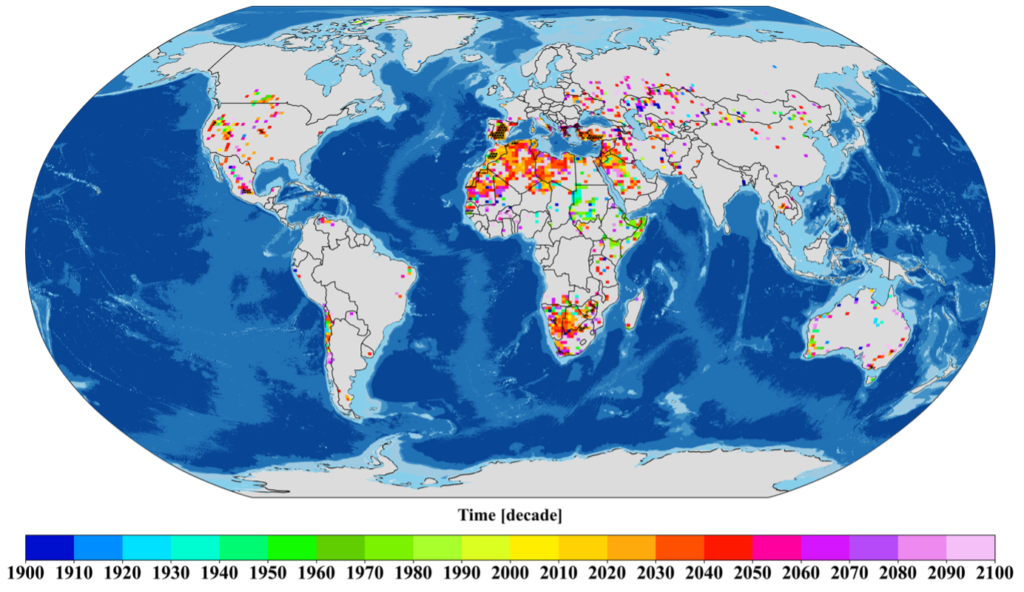
A key finding of my work is the early emergence of these conditions, with many regions projected to experience unprecedented water scarcity as early as the 2020s and 2030s. This marks a critical transition where hydrological variability shifts beyond historical bounds. Central to this process is the declining reliability of water storage systems. Under continued warming, reservoirs increasingly fail to recharge at rates sufficient to meet demand, leading to systemic deficits and, in some cases, complete depletion, true “Day Zero” conditions. This evolution is driven not only by reduced precipitation but also by increased evaporative demand and intensified water use. Importantly, the waiting time between consecutive “Day Zero Drought” events is projected to shorten significantly, while their duration increases,indicating a shift toward more frequent and persistent water scarcity, with limited recovery between events. Therefore, the concept of “Day Zero Drought” is no longer a distant fiction or an isolated event; it is an emerging reality of the Anthropocene
The scale of the future risk is staggering, particularly for urban areas. By the end of the century, up to 750 million people could face “Day Zero” conditions, particularly in regions such as the Mediterranean, Southern Africa, and parts of North America. Notably, resultsindicate that even a warming limit of 1.5 °C would trigger major water crises for urban populations as well as rural areas. This underscores that the challenge extends beyond temperature targets to a broader destabilization of the global water cycle. The coherence and scale of these changes point to a clear anthropogenic signal, where human-driven climate change and water use are fundamentally altering hydrological systems. An important dimension of this emerging risk is the synchronization of drought and water scarcity across regions. In an interconnected world, simultaneous water deficits can amplify impacts across food, energy, and economic systems. Agricultural losses in multiple regions can destabilize global markets, while concurrent stress on water and energy infrastructure can strain governance and resilience. As a result, drought is no longer only an environmental hazard; it is a systemic risk that cascades across sectors and borders.
These findings serve as an urgent call to radically rethink and fundamentally reevaluate water management and climate adaptation strategies. The drying of the reservoirs and the early emergence of “Day Zero” risks in the present decade prove we can no longer afford to be reactive. Proactive planning can improve early warning systems, and stronger international cooperation will be essential. Ultimately, addressing this challenge also requires rapid reductions in greenhouse gas emissions. “Day Zero” may not occur as a single moment, but as a gradual crossing of thresholds across regions. Recognizing and responding to this shift will be critical to navigating an increasingly water-constrained world.
Reference: Vecchia P. Ravinandrasana and Christian L.E. Franzke, 2025: The First Emergence of Unprecedented Global Water Scarcity in the Anthropocene, Nature Communications, vol. 16, 1, article 8281, doi: 10.1038/s41467-025-63784-6
Doi: 10.1038/s41467-025-63784-6
Licence for figures: http://creativecommons.org/licenses/by-nc-nd/4.0/.
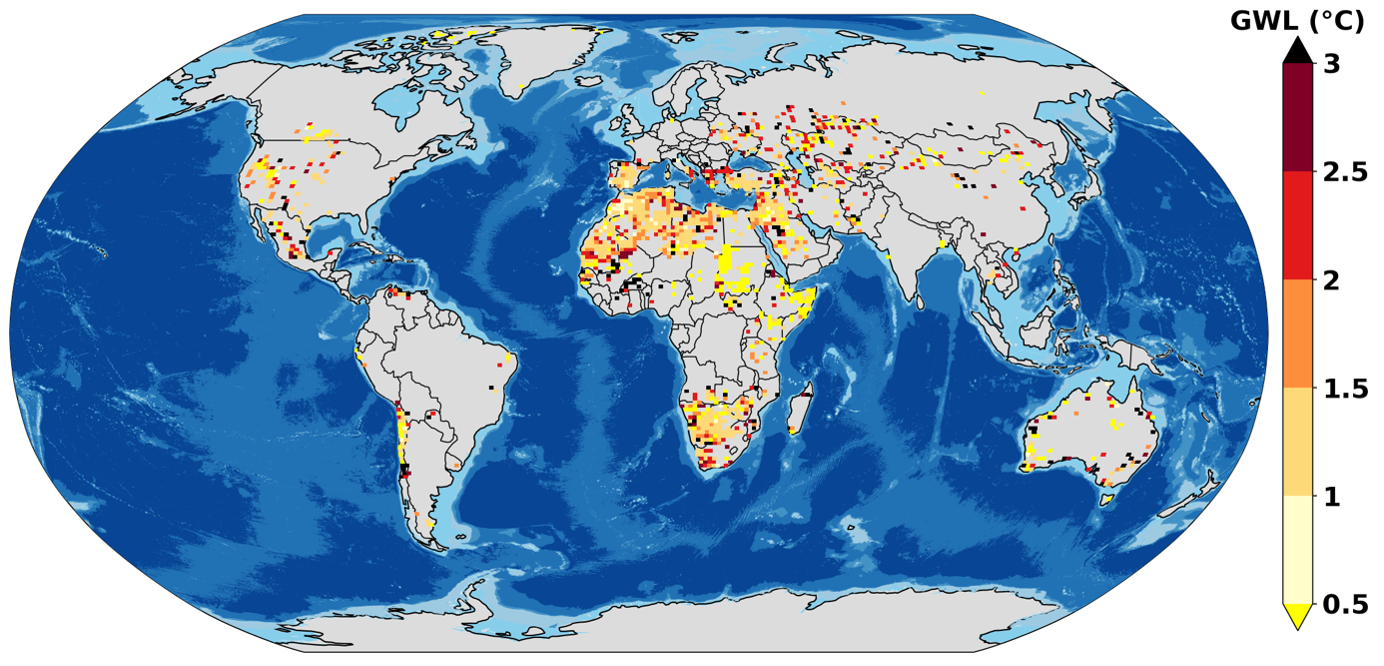
Ravinandrasana and Franzke (2025) Fig. 4b: Global distribution of the Global Warming Level (GWL, in °C above preindustrial) corresponding to the ToFE of DZD, providing insight into the warming levels associated with the onset of DZD events.

Related Posts