In this week’s blog, Dwijendra Pandey, a PhD student in the Tectonic Geodesy Group at CSIR-NGRI, Hyderabad, India, takes us beneath Antarctica’s ice to explore how changes in ice and snow move the solid Earth, and how scientists track this subtle motion from space and on the ground.
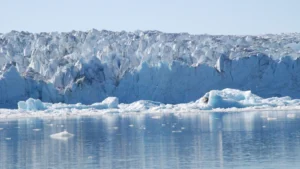
Antarctica might seem like the last place you would expect the ground to move: a vast, frozen landscape resting on ancient rock. Yet beneath all that ice, the solid Earth is responding to changes happening above it.
Imagine pressing your hand into a mattress and then lifting it away. The surface sinks under the extra weight and rises when that weight is removed. The Earth responds in a similar way, although its movements are much smaller relative to its size. As ice and snow accumulate or disappear, the rock beneath them deforms (Whitehouse et al., 2019).
So, how does Antarctica respond when its icy load changes? And can we pick up the rhythm of the seasons in the movement of the ground?
Taking the weight off: how the Earth responds
The solid Earth responds to changing ice loads on different timescales. One response is rapid: when ice mass is lost, the Earth deforms elastically as the load is reduced. Add more snow or ice, and the extra weight pushes the surface down.
Another response involves the slower movement of rock deep inside the Earth. Known as glacial isostatic adjustment, or GIA, this reflects the Earth’s continuing adjustment to changes in ice and ocean loading, including those dating back to past ice ages. How quickly that adjustment happens depends partly on the properties of the underlying mantle (Whitehouse et al., 2019).
The challenge is that our instruments record these movements together. To understand what today’s ice changes are doing, we need to separate their effects from the Earth’s ongoing adjustment to its icy past (King et al., 2010). Even changes in snowfall over several years can influence the trends we measure, making that separation trickier than it first sounds (Koulali et al., 2025).
Following the movement: satellites meet solid ground
How do we track movements that are far too small to notice while standing on the ground?
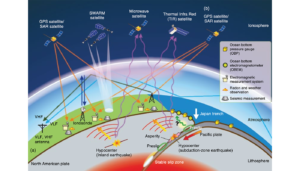
On exposed bedrock, Global Navigation Satellite System (GNSS) receivers repeatedly measure their positions. Over time, these records reveal how the ground moves upwards, downwards, and sideways. Antarctic GNSS observations have become an important tool for investigating both present-day deformation and the longer-lasting effects of past ice changes (Bevis et al., 2009; Buchta et al., 2025).
Meanwhile, satellite altimetry missions such as ICESat, CryoSat-2, and ICESat-2 measure changes in the height of the ice surface. These observations reveal where the ice sheet is thinning or thickening (Helm et al., 2014; Schröder et al., 2019; Nilsson et al., 2022). Translating those height changes into changes in mass requires accounting for factors such as snow density and compaction (McMillan et al., 2014; Nilsson et al., 2022).
Together, these measurements offer complementary views: how the ice is changing above, and how the ground is moving below.
Where the ice retreats, the ground responds
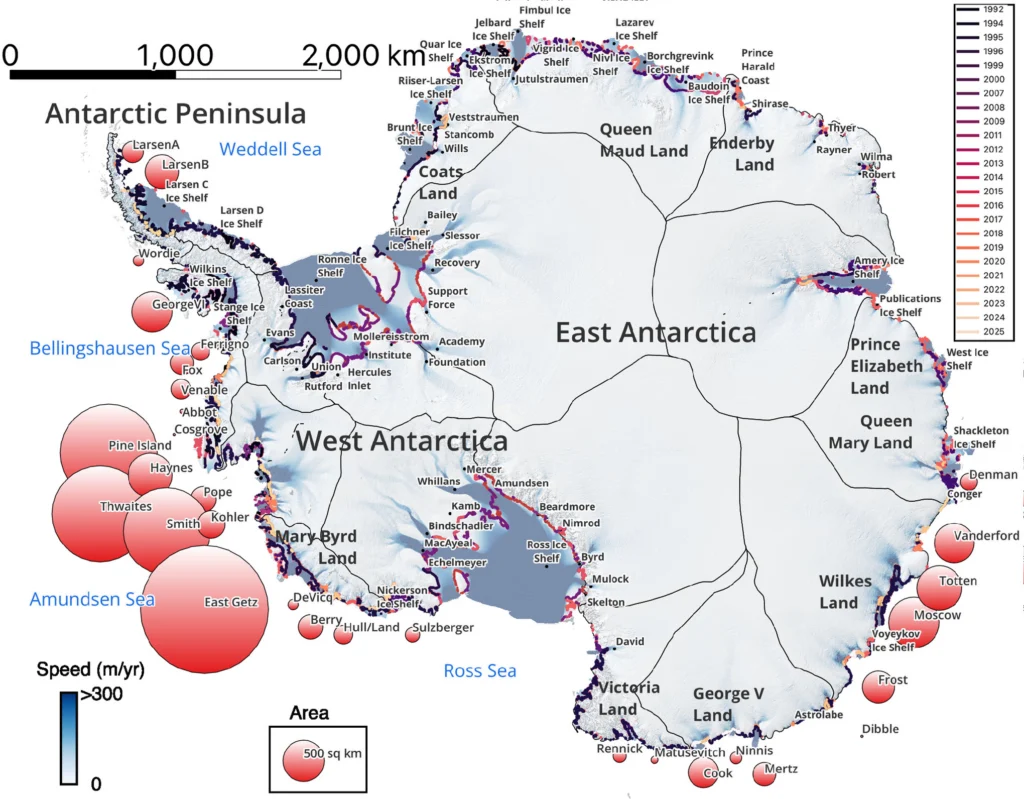
Some of the most striking changes are happening in West Antarctica, particularly around the Amundsen Sea, home to Pine Island and Thwaites glaciers. Satellite observations have documented substantial ice loss in this region, alongside pronounced grounding-line retreat (Shepherd et al., 2018; Rignot et al., 2026). The grounding line marks the transition between ice resting on bedrock and ice floating on the ocean. Tracking its retreat helps us understand where the ice sheet is losing contact with the ground (Rignot et al., 2026).
As glaciers lose grounded ice, the load on the solid Earth decreases. The response includes uplift and horizontal movement, with the pattern depending on where the ice is being lost and how that loss is distributed (Whitehouse et al., 2019).
In our analysis, we investigated how these changing loads relate to patterns of crustal deformation (Pandey et al., 2026, under review). This helps us look beyond the retreating ice front and consider what is happening beneath it.
A seasonal rhythm beneath the ice
Antarctica’s movement is not only a long-term response to ice loss. It also has a seasonal rhythm.
As snow accumulates and mass is removed or redistributed, the load on the ground changes. These variations can produce small, repeating movements, giving the continent something resembling a yearly “breath”. Weather-related changes in atmospheric pressure and ocean loading can also contribute to the movements recorded by geodetic instruments (Bürgmann et al., 2024).
To investigate this rhythm, we removed the long-term trends from continuous GNSS records and examined the remaining seasonal signals.
Our results indicate stronger seasonal deformation along the Transantarctic Mountains and in the Cook Land region, with more moderate annual signals around the Antarctic Peninsula and the Abbot Ice Shelf region (Pandey et al., 2026, under review).
These regional differences raise an interesting question: how closely does the ground follow changes in the surface load? Comparing the seasonal movements with independent estimates of loading can help us work out which processes are driving the pattern.
Why listen to Antarctica’s “breathing”?
These small movements matter because the ground beneath the ice is itself changing. Understanding that motion helps us interpret geodetic measurements and distinguish the effects of present-day ice changes from the continuing response to past ice cover. This distinction is particularly important when estimating ice-mass changes from satellite gravity measurements, which also pick up changes within the solid Earth (Whitehouse et al., 2019; Koulali et al., 2025).
The picture of Antarctica as a motionless frozen continent begins to look rather different. Above the bedrock, ice flows and snow accumulates. Below it, the solid Earth adjusts.
By following both, we can better understand how Antarctica’s ice and the Earth beneath it respond to a changing climate.
References:

Bevis, M., et al. (2009). Geodetic measurements of vertical crustal velocity in West Antarctica and the implications for ice mass balance. Geochemistry, Geophysics, Geosystems, 10(10), Q10005. https://doi.org/10.1029/2009GC002642

Buchta, E., et al. (2025). Advancing geodynamic research in Antarctica: Reprocessing GNSS data to infer consistent coordinate time series (GIANT-REGAIN). Earth System Science Data, 17, 1761–1780. https://doi.org/10.5194/essd-17-1761-2025

Bürgmann, R., Chanard, K., & Fu, Y. (2024). Climate- and weather-driven solid Earth deformation and seismicity. In GNSS Monitoring of the Terrestrial Environment: Earthquakes, Volcanoes and Climate Change (pp. 257–285). Elsevier. https://doi.org/10.1016/B978-0-323-95507-2.00011-6

Pandey, D. N., Gahalaut, V. K., & Catherine, J. K. (2026). Crustal strain in the Antarctic plate: Constraints from GNSS, GRACE, satellite altimetry observations, and GIA models. Manuscript submitted to Geophysical Journal International (under review).

Helm, V., Humbert, A., & Miller, H. (2014). Elevation and elevation change of Greenland and Antarctica derived from CryoSat-2. The Cryosphere, 8, 1539–1559. https://doi.org/10.5194/tc-8-1539-2014

King, M. A., et al. (2010). Improved constraints on models of glacial isostatic adjustment: A review of the contribution of ground-based geodetic observations. Surveys in Geophysics, 31, 465–507. https://doi.org/10.1007/s10712-010-9100-4

Koulali, A., et al. (2025). Geodetic observations reveal near-zero uplift rates in the Transantarctic Mountains: Implications of surface mass loading deformation. Geophysical Research Letters, 52, e2025GL119082. https://doi.org/10.1029/2025GL119082

McMillan, M., et al. (2014). Increased ice losses from Antarctica detected by CryoSat-2. Geophysical Research Letters, 41, 3899–3905. https://doi.org/10.1002/2014GL060111

Nilsson, J., Gardner, A. S., & Paolo, F. S. (2022). Elevation change of the Antarctic Ice Sheet: 1985 to 2020. Earth System Science Data, 14, 3573–3598. https://doi.org/10.5194/essd-14-3573-2022

Rignot, E., et al. (2026). Thirty years of glacier grounding line retreat in Antarctica. Proceedings of the National Academy of Sciences, 123(10), e2524380123. https://doi.org/10.1073/pnas.2524380123

Schröder, L., et al. (2019). Four decades of Antarctic surface elevation changes from multi-mission satellite altimetry. The Cryosphere, 13, 427–449. https://doi.org/10.5194/tc-13-427-2019

Shepherd, A., et al. (2018). Mass balance of the Antarctic Ice Sheet from 1992 to 2017. Nature, 558(7709), 219–222. https://doi.org/10.1038/s41586-018-0179-y

Whitehouse, P. L., et al. (2019). Solid Earth change and the evolution of the Antarctic Ice Sheet. Nature Communications, 10, 503. https://doi.org/10.1038/s41467-018-08068-y