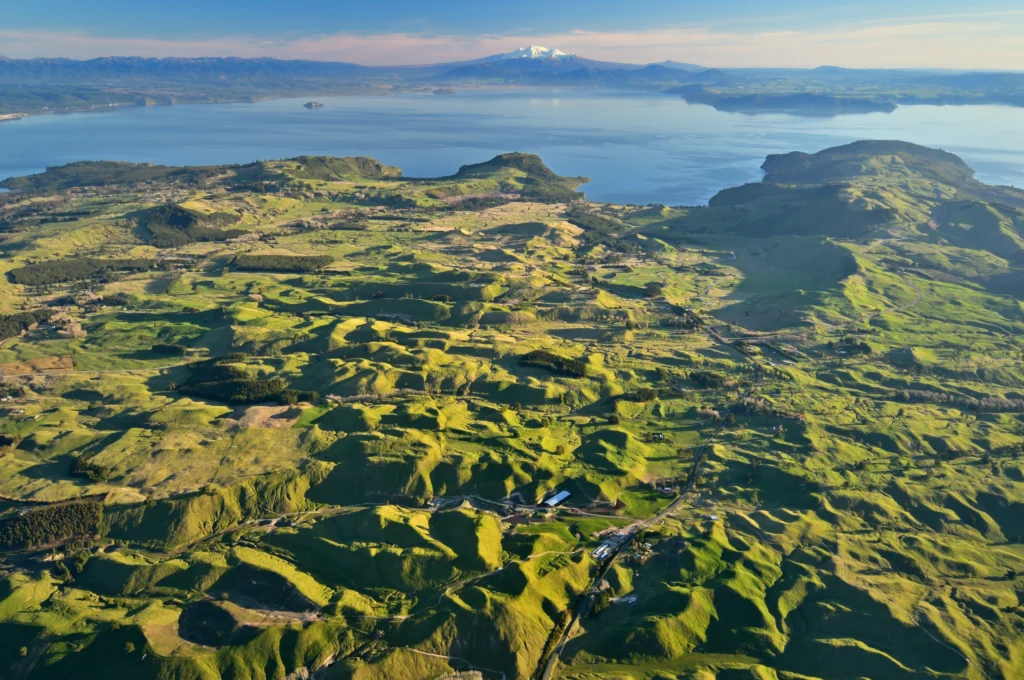
The Taupō Volcanic Zone in the North Island of New Zealand has experienced some of the largest volcanic eruptions in Earth’s recent history. It also offers a quite unique geological setting, with a rift and a volcanic arc overlapping and, unlike most continental rifts, a massive production of rhyolite. This week, Alex Gold, a PhD student from the University of Auckland, is digging – quite literally – into the mysteries of this region, trying to understand the interplay between rift faulting, paleoseismicity, and caldera-forming eruptions.

Alex S. Gold is a 3rd-year PhD Candidate at the University of Auckland – Waipapa Taumata Rau, Auckland, Aotearoa-New Zealand, where he is examining the relationship between large-volume, caldera-forming, rhyolitic volcanism and the evolution of rift segmentation and faulting in the Taupō Rift. His research interests span from caldera volcanism and extensional tectonics to paleoseismicity and rifting. He enjoys bouldering and travel. You can reach out to him at agol196@aucklanduni.ac.nz.
The Taupō Volcanic Zone
The central Taupō Volcanic Zone (TVZ) in Aotearoa-New Zealand’s North Island is arguably the most active zone of rhyolitic volcanism on Earth (Figure 1) [1]. For those of us fascinated by the largest, most explosive eruptions on Earth, the TVZ is one of the most interesting places on the planet. Some notable volcanic cataclysms in the TVZ record include the Kidnappers (~1,200 km3, ~1 Ma: [2]), Whakamaru (~1,500 km3 DRE, ~350 ka: [3]), Ōruanui (~530 km3 DRE, ~25.5 ka: [4]), plus the most recent caldera-forming eruption, the ~232 CE Taupō eruption (~35 km3 DRE: [5]). All told, central TVZ volcanoes over the last ~1.8 Myr have produced >6,000 km3 of rhyolitic magma over >25 caldera-forming episodes [2]. To put this into perspective, that’s the equivalent of 23 m, or around six storeys, of solidified rhyolitic magma covering the entirety of New Zealand (~263,000 km2).
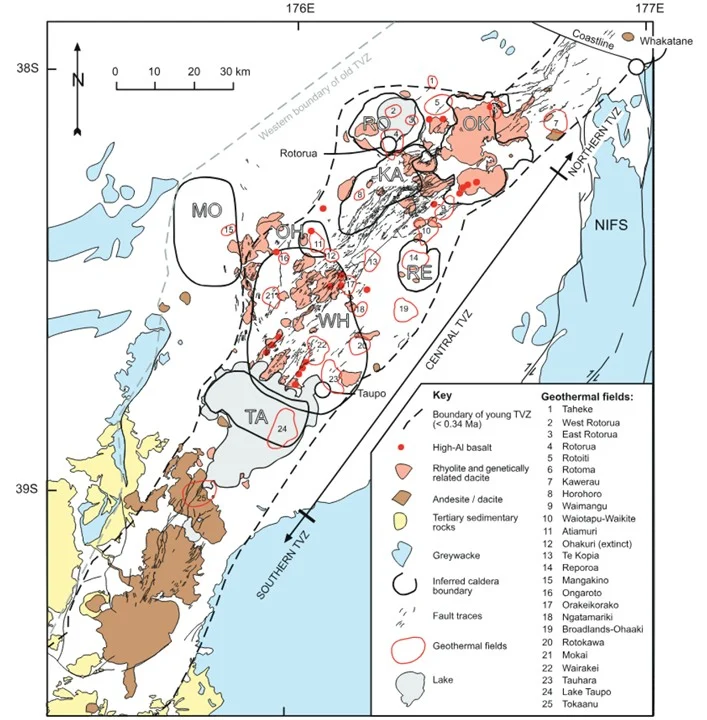
Figure 1: Detailed map of the Taupō Volcanic Zone and the faults that make up the Taupō Rift. TA and OK (Taupō and Ōkataina) indicate the locations of two caldera volcanoes discussed in the main text. Figure is from Wilson and Rowland (2016) [1]. Please see their article for the full caption.
But the TVZ is not just a volcanic arc. The widely distributed deposits from the many TVZ volcanoes are extensively cut by an array of normal faults that span the entire length of the continental section of the volcanic arc (Figure 1). This array of normal faults, referred to as the Taupō Rift, is related to extension driven by the subduction of the Pacific Plate beneath the Australian Plate at the Hikurangi Subduction margin off the east coast of Aotearoa-New Zealand’s North Island [6]. The Taupō Rift faults run along the length of the TVZ and cross the two active rhyolite caldera volcanoes of Taupō and Ōkataina (Figure 1). The spatial coincidence of an arc and a rift has led to the term “rifted-arc” (or “intra-arc rift”) being used to describe this section of the North Island.
Global models of continental rifting
However, the Taupō Rift is not the only continental rift to host volcanic activity. The Icelandic and East African rifts (arguably the most well-studied rifts) are also zones of active volcanism. In such rifts, which are comparatively well understood, faulting and extension are largely accommodated by mafic magma injection, promoting dyking and caldera subsidence through lateral magma transport. While there are some similarities with these models in the Taupō Rift (e.g., caldera-adjacent faults, caldera subsidence, dyking events), there are also incongruencies. For example, viscosity differences between the evolved, viscous rhyolitic magmas of the central TVZ and the fluid, mafic magmas of other continental rifts necessitate different controls on the movement and accumulation of magma in the shallow crust. Additionally, while the Iceland and the Main Ethiopian Rifts host silicic volcanic centres (e.g., Askja volcano; Afar region), the volumes of rhyolite released are much less than in the central TVZ (eruptive rate of 3.8 – 12.8 km3 kyr-1, exceeding that of the Yellowstone system [2]). Although it remains an area of significant unknowns, new research suggests the TVZ’s exceptional rate of magma production is potentially (in part) the product of anomalously high and concerted slab dehydration [7][8] representing an entirely different mechanism for magma production than in global counterparts (e.g., decompressive melting and/or mantle plume related).
Investigating the linkages between large-volume caldera-forming eruptions and rift-related faulting
Here in Aotearoa-New Zealand, the overlapping of rifting and volcanism has led to intense interest from researchers over the last 20-30 years (start with [9] if you are interested in learning more). My PhD aims to continue this legacy of investigating the links between rifting and volcanism in this area. I am approaching this challenge primarily through paleoseismic trenching of caldera-adjacent faults just north of the Taupō caldera (Figures 2, 3, and 4). Preliminary results from this venture were recently published in Gold et al. (2026) [10], which documented two instances of faulting during the caldera-forming 232 CE eruption. First, we showed that a caldera-adjacent fault in the Taupō Rift (the Whakaipō Fault) ruptured just (days to months) before the eruption. Second, we demonstrated that the same fault accumulated ~10 m of throw in the ~20-year period following the eruption. We highlighted that other workers (e.g., [11], [12]) have also reported evidence of pre-232 eruption faulting, demonstrating that tectonic activity likely affected multiple rift faults in the lead-up to the eruption. The ~10 m of throw accrued in the aftermath of the eruption demonstrates the connection between the removal of tens of km3 of material from the shallow crust and tectonic readjustments. Such tectonic readjustments in association with caldera-forming eruptions are documented from some of the largest eruptions (e.g., Ōruanui [13], Kidnappers [14], Huckleberry Ridge [15], Whakamaru [3]). These readjustments are postulated to have influenced eruption dynamics, with further unpublished results from my PhD suggesting they coincide with the onset of the ignimbrite-forming phase of the 232 CE eruption. Furthermore, I am currently writing up results that demonstrate that many more caldera-adjacent rifts faults were active during the 232 CE eruption – stay tuned!
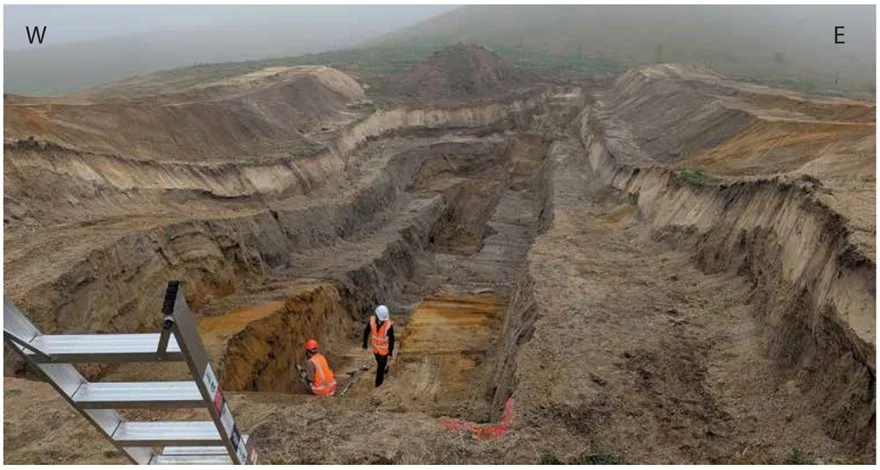
Figure 2: TK3 paleoseismic trench. The footwall of the Kaiapo Fault is represented by the orange material visible on the mid-bench floor. The plane of the fault, which is strinking from E-W, is observable where the colour changes from orange to grey. The grey material, which is ~5 m thick against the fault, is ignimbrite from the 232 CE caldera-forming Taupō eruption.
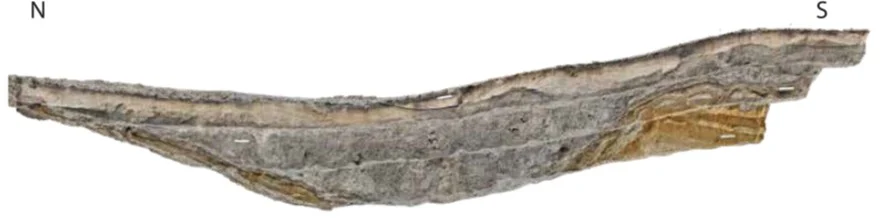
Figure 3: Composite ortho-image of TK3 paleoseismic trench. Grey unit capped by sandy white unit is the ignimbrite formed during the 232 CE eruption. Composite scarp of the Kaiapo Fault (south side of image) is buried and partially reset by the emplacement of the 232 CE ignimbrite.
During the recent JpGU-AGU 2026, a plenary speaker, Dr Jun Korenaga, presented the importance of considering the “So what?” when conducting new research. I believe the so what of my research runs along two pathways. The first pathway, as discussed above, is that there is evidence for connections between caldera-forming eruption dynamics and extensional tectonics. Understanding these connections remains poorly constrained, and my work aims to further advance this critical area of research. The second pathway is addressing how the TVZ and Taupō Rift fit into global models of magma-assisted rifting developed over the last 20-30 years in places like Iceland and the East African Rift. My hope is that by examining both the faults (geologic record) and the seismicity (modern stress state) of the Taupō Rift and comparing these records with the incredible history of volcanism in TVZ, we can better understand the connection between two of Earth’s most powerful forces.
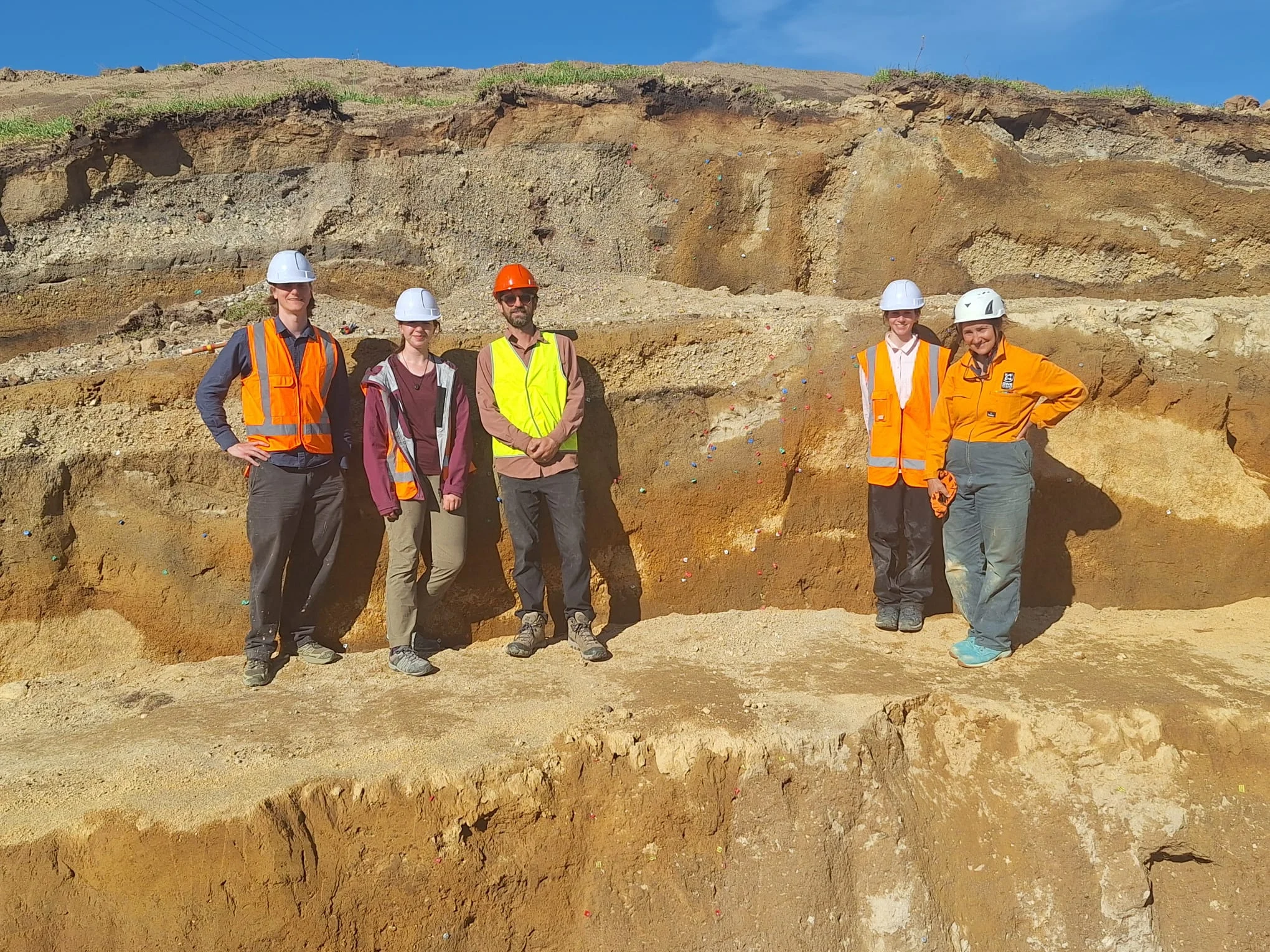
Figure 4: Image of wall of paleoseismic trench across the Kaiapo Fault. From left to right: Alex S. Gold, Katharine Gilchrist, Dr. James Muirhead, Tegan Pegler, Dr. Pilar Villamor.
References:
[1] Wilson, C.J.N., Rowland, J.V., 2016. The volcanic, magmatic and tectonic setting of the Taupo Volcanic Zone, New Zealand, reviewed from a geothermal perspective. Geothermics, Taupo Volcanic Zone Geothermal Systems, New Zealand: Exploration, Science and Development 59, 168–187. https://doi.org/10.1016/j.geothermics.2015.06.013

[2] Wilson, C.J.N., Gravley, D.M., Leonard, G.S., Rowland, J.V., 2009. Volcanism in the central Taupo Volcanic Zone, New Zealand: tempo, styles and controls, in: Thordarson, T., Self, S., Larsen, G., Rowland, S.K., Höskuldsson, Á. (Eds.), Studies in Volcanology: The Legacy of George Walker. Geological Society of London, p. 0. https://doi.org/10.1144/IAVCEl002.12

[3] Miller, A.L., Barker, S.J., Wilson, C.J.N., 2026. Reconstructing one of the largest explosive eruptions of the Quaternary through high-resolution tephra geochemistry: the 349 ka Whakamaru supereruption. Journal of Volcanology and Geothermal Research 474, 108619. https://doi.org/10.1016/j.jvolgeores.2026.108619

[4] Wilson, C.J.N., 2001. The 26.5 ka Oruanui eruption, New Zealand: an introduction and overview. Journal of Volcanology and Geothermal Research 112, 133–174. https://doi.org/10.1016/S0377-0273(01)00239-6

[5] Hogg, A., Wilson, C.J.N., Lowe, D.J., Turney, C.S.M., White, P., Lorrey, A.M., Manning, S.W., Palmer, J.G., Bury, S., Brown, J., Southon, J., Petchey, F., 2019. Wiggle-match radiocarbon dating of the Taupo eruption. Nat Commun 10, 4669. https://doi.org/10.1038/s41467-019-12532-8

[6] Seebeck, H., Nicol, A., Villamor, P., Ristau, J., Pettinga, J., 2014. Structure and kinematics of the Taupo Rift, New Zealand. Tectonics 33, 1178–1199. https://doi.org/10.1002/2014TC003569

[7] Eberhart-Phillips, D., Bannister, S., Reyners, M., 2020. Attenuation in the mantle wedge beneath super-volcanoes of the Taupo Volcanic Zone, New Zealand. Geophys J Int 220, 703–723. https://doi.org/10.1093/gji/ggz455

[8] Mark, O.K., Illsley-Kemp, F., Townend, J., Barker, S.J., 2024. Evidence From Intermediate-Depth Earthquakes of Slab-Derived Fluids Beneath the Taupō Volcanic Zone. Journal of Geophysical Research: Solid Earth 129, e2023JB028586. https://doi.org/10.1029/2023JB028586

[9] Rowland, J.V., Wilson, C.J.N., Gravley, D.M., 2010. Spatial and temporal variations in magma-assisted rifting, Taupo Volcanic Zone, New Zealand. Journal of Volcanology and Geothermal Research, Making and Breaking the Arc: a volume in honour of Professor John Gamble 190, 89–108. https://doi.org/10.1016/j.jvolgeores.2009.05.004

[10] Gold, A.S., Snowden, M., Muirhead, J.D., Villamor, P., Coffey, G.L., Wilson, C.J.N., Morgenstern, R., 2026. Large-scale rift-related faulting linked to a caldera-forming eruption: A case study from Taupō, New Zealand. Journal of Volcanology and Geothermal Research 469, 108481. https://doi.org/10.1016/j.jvolgeores.2025.108481

[11] Villamor, P., Clark, K., Watson, M., Rosenberg, M., Lukovic, B., Ries, W., González, A., Milicich, S.D., McNamara, D.D., Pummer, B., Sepulveda, F., 2015. New Zealand geothermal power plants as critical facilities: an active fault avoidance study in the Wairakei Geothermal Field, New Zealand. 2015-04-19. https://doi.org/10.13025/15479

[12] Muirhead, J.D., Illsley-Kemp, F., Barker, S.J., Villamor, P., Wilson, C.J.N., Otway, P., Mestel, E.R.H., Leonard, G.S., Ellis, S., Savage, M.K., Bannister, S., Rowland, J.V., Townsend, D., Hamling, I.J., Hreinsdóttir, S., Smith, B., McGregor, R., Snowden, M., Shalla, Y., 2022. Stretching, Shaking, Inflating: Volcanic-Tectonic Interactions at a Rifting Silicic Caldera. Front. Earth Sci. 10. https://doi.org/10.3389/feart.2022.835841

[13] Allan, A.S.R., Wilson, C.J.N., Millet, M.-A., Wysoczanski, R.J., 2012. The invisible hand: Tectonic triggering and modulation of a rhyolitic supereruption. Geology 40, 563–566. https://doi.org/10.1130/G32969.1

[14]  Cooper, G.F., Wilson, C.J.N., Millet, M.-A., Baker, J.A., Smith, E.G.C., 2012. Systematic tapping of independent magma chambers during the 1 Ma Kidnappers supereruption. Earth and Planetary Science Letters 313–314, 23–33. https://doi.org/10.1016/j.epsl.2011.11.006

[15] Myers, M.L., Wallace, P.J., Wilson, C.J.N., Morter, B.K., Swallow, E.J., 2016. Prolonged ascent and episodic venting of discrete magma batches at the onset of the Huckleberry Ridge supereruption, Yellowstone. Earth and Planetary Science Letters 451, 285–297. https://doi.org/10.1016/j.epsl.2016.07.023 https://doi.org/10.1016/j.epsl.2016.07.023