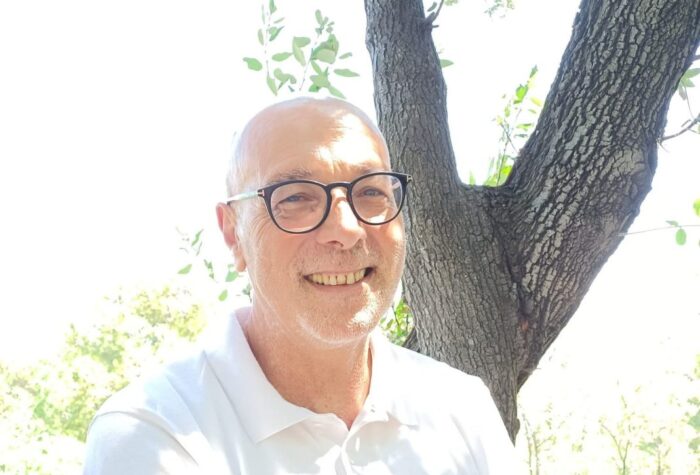
One year ago, Vincenzo Carbone left us. Vincenzo was a leading scientist in nonlinear geophysics, turbulence, and complex systems, influencing fluid and plasma physics, weather and space weather, solar–terrestrial relations, and climate dynamics. Yet for those who worked closely with him, his legacy goes well beyond his remarkable scientific achievements.
Scientific Contributions and Impact
Over more than three decades, Vincenzo provided fundamental new concepts and contributions for the characterization of magnetohydrodynamic (MHD) turbulence and intermittency, laying the foundation for the study of dissipation into the solar wind and space plasmas.
A milestone of his early career was the 1993 Physical Review Letters paper introducing a cascade model for MHD turbulence, derived from a binomial process, that reproduced observed scaling laws and, modified the oldest Kraichnan theory, revealed the multifractal nature of fully developed turbulence. This was the basis to demonstrate that incompressible and isotropic MHD turbulence can be described by an exact relation for the energy flux through the scales, i.e., a Yaglom-like law. This scaling behavior was indeed later observed in the solar wind measurements by the Ulysses spacecraft and Vincenzo made a fundamental contribution in modifying this phenomenological law to account for compressible. He demonstrated that, despite their relatively low amplitude, large-scale density fluctuations play a crucial role in defining the basic scaling properties of turbulence, and the turbulent cascade rate in compressive regimes provides the energy dissipation necessary to explain the local heating of the nonadiabatic solar wind.
His monograph Turbulence in the Solar Wind (Springer, 2016), a reference work in the field, captures these advances in a comprehensive way, integrating observational data together with numerical simulations within MHD turbulence theory, offering new insights into the physical mechanisms behind turbulence generation and the transfer of energy across scales. This provides a coherent and phenomenologically rich picture of solar wind turbulence, showing how theory, observations, and simulations can be combined to understand one of the most complex processes in plasma physics.
Beyond turbulence, Vincenzo contributed to all possible topics belonging to geoscience and nonlinear geophysics, from solar-terrestrial interactions to geodynamo studies. Inspired by complex systems approaches he derived a simple model to link heat flux variations at the core-mantle boundary to the frequency of geomagnetic reversals, as well as, he contributed to the understanding of the variability of the Earth’s climate, providing new insights into the multiscale nature of Earth system processes. These examples point to a shared intellectual foundation that Vincenzo mentored: natural systems across different physical contexts are best understood through unifying, nonlinear lenses that reveal structure across scales.
Vincenzo was a true interdisciplinary scientist, hinging the main aim of the NP Division within EGU. He applied concepts of nonlinear dynamics, intermittency, and self-organized criticality to systems ranging from solar flares to earthquakes and climate variability, helping to establish complex systems approaches as central tools in geophysics. Vincenzo combined scientific leadership with a strong commitment to collective progress and especially in training people, many of whom now hold academic and research positions worldwide. His teaching in complex systems, atmospheric physics, and solar–terrestrial relations inspired generations of young scientists.
A Message to Young Scientists
Despite his international recognition, our relationship was never marked by hierarchy. Although he was far above me in experience and reputation, he never emphasized that difference but, on the contrary, he constantly worked to cancel it. Scientific discussions were always on the same floor, driven by ideas rather than roles. Over time, mentorship naturally evolved into friendship, grounded in deep mutual respect and trust. This was not unique to our relationship, it was simply his way of being a Scientist. Vincenzo believed that science advances through openness, dialogue, and generosity, and that authority comes from competence and integrity, not from roles or distance.
To young scientists: I would suggest to learn from Vincenzo not only how to study turbulence and complex systems (he said: “If you like to study turbulence, make it as a hobby, don’t take turbulence seriously”), but how to be a scientist. Conduct your research with rigor without arrogance, pursuing excellence without losing humanity, and fostering collaboration without competition. His scientific legacy is continuing through his ideas, while his human legacy lives on in the way we build our scientific communities.
One year after his passing, his influence remains alive. It is a legacy that still moves and shapes us, like the energy cascade in turbulence, claiming for enriching our knowledge through connection among scientists whose (nonlinear) interactions can help to project in the future ideas and research topics driven by a large-scale driver known as Vincenzo Carbone.