Extreme meteorological and climatological events can be immensely damaging and disruptive to society. Understanding the physical mechanisms driving these events, and how they will evolve with climate change is crucial for informing societal adaptation to our changing climate. However, extreme events are, by definition, rare. Our capacity to understand these events is, therefore, hindered by the small sample size of observed events.
Recent methodological developments, termed rare events algorithms, have enabled the sample size of these types of events to be vastly increased in models. These methods “push” the model to simulate more extremes, whilst still keeping the estimation of their probability possible. This allows for the simulation of long-lasting extremes with millennial return times and beyond, that would otherwise be too costly to reach with brute force sampling. These methodologies are also readily applicable to other cases, for example shorter events.
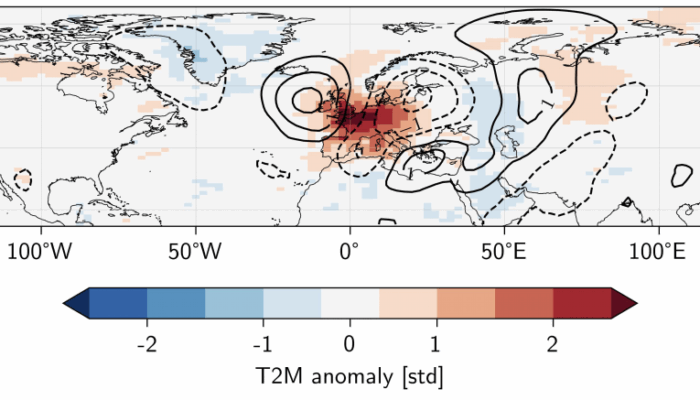
In this paper, we used one of these algorithms to simulate a large number of extremely hot summers for the present and two future scenarios in a climate model. We then study how the physical mechanisms change between the present and two futures for these hot summers. The rare events algorithm allows us to perform robust statistics when investigating how the dynamics of rare events changes for different climate scenarios.
Our results showed that future hot summers became less driven by the large-scale atmospheric forcings, particularly adiabatic warming, and more by regional diabatic warming. This is mainly because soils become climatologically drier in the future, meaning more energy is transferred to the atmosphere through sensible heat fluxes. In other words, when comparing events which are equally rare in their own climate, the climate system requires less large-scale atmospheric organisation in the future compared to the present. Interestingly, the signal for dry soils is not purely local but shifted eastward compared to the region with the maximum temperature anomaly.
This study demonstrates that rare events algorithms are a useful and interesting tool to study the physics of the climate system. By pushing the physical system one studies, here represented by the climate model, in directions that it does not easily go, we can learn about events in the very tails of climatological distributions. More than a fancy tool to simulate more extremes in models, we can actually learn something physical from the output of the algorithm. The algorithm acts akin to a magnifying glass for events in the tails of the climatological distribution, allowing us to learn how the components of the model interact in this regime.
Reference: , , , , & (2025). Evolution of the dynamics of centennial hot summers in Western Europe with climate change. Geophysical Research Letters, 52, e2025GL115552. https://doi.org/10.1029/2025GL115552
DOI: 10.1029/2025GL115552
Licence for images: https://creativecommons.org/licenses/by/4.0/
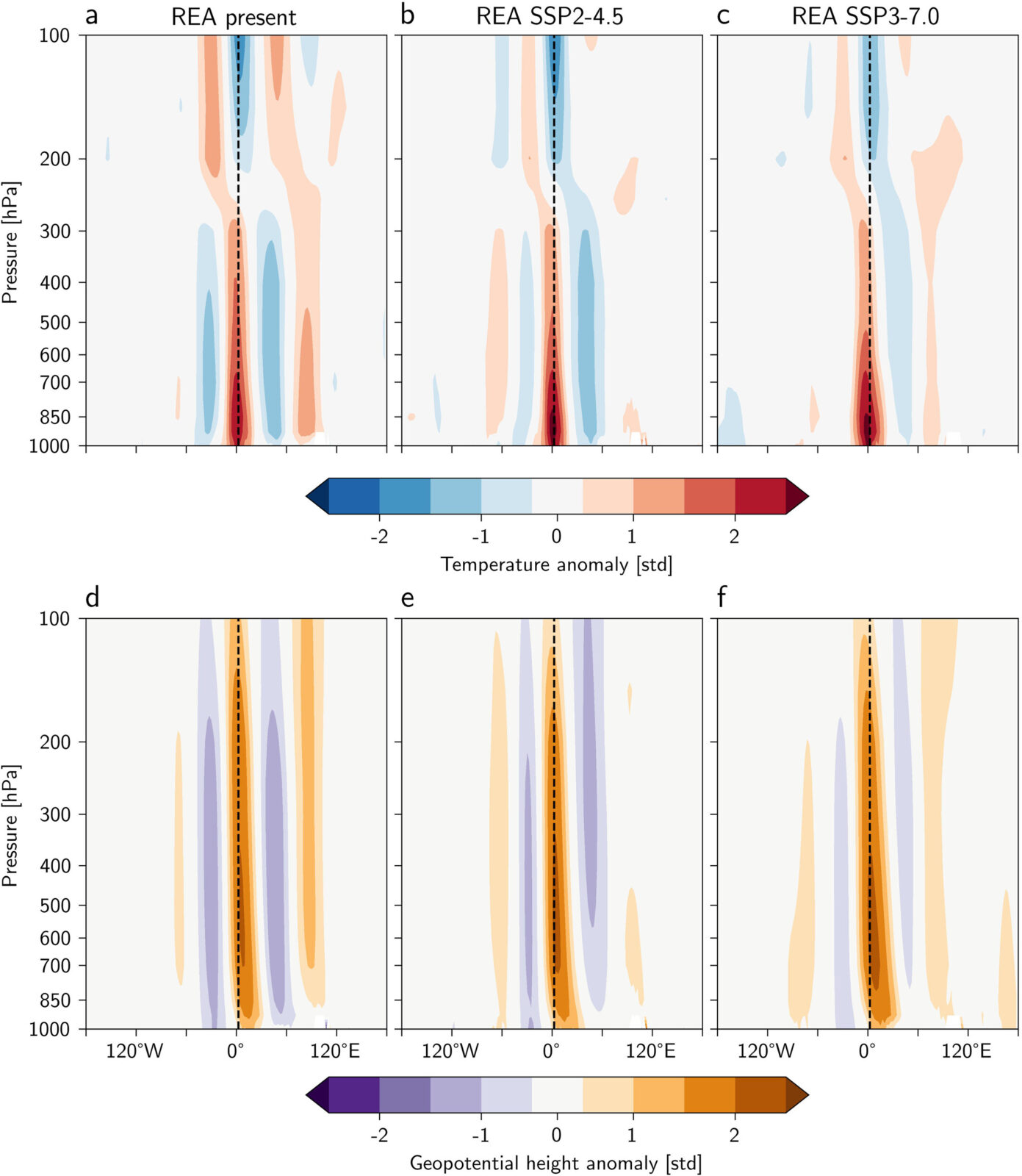
Noyelle et al. (2025), Fig. 2; Vertical cross-section of summer averaged standardized anomalies of (a–c) air temperature and (d–f) geopotential height for centennial hot summers. Standardized anomalies are computed by removing at each grid point the mean and dividing by the standard deviation computed on the control simulation of their period. The cross-section is computed after a latitudinal average between 40° and 70°N. The black dashed line shows the longitude of the grid point where the score function is computed.