What are the most pressing research topics in the international community of hydrologists? What are people working on? And how can you become involved? Many hydrologists, especially early career scientists, struggle to find answers to these questions. That is where the scientific decades of the International Association of Hydrological Sciences (IAHS) come in. Specifically, its latest one – ...[Read More]
Latest posts
Geodynamics
Into the Unknown: Research Cruises and the Geologist’s Drill
With love for geoscience comes a zest for exploring the natural world. What we want to explore might not always be close to us. But science finds a way, even if it means sailing to the middle of the ocean. This week, we are going to dive into the nuts and bolts of how research cruises work in this blog post by Kuan-Yu Lin from the University of Delaware. Kuan-Yu recently sailed as an igneous petro ...[Read More]
GeoLog
Imaggeo On Monday: Elegance with no functionality
The Montejaque dam, with its 84 meters of height, is one of the first vaulted dams built in Europe. Currently, it remains only as a vestige of one of the major hydroelectric projects by the “Sevillana de Electricidad” company. Preliminary studies for its construction began in 1917. Some of these studies indicated that the project was unfeasible due to the karstic nature of the terrain, ...[Read More]
GeoLog
Can anyone engage in geoscience outreach or does it take certain skills?
On 20 October 2023, a team of geoscientists will host EGU’s Geoscience Day in Santorini and Nisyros (Greece) with a diverse audience: 60 young students from Nisyros Elementary School, 120 students from the Vocational High School of Santorini, educators, local journalists and representatives of the tourism industry. With such a mixed group of attendees, one might expect unique challenges that ...[Read More]
Cryospheric Sciences
We are back – with 4 Arctic fieldwork stories!
You might have missed our weekly blog posts, but we are back! This week’s post highlights four field work campaigns our cryo community conducted. Join us on a journey to Greenland, Svalbard and Alaska to learn about methane emissions, glacier flows, tundra fires and ice microbes. Chasing methane in Greenland The subglacial environment of the Greenland Ice Sheet is a relatively new discovered ...[Read More]
GeoLog
GeoRoundup: the highlights of EGU Journals published during August!
Each month we feature specific Divisions of EGU and during the monthly GeoRoundup we put the journals that publish science from those Divisions at the top of the Highlights roundup. For August, the Divisions we are featuring are: Cryospheric Sciences (CR), Energy, Resources and the Environment (ERE) and Atmospheric Sciences (AS). They are served by the journals: Annales Geophysicae (ANGEO), Atmosp ...[Read More]
Hydrological Sciences
Ma Terre en 180 Minutes: reducing our carbon footprint with concrete actions
As with all professional activities, one of the greatest challenges for us, geoscientists, is how to reduce our own CO2 emissions linked to our research activities over the coming decades. A collective of 57 researchers came together in 2021-2022 to promote awareness and concrete action to decarbonize scientific activities: it was the birth of Ma Terre en 180 Minutes, whose title is inspired by Ma ...[Read More]
Geodynamics
Modelling CPO evolution with D-Rex
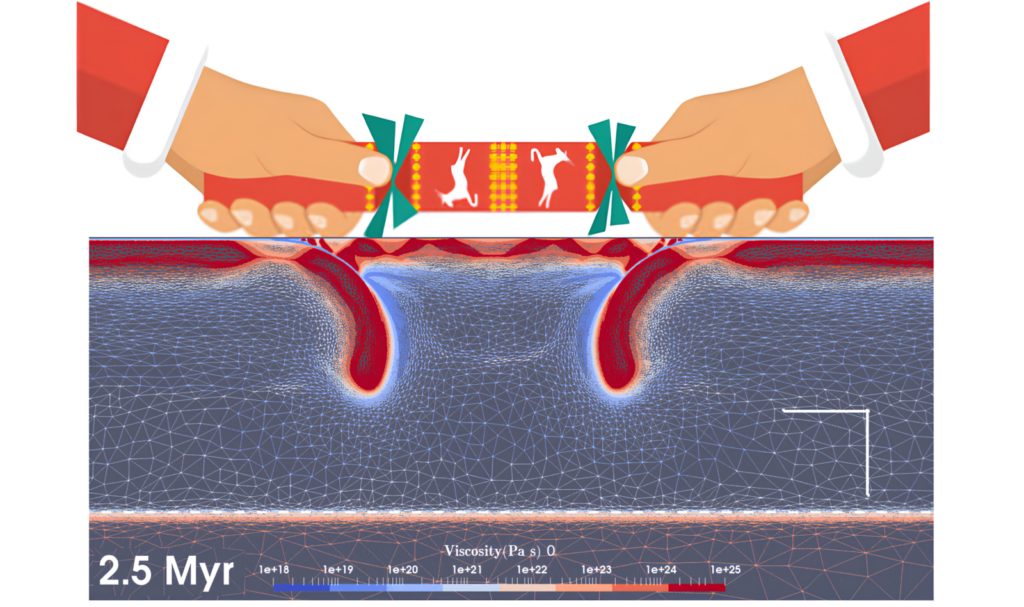
As a result of Earth’s mantle convection, rocks in the earth’s interior flow and develop a crystallographic texture. These textures reveal the planet’s thermal and tectonic history and are responsible for the viscous anisotropy, which can be used to study the planet’s deeper recesses that are not visible through other means. This necessitates the use of models that can pred ...[Read More]
Geomorphology
Flat but Fascinating: A New Perspective on Berlin at the 17th Annual International Young Geomorphologists’ Meeting
Emma Lodes, PhD student, GFZ-Potsdam (Germany) Twitter: @LodesEmma | email: lodes@gfz-potsdam.de When I consider places with exciting geomorphology, Germany’s capital does not spring to mind. Berlin is an isolated urban hub encircled by the flat, agriculturally dominated state of Brandenburg. Northeastern Germany was leveled by ice sheets during the last several glaciations, and its highest ...[Read More]
Geochemistry, Mineralogy, Petrology & Volcanology
Revisiting the roots of minerals’ names: A journey to mineral etymology
Hello everyone!! In an earlier blog, my colleague Eliot Carter discussed the etymology of elements. As a PhD student in geochemistry, mineralogy, Petrology and Volcanology, we all regularly deal with a large number of minerals. Among them, some are very common and a few are hardly known. However, sometimes we forget the basics to deal with the complicated things. In fact, PhD students mostly face ...[Read More]