Trust in science appears to be in crisis these days. So-called ‘alternative facts’ often fall on fertile ground, particularly amongst populist circles. During the Covid-19 pandemic in particular, this loss of trust was evident, for example, in the ‘Querdenken’ movement, which, amongst others, deliberately questioned protective measures and the effectiveness of vaccines. But what exactly does the pandemic have to do with uncertainty, and how can trust be built through better science communication?
(Mis)trust in science during the pandemic
Let’s look back at two specific examples from the pandemic. We all remember the AstraZeneca debacle, involving cases of cerebral venous thrombosis in young people despite STIKO’s prior recommendation. The STIKO initially recommended the use of the vaccine for a cohort that was broad in terms of age. Butwhen severe cases of cerebral venous thrombosis were emerging in young people approximately 4–16 days after administration that the recommendation was revised by the experts to apply to people over the age of 60. At the same time, the EMA maintained its recommendation on the use of the vaccine, which led to visible disharmony among European institutions and provocated the impression of arbitrariness [1]. Here, too, one can speak of a lack of transparency, which led to a loss of trust [2].
Communication was also lacking, particularly regarding the gap between experience, knowledge and recommendations, as well as the reliability of theoretical assumptions – including with regard to protecting others from infection through vaccination. With his statement “Pandemic of the Unvaccinated”, [SM2.1]Jens Spahn, then Germany’s Health Minister, painted a picture that was not entirely accurate, and later contradicted himself: “Protecting others was never the goal” [3].
But how could such facts have been communicated more effectively and in a more differentiated manner? Let us take a look at the UK, where the government commissioned specific infographics to help weigh up the risks associated with the AstraZeneca vaccine (see Figure). These used tangible comparisons to create transparency and facilitate a balanced assessment. The authors themselves emphasised that the estimates were subject to uncertainty due to the low case numbers and cases that had not yet been fully reported – and this made a crucial difference. After all, acknowledging uncertainties when in doubt builds more trust than admitting them only in hindsight. In line with this approach, the graphs were deliberately designed using absolute frequencies rather than percentages to allow laypeople to intuitively compare risks. Even a comparative benchmark such as the contraceptive pill was used (the risk of thrombosis associated with the pill is around 5 per 10,000 users per year) to put the AstraZeneca figures into perspective. It breaks down the information by age, risk, etc., which fosters transparency and trust [5].
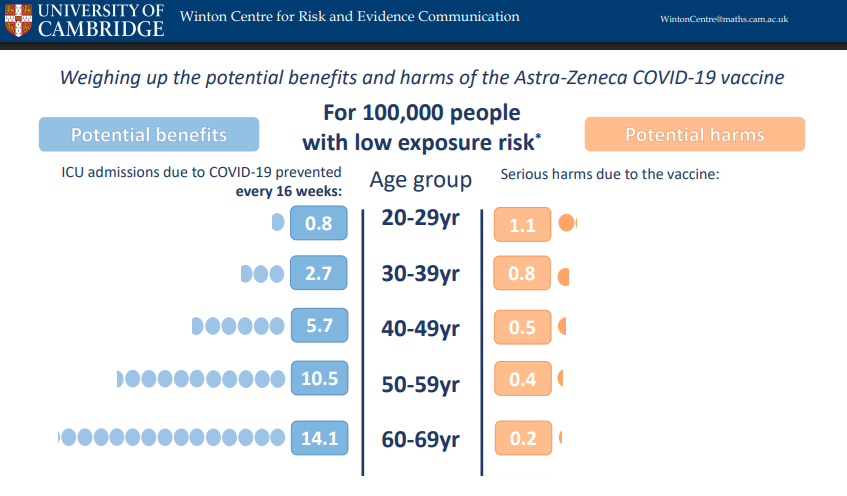
A positive example of better science communication – a slide weighing up the risks of infection and vaccination in relation to Covid-19, from a UK campaign.(https://assets.publishing.service.gov.uk/government/uploads/system/uploads/attachment_data/file/976877/CovidStats_07-04-21-final.pdf)
Trust through transparency
The UK case was one example of how science communication could have been handled better. However, the AstraZeneca case is representative and symptomatic of a generic problem in communicating uncertainties during the pandemic. Scientific findings in general were changing at high pace (e.g., masks, aerosols, vaccine efficacy, and the need for boosters), and the public in general expected and wished for stable, unambiguous statements. The pandemic has at times eroded trust in science also because communication had taken place under enormous time pressure and in a highly polarised environment in the society. Social media, a largely unregulated medium that rewards simplicity, also contributed to this.
It becomes particularly interesting when the timeline is taken into account. At the start of the pandemic in 2020, trust in science and research in Germany indeed reached an all-time high. At 73% in April 2020 and 66% in May the same year, which was significantly above the level of around 50% seen in previous years before the pandemic. As 2020 progressed, the data levelled off at 60%, remaining above average. After that, however, the trend began to decline again. In 2022, the surveys stood at 62%, and declined further to 56% in 2023 roughly back to the level seen before the pandemic [5-6]. These numbers can be seen not only as an indicator for trust in science itself, but also explicitly for the institutions behind the communication. In fact, pre-existing institutional trust was the strongest single factor influencing how a health message was received, rather than just the communication technology [7]. Communication strategies, nonetheless, varied depending on the country and its governments.
Internationally, the pandemic was a trigger event for evolving trust in science. The Wellcome Global Monitor 2020: Covid-19 explored how Covid-19 has affected peoples’ trust in science worldwide and reported that even though perceived by many as failure of scientific and governmental communication, the number of people who trust science “a lot”, jumped from 34% in 2018 to 43% in 2020. [8] While these numbers may differ between countries, the international consensus stays the same. [9] Especially interesting is the fact that the rising trust in science is strong in people with some or no knowledge of science. Also, the communicating institution plays a vital role. Due to the worries, whether local governments take scientific advice seriously enough, the trust in local governments is noticeably less than the trust in scientists. [8] On the other hand, the trust in scientists’ opinion was strongest, where overall trust and confidence in the government was highest. [9]
But how can trust or the lack there of directly be influenced by uncertainty? Or rather, (the lack of) communication regarding uncertainty? An infographic published by Transfer Unit has shown that in general, communicating scientific uncertainties, whether it is about Covid-19 or not, has positive effects on trust in science, especially in the long run. But communicating uncertainties can sometimes have the opposite effect on trust, especially with individuals with a generally low trust in science, certain political or ideological views, and groups with conflicts of interest. Especially in these cases, communicating uncertainty must be done properly and tailored to the respective groups, to prevent misinterpretation or instrumentalization of uncertainties. [10] This of course was a very sensitive topic during Covid-19. Everyone was affected by the rules, prohibitions and stigmas resulting from the pandemic, especially when it comes to the vaccination debate, which made it especially complicated to discuss.
Science as a process
Let’s recall some of the key reasons for why people were told to get the Covid-19 vaccine in Germany – By vaccination:
- Protect yourself and those around you
- Reduce transmission and break infection chains
- Trust in the thorough tests and the continuous monitoring of them
While per law, almost everyone (except critical care workers or similar people) was free to decide on their own, whether to get vaccinated or not, people who chose against it faced serious everyday life burdens and prejudice by society. As a result, people were not allowed to visit certain areas. Friendships were crumbling under this debate. Whole groups of people were stigmatized. And this is because of a debate, which was dependent on evolving evidence and was therefore based on the current available knowledge at the time, not on absolute certainty, which shows us that science is a never-ending process [11].
As we can see, the communication regarding vaccines is a powerful example of how uncertainty in science can occur and how it can affect people. While the vaccine recommendations were based on expected and logical results, they were not based on 100% complete scientific evidence. This was not due to a mistake or bad research. Rather, it was a result of the ongoing and iterative scientific process at the time. Both vaccine and Covid-19 research was accelerated during this time of international crisis and decisions had to be based on the knowledge at hand, even though evidence changed rapidly. Only with time and continuous observation, long-term results and side effects can be mapped more accurately. This nature of science as a process should be explained and highlighted to improve and maintain peoples’ trust in science [11].
What we learned from Covid-19
To gain trust in science, people need to understand that science is a process and not an all-encompassing truth. Communicators need to show what is known, what is not known and what still must be done. They need not shy away from uncertainties but rather show the process behind them and carefully evaluate communication regarding target groups and put it into context. Once people understand the process behind science, they can implement scientific evidence in their own decision making without having to fear social ostracism [11]. At the same time, institutional entities should proactively explain disagreements between official bodies rather than leaving them in the background and thereby creating room for conspiracy theories. And governments need to show they take scientific advice seriously. Science communicators need real support, training, time, and institutional backing – which are often lacking at present. Trust in science strengthens social cohesion, and that is what we really need these days.
Sources:
[1] Ärzteblatt (2021, March 23)
[2] Businessinsider (2021, April 21)
[3] NGO (2025, December 17)
[4] Van der Bles et al. (2020). The effects of communicating uncertainty on public trust in facts and numbers.
[5] Fraunhofer (2020, April 28)
[6] Bundesverband Hochschulkommunikation (2023, Dezember 05)
[7] Matthew Facciani Blog (2026, July 02)
[8] Wellcome Global Monitor 2020: Covid-19 (2021, November 29).
[9] Wellcome Public trust in scientists rose during the Covid-19 pandemic (2021, November 29).
[10] Transfer Unit. (n.d.). Forschungsüberblick. Wie wirkt sich die Kommunikation von wissenschaftlichen Unsicherheiten auf das Vertrauen in Wissenschaft aus?
[11] Schuster, C. & Scheu, A. M. (2023). Wie beeinflusst die Kommunikation wissenschaftlicher Unsicherheiten Vertrauen in Wissenschaft? Ein Systematic Review. Transfer Unit Wissenschaftskommunikation, Berlin-Brandenburgische Akademie der Wissenschaften.