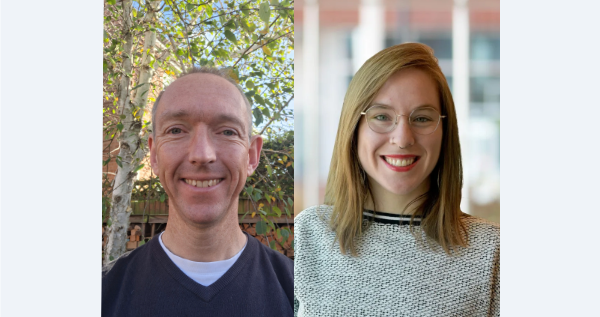
Welcome to GeoTalk, Caitlyn and John! Could you please briefly introduce yourselves to our readers?
John Hillier (Interim Division President): I have a very mixed research background. I started off in marine geophysics and then I moved to glacial geomorphology. At the end of that I worked for an insurance company as a catastrophe modeller, and then returned to the academic space looking at multi-hazard risk. I’ve been working with the insurance companies, to look at when risks co-occur, identify the natural hazards and their impact on regulations. So I’ve chased my research all the way from science to communication.
Caitlyn Hall (Interim Deputy Division President): I’m an Assistant Professor of Practice in the School of Geography, Development & Environment and the Arizona Institute for Resilience at the University of Arizona. I focus on transdisciplinary approaches to geoscience, co-creation, and applied research by bringing together environmental science, policy, and community knowledge and practice. I’ve worked in universities, government, and community organisations, often with people who approach the same landscape with different questions and responsibilities; I’m interested in how we work together and how that knowledge informs what happens in a place.
Congratulations on the launch of EGU’s new scientific division: ‘Geoscience and Society‘. Why was this new division created?
Cailyn: People have been developing research on how geoscience connects with public decisions, community priorities, education, and everyday life for many years. This division gives that work a clearer home, recognises that work and gives us more opportunities to learn from one another.
John: Some people who work extensively with science communication and society, they didn’t have a home at EGU. How do you reach out to them? With the creation of a division, it’ll give that functionality; it’s a chance for the community to coalesce and grow. It also gives us the chance to include social scientists, who really were on the fringes previously, but now it gives a node to link into EGU.
Cailyn: A community was already working to understand geoscience and its relation to society–EGU has hosted Education and Outreach Sessions (EOS) since 2009, for example–and it had grown beyond the spaces available for it… We’ve found connections across every division at EGU, and we want to help people recognise where their experiences could be useful to one another, lead to a collaboration they hadn’t considered, or identify similar questions they are working on, such as questions about trust, uncertainty, or response.
Why is it important that the social sciences are represented in the geosciences?
John: It’s important because many scientists don’t engage well enough with society. If people stop regarding this as an add-on, a secondary thing to do, then there’s a chance we can build it in as ‘business as usual’ and start to do it more effectively.
Cailyn: For example, we can measure groundwater levels and estimate future supply, but decisions about water also involve legal agreements, public institutions, livelihoods, and people’s relationships with the places they live. Social sciences give us ways to study those parts of the problem carefully, such as why people trust certain information and how decisions get made.
John: Very few of us physical scientists are social science trained, which is a different, and important, skill set if you’re trying to bridge this gap between physical scientific research and its end destination. To give a medical analogy: many physical scientists can do first aid – perhaps a simple questionnaire or interviews. However, if we need to involve more complex techniques, or consider sensitives, such as engaging different demographic groups, you want a fully qualified heart surgeon.
Cailyn: Social scientists also help us ask better questions at the beginning of a project: Who needs this research? Who should be involved? What assumptions are we bringing? That can change both the research itself and how useful it becomes.
What research will find a home in this division?
Caitlyn: We welcome research that looks at the relationships between geoscience and society. That could be how people learn about climate change, how communities participate in monitoring their water, how hazard information informs a planning decision, or how businesses use geoscience. It also includes research on ethics, equity, communication, and how we do science… We also want people to continue sharing their teaching, outreach, and engagement experiences. There is real value in being able to talk honestly about what you tried, what happened, and what you would change.
John: For me, the research that will find a home in this division is anything where the primary conclusions are about society, but not about a physical process; it can be a fuzzy line! It allows people to explore how they fit in a bottom-up approach.
What activities can we expect from the Geoscience and Society division in the future?
John: I’ve got one main job: Set the division up and get it going at the next EGU in Vienna. Beyond that, what I’m hoping to do at the EGU27 division meeting is work out where the community wants to go. We’re going to establish a priority list at the EGU27 division meeting, and then we will start with that. There will be the regular items you can expect from all EGU divisions: a mailing list, for example, and eventually the awards and medals.
Caitlyn: We’re still building the division, so part of our job now is to listen to what people would find useful and give them opportunities to help shape it. I’d like us to to keep those conversations going throughout the year, through workshops, exchanges of methods, and collaborations with other divisions. There’s a lot to learn from how people work in different places, including what makes an approach useful in one place and what needs to change for it to work elsewhere.
Could you give us a peek into what the Geoscience and Society programme at the EGU27 General Assembly might look like?
John: Well, firstly, the Education and Outreach Sessions (EOS) are still in there, but re-labelled. They’ll be largely the same. If your subdivision was there last year in EOS, have a look for it. It’ll be in the programme!
Caitlyn: The exception to be able to submit an additional abstract to an EOS-led session will continue for Geoscience and Society-led sessions, as we are still getting established. There will also be a broader programme, with clearer spaces for community science, policy and governance, risk and decision-making, business and infrastructure, and climate resilience. My hope is that people will find sessions that connect different parts of their work. I’d also like people who work across research and practice to see themselves in the programme.
How can EGU members get involved in the Geoscience and Society division?
John: Submit a session for EGU27! Or join us at the division meeting at the General Assembly, share your ideas, and let’s use the division as a way to bring the community forward! We will soon be adding more roles to the division (for example an ECS Rep), so if you have an idea, please contact us directly or sign-up to our mailing list.