Research generally requires funding. Looking at Atmospheric Measurement Techniques papers published in 2026 up until October 27 (332 to be specific), only 42 either lacked a ‘financial support’ section or stated only article processing charges. Of those, 40 collected no primary data or relied on existing infrastructure from past funding. Only two represented primary data collection without clear reference to financial backing.
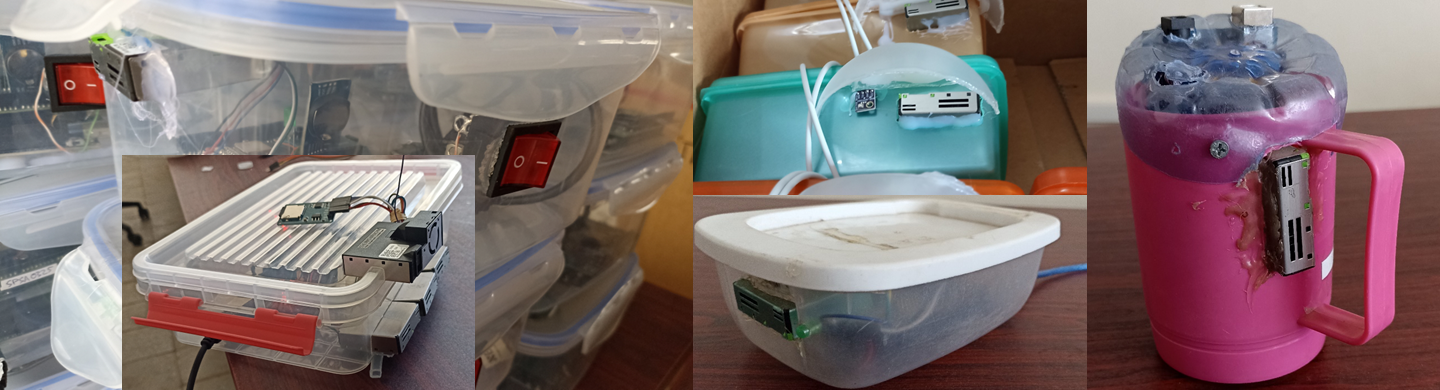
Figure 1: These creative low-cost constructions have allowed us to collect air quality measurements across various Ethiopian contexts.
And now, a third one: our study, published in EGU’s Atmospheric Measurement Techniques, regarding validation of two fine particulate matter sensor modules (PM2.5 – particles ≤ 2.5 µm in diameter, responsible for the majority of air-pollution-related diseases) was conducted entirely without funding. Drawing on our experience building and validating air quality instruments in Ethiopia, this post reflects on the possibilities of low-cost research, and how international collaboration can support it.
Options for low-cost research
Based in Ethiopia, I see a large academic workforce that remains underutilized due to limited budgets. Low- to no-cost research bypasses this bottleneck, connecting university staff directly to field measurement, hardware assembly, and skill development. Our study supports this in two practical ways:
Firstly, we showed that research without funding is possible. Granted, for validation we used donated equipment: filters written off from an ongoing project and instruments that wouldn’t be missed if shipped to Ethiopia. The sensor components weren’t completely free (about €480 on components for 12 operational units), but internationally this is pocket money, and locally it fits within departmental budgets. We kept other costs down through pragmatic choices. Relevant emission sources are all around us, so we sampled on our university campus. Staff and students collected data out of research interest, paid in experience, skills and data rather than stipends. And we housed our electronics inside plastic lunch boxes (Fig. 2). If it works, why spend more?
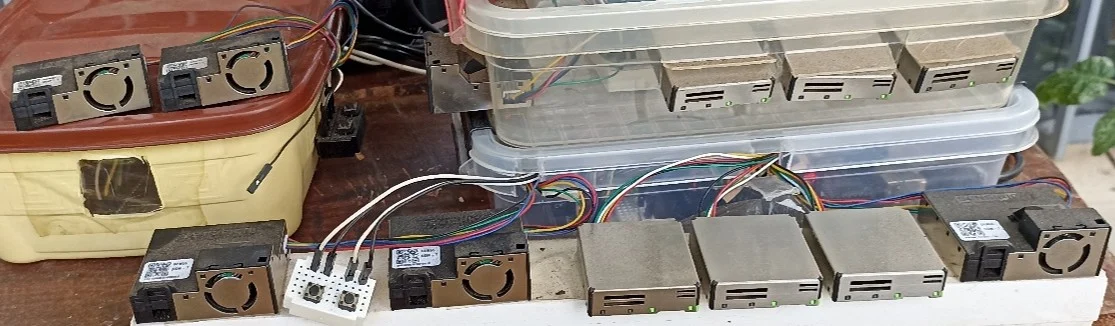
Figure 2: our study setup of 12 operational sensor units, total costs <€480.
Secondly, we showed that two low-cost optical sensor models – the Sensirion SPS30 and SEN55 – are precise and accurate in measuring PM2.5 (fine particulate matter) under ambient and high-concentration indoor Ethiopian conditions (Fig. 3). This provides solid backing for local sensor system production. For instance, AddisAirNet is establishing a network of SEN55 sensors in Addis Ababa, complete with 3D-printed enclosures and network connectivity. In Arba Minch, we are building a network at “as-low-as-possible” costs (Fig. 4), run by the curiosity of academic staff rather than external funding. Our findings imply that local assembly around raw modules does not mean compromising data quality.
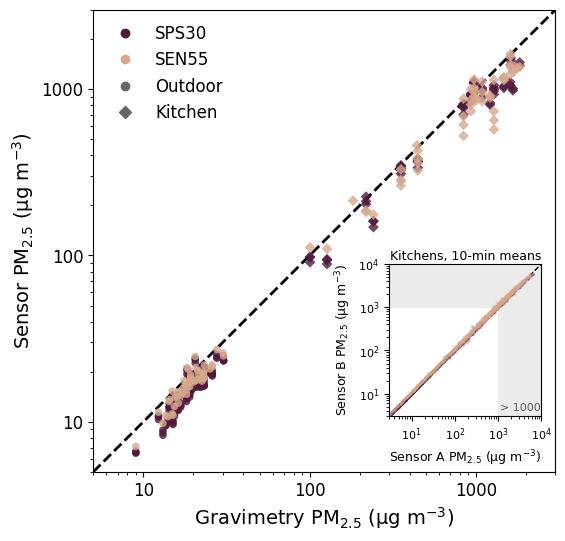
Figure 3: The sensors showed high linearity amongst themselves (small panel) and to a higher standard (big panel) across a high range of concentrations
Figure 4: Locally constructed sensor system (~€50), part of a low-cost measurement network in Arba Minch, Ethiopia.
International collaboration at high costs
I regularly witness interactions between well-resourced international institutes and researchers in lower-resource settings where “proper” science is implicitly assumed to be high-cost, with much of that money to be spent outside the host country and the local workforce largely unengaged. Let me share and react to four common statements:
- “Work with our world-class lab for the best insight into atmospheric contents.”
I have sat through workshops that spent significant time showcasing state-of-the-art facilities in the Global North. Though stemming from a genuine desire to demonstrate advanced analytical capabilities, these displays can unintentionally signal that rigorous science only happens elsewhere, on equipment out of reach. Reliance on external labs reinforces dependency. When local researchers instead assemble, program, and maintain their own monitoring units, they build operational resilience, technical capability, and research autonomy.
- “You need super-sites measuring trace gases and speciation before drawing conclusions.”
Is building a single, high-end monitoring station that tracks multiple gases and soot really the right priority for an under-monitored region? For the 100,000 to 300,000 euros one of those stations costs, local teams could build 1,000 to 5,000 low-cost sensors (Fig. 5), and actually keep them running, unlike pricey monitors I have seen gathering dust because the special gases needed to maintain them cannot be imported. Even at its best, a single station in one spot cannot match a dense sensor network for mapping local health risks from fine dust particles (PM2.5), the biggest culprit behind pollution-related disease.
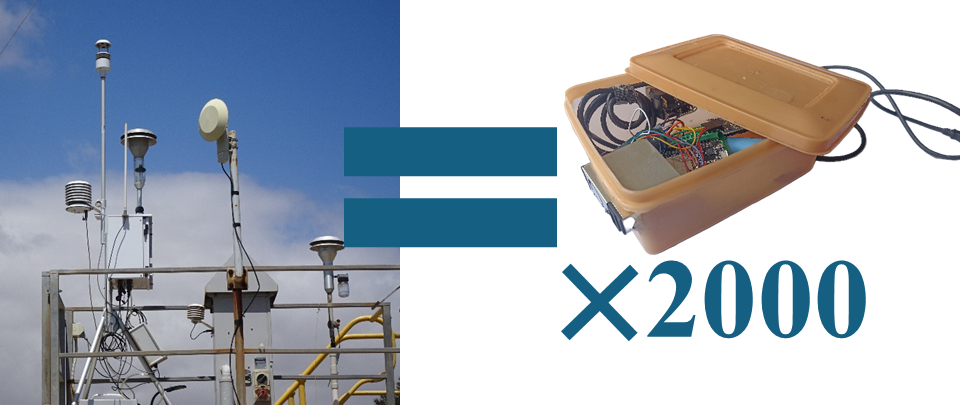
Figure 5: for the cost of a multi-parameter reference station (left; Michael Coghlan, CC BY-SA 2.0, via Wikimedia Commons) we can build beyond 2000 sensor systems.
- “At the very least, you need a stationary reference-equivalent monitor for calibration.”
A reference equivalent PM2.5 monitor, such as a Beta Attenuation Monitor (BAM), costs tens of thousands of dollars, requires specialized expertise, and is fixed to one location. Low-cost optical sensors need environment-specific calibration because their readings are influenced by particle composition, size distribution and relative humidity, so a fixed BAM only calibrates for its own microenvironment. Portable gravimetric filter samplers (easily three for the price of one BAM) are far more effective: they can rotate between roadside sites, residential areas, and indoor biomass kitchens to derive site-specific calibration factors.
- “Buy commercial low-cost systems; they are already pre-calibrated.”
Some Ethiopian institutions have acquired units costing 1,000 to 7,000 euros under the assumption that a higher price tag guarantees calibrated data, stability and simplicity. Yet inside the proprietary shell sits an optical module that still requires local validation, since factory curves from European or North American climate chambers do not necessarily translate to Ethiopian air. Furthermore, data subscriptions and overseas servicing lock institutions out once funding or foreign exchange runs dry. Paying commercial markups exhausts a tight budget on just a handful of nodes, destroying the primary advantage of low-cost sensing.
International collaboration for low costs
This is not to say high-end collaboration has no place. If you can apply your advanced chemical characterization to Ethiopian air, that is fantastic. If you can donate a reference monitor with technical support, please do! However, partnerships can also explicitly support low-cost methodologies and engage local researchers. Our study, and local sensor system construction, benefitted from interactions that sounded more like this:
- “You are just missing filters? Let me send a package.”
Procuring validation equipment in Ethiopia is difficult. In our case, international contacts were willing to cover filter packages from project overheads, and a company made a spare gravimetric sampler available. Sponsoring basic consumables or sourcing mobile reference tools helps local teams to run their own validations.
- “Let me bring sensor components, rather than finished systems.”
Procuring a €5 microcontroller or a raw sensor module into Ethiopia is difficult due to foreign currency restrictions and shipping barriers. International visitors helped us by bringing components in their luggage – including one researcher who deliberately shifted from bringing commercial systems to bringing raw sensor modules. Acting as logistical facilitators for microelectronics enables local teams to build and repair their own hardware.
- “We understand that hardware development takes time.”
For international projects bound by tight deliverables, buying ready-made units often seems the safer bet. Yet time spent on iterative engineering yields greater long-term value than importing finished units. For example, AddisAirNet could get off the ground because the funding framework allowed for months of local hardware design and trial-and-error.
- “Let us demonstrate that local assembly works.”
Experts and international partners carry significant weight when speaking with university leadership, funding bodies, and government institutes. A senior researcher who heard about our work organized a hands-on training workshop with a key Ethiopian institute, which convinced a future decision-maker that local production was viable and paved the way for subsequent project backing. Using an expert platform to validate locally built hardware helps dismantle the myth that science is only legitimate when performed on expensive imported instruments.
Our study showed that a <50 EUR sensor system can be of high data quality. Collaboration made our work possible, not through a funding budget, but through pragmatic support of local creativity (Fig. 5). If you work in a resource-constrained setting, you can likewise conduct relevant unfunded independent research. And if you have access to research funding or decision-making power, consider directing resources toward local development and validation. It is a catalyst for engaging the local workforce and building scientific autonomy right where environmental data is needed most.