At the geodynamic scale, tectonic forces guide the distribution of stress. Stress in the Earth is not constant, but varies through space. Variations in gravitational energy caused by changes in mass distribution within the Earth, forces acting at plate boundaries, and basal mantle drag all cause stress to vary and act in different directions. Overall, …[Read More]
geodynamics 101
Don’t Stop Me Now: A Fracture Mechanics Perspective on Earthquake Nucleation
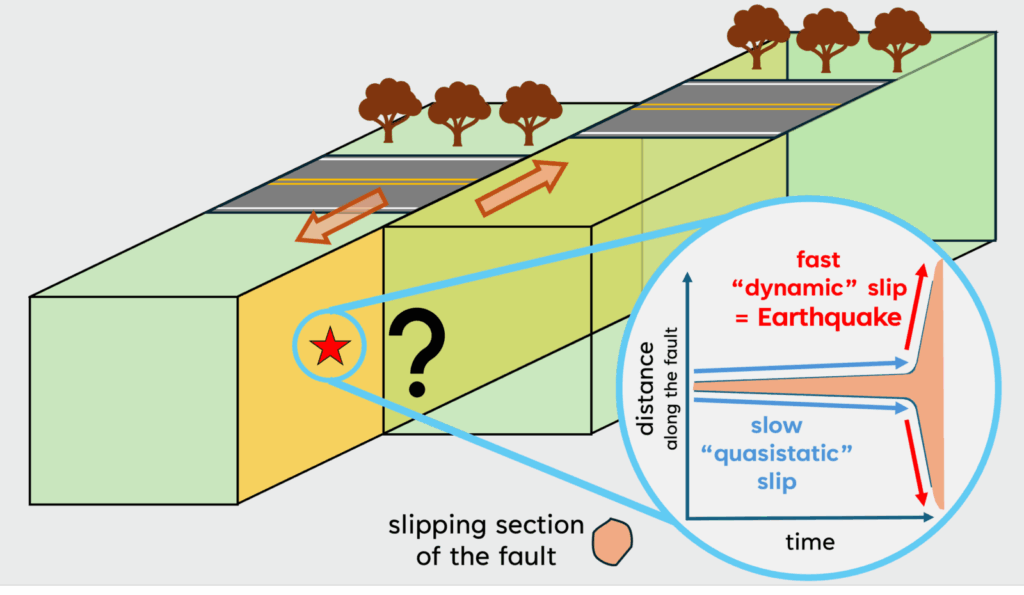
How do earthquakes start? Earthquakes occur when a block of rock rapidly slides past another along an interface or a discontinuity in the medium and release energy in the form of seismic waves. Turns out, the surface of the earth is riddled with a lot of these discontinuities, which we call “faults”. If we plot …[Read More]
Geodynamics 101 – Viscous anisotropy
We are living in an anisotropic world. From rock-building crystals, ice, and trees growing in your garden to your favourite slice of cake many materials or objects has some anisotropic behaviour. What does this mean? Anisotropy (non-isotropy) implies that a material property depends on the direction of the measurement. In geodynamics we often talk about …[Read More]